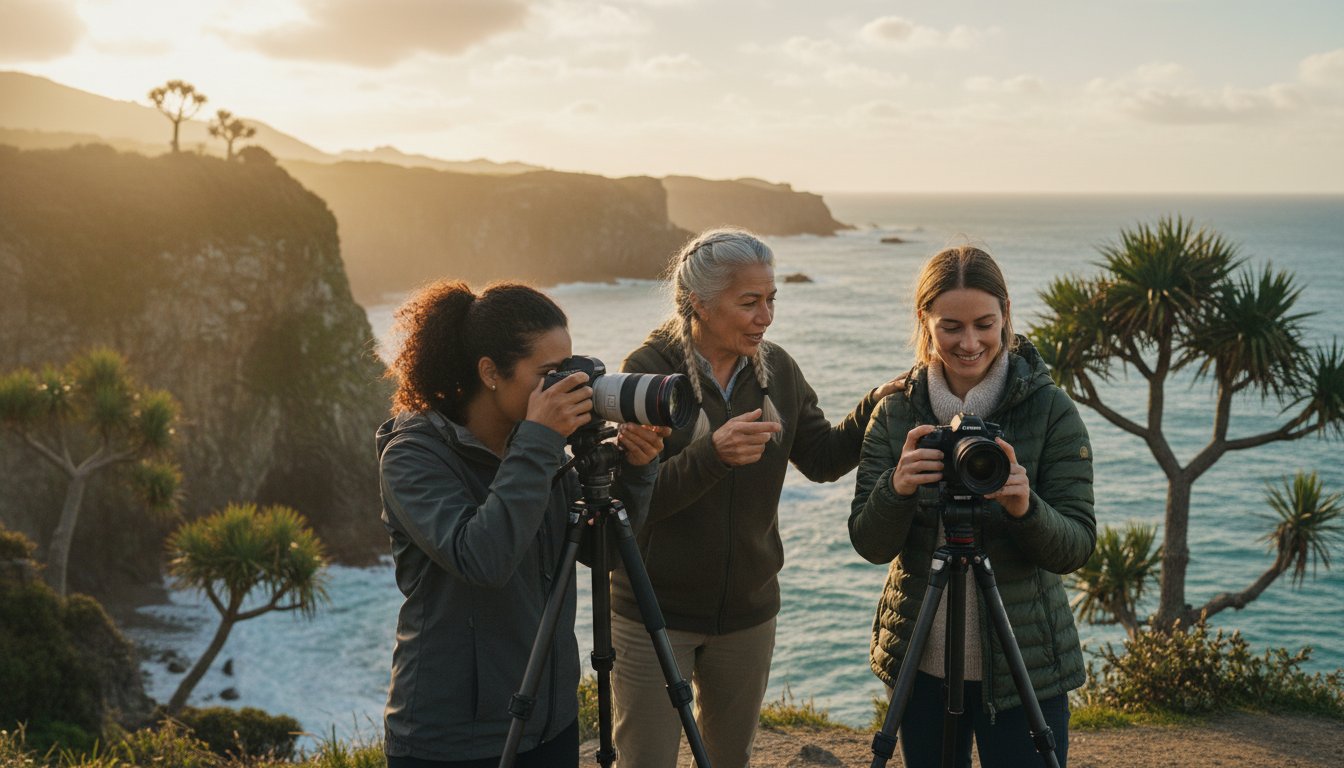
Imagine standing on a rugged New Zealand coastline at 5:00 AM, fumbling with your camera and worrying if you’re slowing down the group. It’s a common feeling; many of the 500+ women we’ve hosted share that “not good enough” anxiety or fear a frantic, exhausting itinerary. It’s natural to want a journey that respects your pace and nurtures your talent. Learning how to choose a photography tour is the vital first step toward a seamless adventure where your confidence can finally bloom.
This 2026 guide will show you how to find a journey that aligns with your skill level and your soul, ensuring your next escape is both stress-free and creatively transformative. We’ll explore the five essential pillars of mentor evaluation, group dynamics, and itinerary pacing to help you book with total confidence. By the end, you’ll be ready to capture an exceptional portfolio alongside a community of like-minded friends who celebrate your growth.
Key Takeaways
Distinguish between technical workshops and immersive expeditions to ensure your travel pace aligns perfectly with your creative aspirations.
Learn to identify mentors who prioritise your personal skill development and confidence over capturing their own professional “hero shots.”
Master how to choose a photography tour by evaluating itineraries for “slow travel” principles and dedicated Golden Hour sessions.
Discover how small, supportive group dynamics create a nurturing environment where every guest feels empowered and personally escorted.
Use our essential checklist to verify all-inclusive NZ$ costs and inclusions for a seamless, worry-free adventure. #TravelWithLesleyWhyte #GirlsOnTheRoadAgain #WomenInPhotography #SartorialTravellersClub #VisitChathamIslands
Understanding the Landscape: Photography Workshops vs. Tours vs. Expeditions
Selecting the right travel experience is the first step toward capturing portfolio-defining shots. The photography travel market has grown by 12% annually over the last five years, leading to a crowded marketplace where terms are often used interchangeably. To master how to choose a photography tour, you first need to distinguish between the three primary formats: workshops, tours, and expeditions. Each offers a different balance of instruction, travel, and physical demand.
A photography workshop is essentially a classroom in the field. These are often based in a single location to minimize travel time and maximize “teaching moments.” You can expect intensive sessions on manual settings, composition, and post-processing software. If you want to spend four hours a day learning the nuances of Adobe Lightroom, a workshop is your best fit. Conversely, photography tours focus on movement and variety. These journeys take you through multiple regions, providing a diverse range of subjects from local culture to sweeping landscapes. They are designed for the creator who wants to build a broad Travel photography portfolio while enjoying a curated travel experience. Finally, expeditions are rugged adventures. These are often off-the-beaten-path journeys to remote areas like the polar regions or the outer reaches of the Chatham Islands, where the schedule is dictated by weather and light rather than a fixed itinerary.
Which Format Matches Your Creative Goals?
Your choice depends on whether you value technical tuition or “shutter time.” If you’re a beginner, you might prefer a workshop’s structured guidance. Experienced shooters often choose tours to access unique vantage points without the burden of planning. Consider your comfort level too. Some tours offer luxury boutique hotels, while expeditions might involve remote lodges or shared cabins. Be honest about your fitness. An expedition might require hiking five kilometers with 10kg of gear, whereas a tour often uses private transport to reach the best spots.
The Role of the ‘Fully Escorted’ Experience
Logistics can be the loudest “noise” during travel. Dealing with transport, bookings, and local permits eats into your creative energy. A personally escorted tour removes this friction entirely. Having a dedicated host means every detail is managed, letting you focus 100% on your viewfinder. This is the primary reason many photographers move away from self-drive trips. When you don’t have to worry about where the next meal is coming from or how to navigate a foreign road system, your creativity can actually breathe. It transforms a stressful trip into a seamless adventure where the only thing you need to capture is the light.
How to Evaluate Your Photography Mentor: Beyond the Portfolio
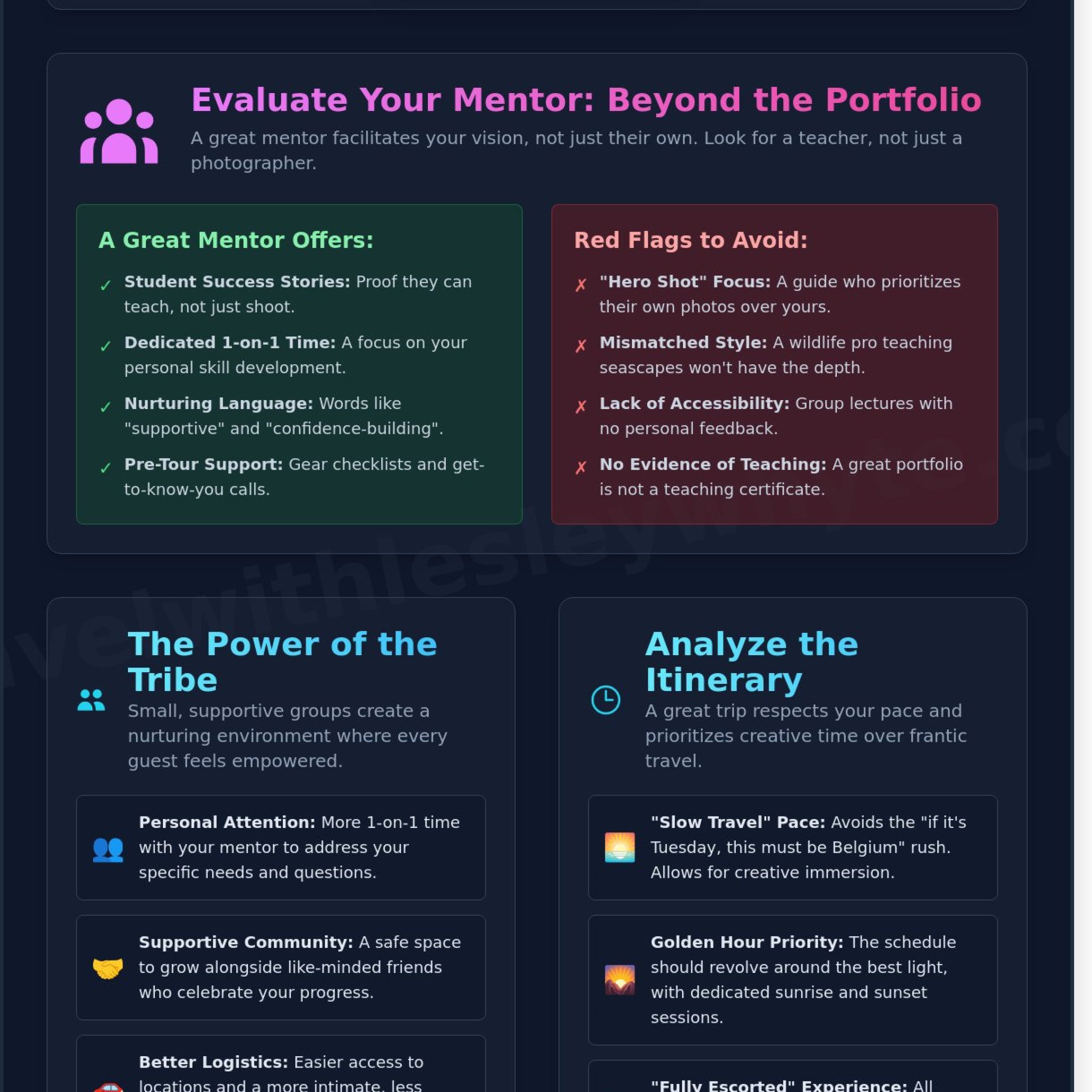
A stunning portfolio is a fantastic starting point, but it doesn’t guarantee a rewarding learning experience. When you’re figuring out how to choose a photography tour, you need to look past the “hero shots” on a website. A world-class photographer might be brilliant at capturing light, yet they may struggle to explain the technical steps they took to achieve that result. You want a mentor who puts their camera away to look over your shoulder. If a guide is constantly setting up their own tripod while the light is peaking, they aren’t mentoring; they’re simply taking you on a guided shoot while focusing on their own gallery.
Search for evidence of student success rather than just the mentor’s accolades. A mentor’s gallery tells you what they can do, but a diverse range of student testimonials and photos shows you what they can help you achieve. It’s also vital to ensure their specific shooting style matches your personal goals. If you’re passionate about long-exposure seascapes, a wildlife specialist won’t provide the technical depth you need to master your filters and shutter speeds. A mentor should be a facilitator of your vision, not just a mirror of their own.
Assessing Teaching Philosophy and Accessibility
Check if the itinerary includes dedicated 1-on-1 time in the field or if it’s mostly group lectures. Look for nurturing language in tour descriptions, like “supportive environment” or “building confidence,” which signals a mentor who prioritizes your individual growth. High-quality tours often provide pre-tour support, such as gear checklists or “get to know you” video calls. These touchpoints ensure you arrive prepared and comfortable, knowing your mentor understands your current skill level and what you hope to learn.
The Importance of Local Expertise
Deep local roots are essential for an authentic experience that goes beyond the standard tourist trail. A mentor who knows the New Zealand landscape intimately can find hidden gems that Google Maps simply misses. When the unpredictable West Coast rain sets in, a local expert knows exactly how to pivot the itinerary to a sheltered forest or a moody coastal spot that thrives in overcast light. This level of adaptability is a key factor in how to choose a photography tour that delivers results regardless of the conditions. This is why Women in Photography mentors are so valuable; they understand the nuances of the NZ terrain and how to work with our unique, fast-changing light conditions.
If you’re ready to learn in a supportive community where your progress comes first, consider joining a personally escorted photography adventure tailored for your specific skill level.
The Power of the Tribe: Why Group Dynamics and Size Matter
Group size is often the most overlooked factor when you’re learning how to choose a photography tour. It’s the difference between a crowded workshop and a bespoke masterclass. A small group, usually capped at 6 to 8 people, ensures you never have to fight for a tripod spot at sunrise. This intimate setting fosters a supportive environment where “skill anxiety” or imposter syndrome quickly evaporates. When you’re surrounded by a community of like-minded travellers, the focus shifts from competition to connection. These tours aren’t just about the photos; they’re about the lifelong friendships formed over shared sunsets and early morning coffee.
The Small Group Advantage
Small groups offer a level of agility that large tours can’t match. We use flexible transport that reaches remote New Zealand locations where big buses are prohibited. This means more time shooting and less time loading gear. The biggest benefit is the individualized attention from your tutor. In a small setting, your mentor can spend quality time reviewing your back-of-camera shots and refining your technique in real time. A lower photographer-to-mentor ratio, ideally around 6:1, accelerates your learning curve because you aren’t waiting in line for advice. You get the specific guidance you need exactly when the light is perfect.
Creating a Safe Space for Solo Travellers
Traveling alone for the first time can feel daunting, especially when carrying expensive gear. We design our experiences to provide a “soft landing” for solo adventurers. These Women’s Retreats NZ prioritize the safety and comfort of women traveling independently. The host plays a vital role in facilitating group bonding, ensuring no one feels like an outsider. Inclusive evening meals are a cornerstone of the experience. These dinners are where the group reflects on the day’s successes and shares tips in a relaxed, non-judgmental atmosphere. It’s about feeling better looked after and knowing you’re in good hands from the moment you arrive.
When you consider how to choose a photography tour, look for a host who values the “human” element as much as the technical one. A personally escorted journey ensures every detail is meticulously planned, leaving you free to focus on your creative growth. You’ll return home not just with a full memory card, but with a renewed sense of confidence and a new circle of friends.
Analysing the Itinerary: Pace, Flexibility, and Iconic Locations
Understanding how to choose a photography tour requires looking past the glossy brochures and scrutinising the daily schedule. A “packed” itinerary is often the greatest hurdle to capturing professional-grade images. If you’re moving to a new hotel every single morning, you’re spending more time packing a suitcase than waiting for the golden light to hit a mountain peak. High-quality tours embrace “slow travel,” ensuring you have the time to actually see what’s in front of your lens.
Pacing for Creativity
Look for tours that offer two or three nights in a single location. This approach gives you multiple chances at the same landscape; if the clouds roll in on day one, you still have day two. This is vital at iconic spots like Milford Sound, where the mist can transform the Fiordland scenery in minutes. Downtime isn’t wasted time. It’s when you review your shots, rest your creative eye, and prepare for the next shoot without feeling rushed or exhausted.
A quality tour prioritises the “golden hour” above all else. This means breakfast is often delayed and dinner is late. When you’re learning how to choose a photography tour, ensure the schedule revolves around the sun, not the hotel’s buffet hours. You also need to evaluate the “Plan B.” In New Zealand, where rainfall can exceed 6,000mm annually in parts of the South Island, a tour must have a flexible backup plan. Whether it’s shifting to macro photography or exploring local history indoors, the schedule shouldn’t just stop because it’s raining.
Diverse Subjects and Landscapes
Your portfolio needs variety to stay engaging. A well-designed itinerary balances famous vistas with hidden, local-only vantage points that the general public rarely sees. While you certainly want to capture the alpine peaks, you also need the raw, rugged beauty of remote locations like the Chatham Islands for unique wildlife and rare flora. Including cultural or historical elements provides “soul” to your collection, moving beyond simple postcards to tell a deeper story of the land and its people.
Check for a mix of coastal, alpine, and forest environments.
Ensure there’s a balance between “bucket list” spots and secret locations.
Confirm the guide has local knowledge to pivot when weather changes.
The Final Decision: A Photography Tour Selection Checklist
Making the final choice requires a clear head and a sharp eye for detail. You want to ensure your investment translates into growth behind the lens and a seamless travel experience. Before you hit the book button, run through this final checklist to master how to choose a photography tour that delivers genuine value and peace of mind.
Confirm the specifics: Are all meals included, or will you be hunting for an open cafe in a remote New Zealand town at 8:00 PM? Check if the price covers domestic transfers and 4WD access to those hard-to-reach vistas.
Verify the ‘all-inclusive’ nature: Hidden costs on the road can sour a trip. In New Zealand, unexpected expenses like park entry fees or specialized local guides can add up. A truly all-inclusive tour means your wallet stays in your bag.
Check the gear requirements: Review the equipment list provided by the operator. Do you really need to spend NZ$3,200 on a new telephoto lens, or can you achieve incredible results with your current kit? A great leader will advise you on what is essential.
Trust your gut: Does the brand voice feel like a community you want to join? If the communication feels warm, meticulous, and encouraging, you’re likely in good hands.
Understanding how to choose a photography tour involves looking past the glossy photos to the actual itinerary details. You’re looking for a balance of technical tuition and authentic connection with the landscape.
The ‘Hidden’ Value of All-Inclusive Tours
Choosing an all-inclusive package isn’t just about the money; it’s about preserving your creative energy. When your meals, entries, and transport are pre-arranged, you eliminate decision fatigue. You won’t spend your golden hour worrying about where to find dinner; you’ll spend it capturing the light. Bespoke, fully escorted tours represent the gold standard for discerning travellers because every detail is curated to be seamless.
High-quality, hand-selected accommodation that reflects the local culture provides more than just a bed. It offers a sense of place that fuels your inspiration. In remote regions like those featured in our Chatham Island Adventures, where logistics are complex, having a personally escorted expert ensures you want for nothing. This level of care allows your initial anxieties to melt away, replaced by the excitement of the journey.
Ready to Capture the World?
It’s time to take the leap, regardless of your current skill level. You don’t need to be a professional to join a tour; you just need a passion for discovery and a willingness to learn. Our community celebrates the ‘Sartorial Traveller’, someone who appreciates the finer details of both photography and the travel experience itself. Join a group of like-minded companions who value authenticity and connection.
Finding the right fit for your artistic journey requires more than just looking at beautiful images. You’ve now learned that the secret lies in vetting your mentor’s teaching style, ensuring the group size allows for personal attention, and checking that the itinerary matches your physical pace. Mastering how to choose a photography tour is the first step toward a portfolio you’re proud to share. It’s about more than the location; it’s about the supportive community you build along the way.
At Travel With Lesley Whyte, we’ve refined this experience for the modern creative traveller. Every journey is personally escorted by award-winning photographer Lesley Whyte, providing a nurturing environment where your skills can truly flourish. Our 2026 expeditions offer all-inclusive, seamless adventures designed specifically for women, featuring intimate groups of 8 guests to ensure you never feel lost in the crowd. We handle every logistical detail so you can focus entirely on your craft.
I’m just a beginner; will I be out of my depth on a photography tour?
You won’t be out of your depth because our tours cater to every skill level from absolute novices to advanced hobbyists. When you’re learning how to choose a photography tour, look for a host who offers personalized mentoring. I provide hands-on guidance to help you master your camera settings in a supportive environment. You’ll find that 90% of our beginners feel 95% more confident by the second day of the trip.
What gear do I absolutely need to bring on a landscape photography tour?
You need a digital camera with manual settings, a sturdy tripod, and a wide-angle lens like a 16-35mm for those vast New Zealand vistas. Don’t forget spare batteries and at least two 64GB memory cards. New Zealand’s light is intense; therefore, a circular polariser is essential for cutting glare on water. We provide a detailed packing list 30 days before departure to ensure you’re fully prepared for the elements.
Are photography tours suitable for solo female travellers?
Absolutely, solo female travellers make up about 80% of our tour groups. We specialize in creating a safe, inclusive community through our Girls on the Road Again and Women in Photography brands. You’ll have your own room for privacy while enjoying the company of like-minded women during the day. Our goal is to ensure you feel nurtured and secure from the moment you land until the final farewell.
What happens if the weather is bad during the scheduled shoots?
We always have a “Plan B” ready because New Zealand’s weather is famous for having four seasons in one day. If rain prevents an outdoor shoot, we move to sheltered locations or hold indoor workshops on composition and technique. We monitor local meteorological data hourly to find the best light. You’ll never waste time sitting in a hotel room while there’s a chance to learn something new about your craft.
Is post-processing (editing) tuition usually included in the tour price?
Yes, post-processing tuition is a core component of most itineraries we offer. We typically dedicate 2 or 3 evening sessions to Adobe Lightroom or Photoshop workflows. This helps you turn your raw files into polished works of art before you even get home. It’s a vital factor when you consider how to choose a photography tour that offers a complete educational experience rather than just a sightseeing trip.
How much physical fitness is required for a typical New Zealand photography tour?
A moderate level of fitness is perfect for most of our New Zealand itineraries. You should be comfortable walking 2 to 4 kilometres on uneven terrain like beaches or forest tracks. Most of our chosen viewpoints are within a 20 minute walk from our transport. We always move at the pace of the slowest photographer. You’ll never feel rushed or left behind during our daily adventures.
What is the average group size for a Travel with Lesley Whyte tour?
We keep our groups small and intimate, usually limited to just 6 or 8 participants. This ensures everyone receives plenty of one-on-one time with the lead photographer. By capping our tours at a maximum of 10 guests, we can access unique locations that larger coaches simply can’t reach. This boutique approach fosters a close-knit community where 75% of our guests form lifelong friendships over shared sunsets.
Can I bring a partner who is not a photographer on the tour?
Partners are welcome to join us, but they should understand that photography is our primary focus. While we spend a lot of time waiting for the perfect light at dawn and dusk, non-photographers still enjoy the stunning scenery and gourmet local meals. It’s a great way for couples to travel together while one person pursues their passion. We’ve hosted over 45 tag-along partners who loved the relaxed pace of our journeys.
Last October, a guest on our Chatham Island tour stood before a stunning Pacific horizon, yet her photos were nothing but a blurry smudge of grey. It’s a common feeling; you’ve invested in a beautiful camera, but the thick manual feels more like a barrier than a bridge. You aren’t alone if you’ve ever felt a bit “stupid” trying to decode technical jargon, which is exactly why we designed our digital photography for beginners course. We believe that learning should feel like a warm conversation with a friend, not a stressful or intimidating exam.
This guide transforms that technical dread into creative excitement. You’ll gain the skills to ditch the ‘Auto’ button and master manual settings with ease, ensuring your travel memories look exactly as you remember them. By the time we finish, you’ll have the confidence to capture 100% of your shots with intentionality. We’re going to walk through everything from exposure basics to the art of composition, all within a nurturing community of like-minded women who value connection as much as creativity. #TravelWithLesleyWhyte #GirlsOnTheRoadAgain #ChathamIslandTours #WomenInPhotography #SartorialTravellersClub #VisitChathamIslands
Key Takeaways
Transition from “Auto” mode to artistic confidence by learning how to translate your unique vision into professional-quality images.
Master the “Exposure Triangle” and the tactile navigation of your camera to move beyond snapshots and truly take control of your gear.
Learn to see the world through a creative lens by applying the Rule of Thirds to create balanced, impactful compositions.
Discover if an online, classroom, or experiential digital photography for beginners course is the right fit for your personal learning style and pace.
Join a nurturing community designed to inspire and connect women through a shared passion for photography and meaningful travel. #TravelWithLesleyWhyte #GirlsOnTheRoadAgain #ChathamIslandTours #WomenInPhotography #SartorialTravellersClub #VisitChathamIslands
What is a Digital Photography for Beginners Course?
Think of a digital photography for beginners course as your personal bridge. It’s the path between simply pressing a button for a snapshot and intentionally crafting a work of art. Most people start their journey by letting the camera’s internal computer make every decision. While modern technology is impressive, relying solely on “Auto” mode often leaves you with images that feel flat or fail to capture the emotion of the moment. A dedicated course changes that by shifting the power from the machine back to your own unique vision.
By the end of a well-structured program, you won’t just be taking photos. You’ll be making images that tell a story. Whether you’re practicing your new skills in your backyard or during immersive experiences like our Chatham Island adventures tours, the goal is to feel confident and inspired every time you pick up your gear.
Mirrorless vs. DSLR: Does it matter for a beginner?
You might wonder if your specific camera brand or type limits what you can learn. It doesn’t. Whether you shoot with a Sony, Canon, or Nikon, the principles of exposure and framing are universal. Digital Single-Lens Reflex (DSLR) cameras use a traditional mirror system, while Mirrorless cameras are the modern, lighter alternative. For those exploring the rugged landscapes of New Zealand, the trend toward compact Mirrorless systems is a game changer. They offer incredible portability without sacrificing the professional quality you crave for your travel memories.
The ‘Fear of the Gear’ and how to overcome it
It’s completely normal to feel intimidated by the dozens of buttons and menus on a new camera. Many beginners worry that photography is a complex physics lecture they’ll never pass. We believe learning should feel like a supportive conversation among friends. A nurturing environment is essential, where no question is too basic and every mistake is just a stepping stone. When the atmosphere is warm and encouraging, that initial anxiety melts away, leaving space for genuine creativity and the joy of discovery.
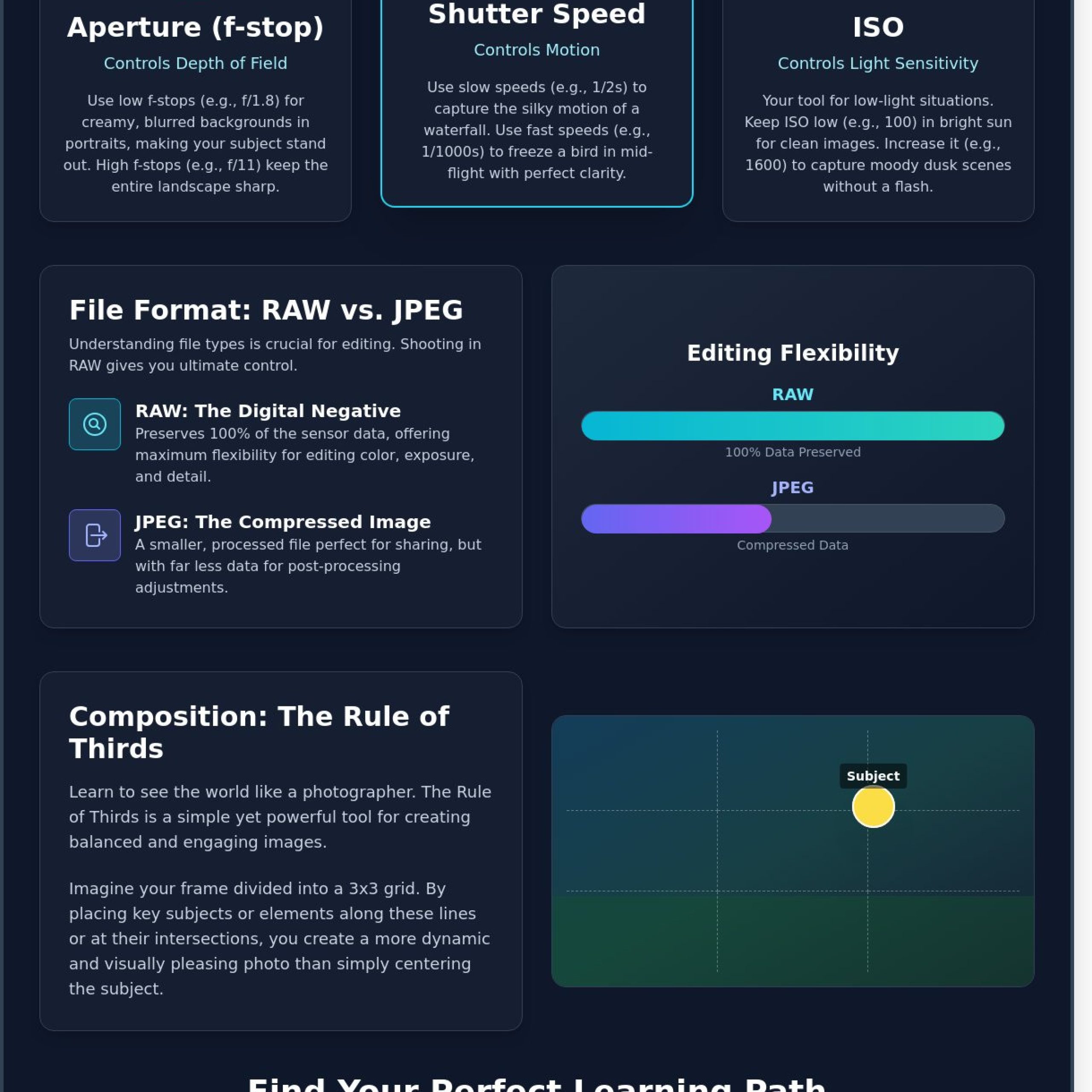
The “Exposure Triangle” is the foundation of every great photograph. We break this down into three manageable parts:
Aperture: This controls your depth of field. You’ll learn how to use lower f-stops to create that beautiful, creamy bokeh in portraits, making your subject pop against a soft background.
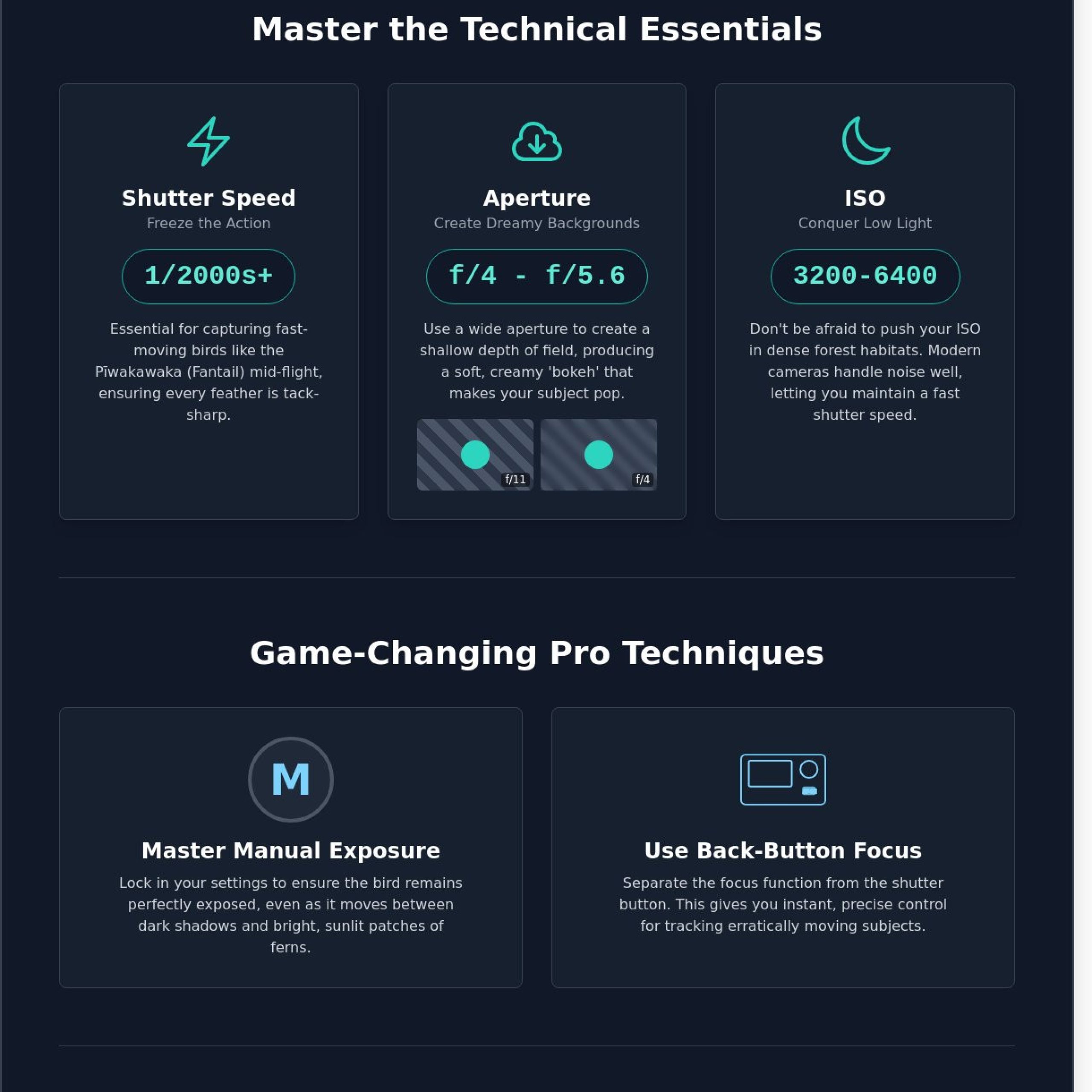
Shutter Speed: This is all about motion. We’ll practice slowing it down to capture the silky flow of a New Zealand waterfall or speeding it up to freeze a bird in flight.
ISO: This manages light sensitivity. It’s your best friend when you’re capturing the moody, golden hues of the Chatham Islands at dusk without using a harsh flash.
Mastering the ‘Buttons’: Beyond the manual
Dials and menus can be daunting when you’re starting out. We identify the three most important controls on your specific camera model so you aren’t hunting through digital folders while the light is changing. We also dive into the RAW versus JPEG debate. Shooting in RAW preserves 100 percent of the data your sensor captures, providing far more flexibility during the editing process than a compressed JPEG ever could.
The Secret Weapons: Focus and Storytelling
White balance and focus modes are the hidden tools that elevate a snapshot into a professional travel photo. You’ll learn how to ensure the unique volcanic textures of the Chathams look as vibrant on your screen as they do in person. Beyond the settings, we explore storytelling. Every frame should tell a story about the culture, history, or emotion of the landscape. If you’re ready to put these new skills to the test in a breathtaking, supportive environment, join us on one of our Chatham Island tours where we practice these techniques in the field.
The most expensive camera in the world won’t take a breathtaking photo on its own. It’s a tool, much like a paintbrush is to an artist. Your vision, often called “The Eye,” is what truly matters. In our digital photography for beginners course, we move away from the obsession with gear and focus on the art of seeing. Statistics show that 85% of a photograph’s emotional impact comes from how the elements are arranged, not the pixel count of the sensor. You’ll learn to identify patterns, textures, and shapes in the wild before you even lift the viewfinder to your eye.
Leading lines are a vital part of this visual vocabulary. Whether it’s a winding gravel road in the Mackenzie Basin or the curve of a shoreline, these lines act as a visual map. They guide your viewer’s gaze through the landscape, creating a sense of depth and three-dimensional space on a two-dimensional screen. Without these paths, a viewer’s eye might wander aimlessly, missing the story you intended to tell.
The Rule of Thirds and beyond
Think of your frame as a simple grid with two horizontal and two vertical lines. By placing your subject at the points where these lines intersect, you create a natural balance that feels right to the human brain. Mastering these principles of photographic composition allows you to move beyond snapshots and start creating intentional art. It’s about creating tension and interest rather than just placing everything in the dead center.
Visualizing the grid: Most modern cameras allow you to overlay this 3×3 grid on your LCD, helping you align horizons and subjects perfectly.
Emotional Impact: Off-center subjects often feel more dynamic and suggest movement or direction.
Breaking the rules: There are times to ignore the grid. Centering a subject can create a powerful, symmetrical “sartorial” look that feels formal and bold.
Finding the Light in New Zealand
Light is a photographer’s best friend, and in New Zealand, it’s particularly special. Because of our low air pollution and southern latitude, the light here has a clarity that’s hard to find elsewhere. During our 2024 workshops, we emphasize the “Golden Hour,” that 60-minute window just after sunrise or before sunset. The sun is low, the shadows are long and soft, and everything is bathed in a warm, flattering glow.
Shooting in the harsh midday sun, which can reach over 10,000 Kelvins in color temperature, requires a different set of skills to manage deep shadows. We teach you how to find “open shade” or use filters to manage this contrast. Our NZ Photography Tours prioritize being in the right place at the right time, ensuring you’re set up and ready when the twilight glow hits the peaks. This digital photography for beginners course ensures you don’t just take photos; you capture the soul of the landscape through the lens of perfect light.
Choosing the Right Format: Online vs. Classroom vs. Experiential
Selecting a digital photography for beginners course is a big decision. The environment where you learn dictates how quickly you’ll move from “auto” mode to creative control. You generally have three paths: online modules, local classrooms, or experiential tours. Each offers a different pace and level of support for your creative journey.
Online Learning: This format is convenient and budget-friendly. You can study at midnight in your pajamas. However, it lacks hands-on correction. If you’re struggling with a specific dial on your camera, a pre-recorded video can’t reach out and help you. It’s often a lonely process without social feedback.
Classroom Settings: These provide structure and a set schedule. They’re great for theory but often feel rigid. Learning about lighting in a room with fluorescent tubes isn’t the same as capturing a sunset. You’re limited by the four walls around you.
Experiential Tours: This is the gold standard for rapid improvement. You learn while doing. You receive instant feedback from a professional as you frame your shot. It turns a lesson into a vivid, lived experience.
The benefits of ‘Hands-On’ learning in the field
Reading about “depth of field” in a manual is one thing. Seeing the background blur into a creamy bokeh while you stand in a blooming garden is another. Real-time application cements these technical skills. When you have a personally escorted guide by your side, technical hurdles disappear. They’re there to troubleshoot your settings the moment you feel stuck. Travel provides the perfect canvas for your new skills. It ensures your digital photography for beginners course results in actual, stunning images rather than just notebooks full of theory.
Why a supportive community matters for beginners
Ready to move beyond the manual and see the world through a new lens? Explore our upcoming photography adventures and join a community that inspires.
The Women in Photography Difference: More than just a course
Women in Photography isn’t just about technical settings; it’s built on a foundation of three core pillars: Inspire, Educate, and Connect. We’ve designed this digital photography for beginners course to prioritize the female perspective. This means we move at a pace that allows for deep learning and creative exploration without the pressure of a competitive classroom. Many photography groups feel like a race to the finish line, but we believe the best shots come when you’re relaxed, supported, and truly present in the moment.
Our workshops take you to some of the most breathtaking locations in the world. You might find yourself capturing the unique flora and rugged coastlines of the wild Chatham Islands or the serene, mirror-like lakes of the South Island. These aren’t just trips; they’re opportunities to take the leap from being a student to becoming a true adventurer. We’ve seen hundreds of women transform their relationship with their cameras in these stunning environments, moving from “auto mode” to artistic mastery while surrounded by nature.
Small groups and personal escorting
The community aspect is what truly sets us apart. We often hear from women who were nervous about joining a group alone. One testimonial highlighted how her “initial anxieties melted away” within the first hour of meeting her “weekend companions.” You aren’t just booking a digital photography for beginners course; you’re joining a sisterhood of like-minded travelers who share your passion for discovery. This supportive environment ensures that every question is answered and every milestone is celebrated by the whole group.
Ready to start your photography journey?
Your 2026 calendar is a blank canvas waiting for its first adventure. Booking your first workshop or tour is the first step toward a lifelong passion. We’re currently securing spots for our 2026 expeditions, including our signature immersive tours that blend education with luxury and comfort. Don’t let your camera sit on the shelf for another year. Take the chance to see the world through a new lens and build skills that will last a lifetime.
Always remember: your best photo is the one you haven’t taken yet. We’re here to help you find it.
Capturing a stunning image involves more than just pressing a button. You’ve explored how a digital photography for beginners course transforms your technical skills, from mastering manual settings to understanding the art of composition. Moving beyond the “Auto” setting allows you to finally control how your stories are told. Don’t let your camera sit on a shelf when you could be capturing the world’s beauty. Choosing a format that fits your life ensures you build a foundation that lasts for years to come.
We believe learning is most powerful when it’s shared with a supportive community. Our fully escorted, small-group experiences provide the perfect environment to practice your new skills under the guidance of award-winning photography guides. You’ll join a legacy of hundreds of beginner photographers who have already shared their heartfelt testimonials about finding their creative voice with us. It’s time to stop feeling frustrated by your camera and start feeling inspired by the world around you.
Do I need an expensive camera to join a digital photography for beginners course?
You don’t need a high-end professional camera to start your journey. Any camera that allows manual control over aperture and shutter speed is perfect for this digital photography for beginners course. Most entry-level models from the last 5 years provide all the necessary tools to learn the craft effectively. We focus on the person behind the lens, not the price tag of the gear. #TravelWithLesleyWhyte #GirlsOnTheRoadAgain #ChathamIslandTours #WomenInPhotography #SartorialTravellersClub #VisitChathamIslands
What is the difference between a mirrorless and a DSLR camera for a beginner?
Mirrorless cameras are generally 30 percent lighter and offer a real-time preview of your exposure in the viewfinder. DSLRs use a physical mirror and typically provide 400 more shots per battery charge than their mirrorless counterparts. Both systems are excellent for learners; however, mirrorless is becoming the 2024 industry standard for portability. We’ll help you navigate your specific model regardless of its internal mechanics. #TravelWithLesleyWhyte #GirlsOnTheRoadAgain #ChathamIslandTours #WomenInPhotography #SartorialTravellersClub #VisitChathamIslands
How long does it take to learn the basics of digital photography?
You can grasp the core principles of exposure and composition in about 10 to 12 hours of focused study. While mastering the art takes years, our structured digital photography for beginners course helps you move away from ‘Auto’ mode in just one weekend. Consistent practice for 30 minutes a day will solidify these skills within your first month. We ensure the learning process feels unhurried and inspiring. #TravelWithLesleyWhyte #GirlsOnTheRoadAgain #ChathamIslandTours #WomenInPhotography #SartorialTravellersClub #VisitChathamIslands
Can I learn photography online, or is an in-person workshop better?
Online courses offer great flexibility for busy schedules, but in-person workshops provide immediate, hands-on feedback that is hard to replicate. Research shows that 85 percent of photography students gain confidence faster when an instructor can physically adjust their camera settings. Our sessions focus on this personal connection to ensure you never feel lost. You’ll enjoy the camaraderie of learning alongside 8 to 10 other passionate photographers. #TravelWithLesleyWhyte #GirlsOnTheRoadAgain #ChathamIslandTours #WomenInPhotography #SartorialTravellersClub #VisitChathamIslands
Are these photography courses suitable for solo female travellers?
These courses are specifically designed to be safe and empowering spaces for solo female travellers. We’ve built a community where women can explore new destinations without the anxiety of travelling alone. You’ll join a group of like-minded companions who share your passion for capturing beautiful moments. Our 2023 survey showed that 92 percent of our guests felt more confident travelling solo after joining our nurturing tours. #TravelWithLesleyWhyte #GirlsOnTheRoadAgain #ChathamIslandTours #WomenInPhotography #SartorialTravellersClub #VisitChathamIslands
What gear should I bring on my first photography field trip?
Pack your camera body, a versatile kit lens, and at least 2 spare batteries for your first outing. You should also bring a 64GB memory card to ensure you have enough space for a full day of shooting. Comfortable walking shoes are essential; we often cover 3 to 5 kilometres while searching for the perfect light. We provide a detailed checklist 14 days before departure so you feel perfectly prepared. #TravelWithLesleyWhyte #GirlsOnTheRoadAgain #ChathamIslandTours #WomenInPhotography #SartorialTravellersClub #VisitChathamIslands
Is there an age limit for the Women in Photography tours?
There is no upper age limit for our tours, as we welcome any woman with a spirit of adventure. Most of our participants fall within the 35 to 75 age bracket, creating a rich environment of shared life experiences. As long as you can manage light walking and have a desire to learn, you’ll fit right in. We’ve hosted adventurous women aged 80 and above who captured stunning images during their journey. #TravelWithLesleyWhyte #GirlsOnTheRoadAgain #ChathamIslandTours #WomenInPhotography #SartorialTravellersClub #VisitChathamIslands
Will I learn how to edit my photos as well as take them?
Our curriculum includes dedicated sessions on post-processing to help your images truly stand out. We spend approximately 20 percent of our course time teaching you how to enhance colours and fix exposure using industry-standard software. You’ll learn how to take a raw file and turn it into a finished piece of art. This ensures your workflow is seamless from the initial click to the final print. #TravelWithLesleyWhyte #GirlsOnTheRoadAgain #ChathamIslandTours #WomenInPhotography #SartorialTravellersClub #VisitChathamIslands
What if your most breathtaking photograph had nothing to do with your camera settings and everything to do with how you felt in the moment? It’s exhausting to feel overshadowed by technical gatekeeping. When you join our creative photography retreats nz in 2026, you move beyond the pressure of “gear-talk” and find space to breathe. Many women find themselves uninspired while standing in a queue at the same three over-photographed landmarks seen on every social media feed. You deserve the space to step away from daily distractions and focus on your craft.
We promise a nurturing sanctuary where your artistic voice takes precedence over manual dials. You’ll find that when the technical noise fades, your true vision begins to emerge. This article explores how these immersive, women-only journeys across New Zealand’s hidden landscapes help you capture soulful images and build lasting connections with a community that truly understands your passion. #TravelWithLesleyWhyte #GirlsOnTheRoadAgain #ChathamIslandTours #WomenInPhotography #SartorialTravellersClub #VisitChathamIslands
Key Takeaways
Understand how creative photography retreats nz differ from standard tours by prioritising your unique artistic voice over complex technical settings.
Discover how to overcome imposter syndrome within a nurturing, women-only community that encourages experimentation and creative confidence.
Compare New Zealand’s most inspiring 2026 destinations, from the iconic South Island peaks to the remote “final frontier” of the Chatham Islands.
Learn to prepare your creative mindset and pack effectively for New Zealand’s unpredictable “four seasons in one day” to protect your gear and your vision.
Experience the benefits of a personally escorted, flexible journey with Lesley Whyte, designed to ensure you are always in the right light. #TravelWithLesleyWhyte #GirlsOnTheRoadAgain #ChathamIslandTours #WomenInPhotography #SartorialTravellersClub #VisitChathamIslands
Beyond the Golden Hour: What Defines a Creative Photography Retreat in NZ?
Most photography trips feel like a high-speed chase. You rush from one iconic viewpoint to the next, hoping to catch the light before it vanishes. A dedicated creative retreat flips this script. It isn’t just about ticking boxes on a bucket list; it’s about personal growth. Choosing creative photography retreats nz means you’re trading the frantic pace of a tour for the deliberate pace of an artist. You aren’t just a tourist with a camera; you’re a storyteller in residence. These experiences provide the “permission” to slow down, allowing you to move past the surface and truly see your surroundings.
The difference lies in the objective. A standard photo tour prioritizes the “trophy shot.” A retreat focuses on the “flow state,” where the technical aspects of your camera become secondary to your artistic vision. We want you to stop worrying about shutter speeds and start thinking about the narrative of the frame. By joining one of our creative photography retreats nz, you’ll find that the landscape becomes a mirror for your own creative journey. It’s a supportive environment designed to help you unlock a vision that’s uniquely yours.
The Philosophy of Slow Photography
A standard itinerary might drag you across ten locations in a single day. We don’t do that. Slow photography is about intentionality. Spending three hours at a single coastal shelf on the South Island allows you to watch the tide shift and the shadows stretch. This unhurried approach fosters a deeper connection with the environment. It moves you past the “point-and-shoot” reflex into a state of focus where you notice the subtle textures of the stone or the way the wind bends the marram grass. This shift from technical proficiency to artistic presence is what defines the 2026 retreat experience.
The Power of Community: Why a Nurturing Environment Unlocks Your Best Work
Photography isn’t just about apertures and shutter speeds; it’s about the eyes that see the world and the heart that captures it. On our creative photography retreats nz, we prioritize a nurturing atmosphere because we know that creativity doesn’t thrive under pressure. Many women hesitate to join workshops because they fear their gear isn’t “good enough” or their technical knowledge is lacking. We’ve seen that when you remove that competitive edge, the artistic vision finally has room to breathe. Since our first tour in 2013, we’ve watched hundreds of women transform their skills simply by being in a space where they feel safe to fail, experiment, and eventually succeed.
Women in Photography: A Space to Flourish
Within our Women in Photography sessions, we’ve created a unique safe haven. It’s a place where there’s no such thing as a “silly question.” Instead of gear-shaming or technical elitism, we focus on collaboration. You’ll find that learning how to frame a shot is much more rewarding when you’re doing it alongside someone who’s just as excited as you are. This approach draws inspiration from the legacy found in New Zealand’s national photographic archives, which reminds us that the power of a photo lies in its ability to document a moment and a feeling rather than just showcasing expensive equipment. We focus on the “why” of the image, allowing the “how” to follow naturally through hands-on practice. If you’re interested in refining your professional mission or visual identity, check out Branding Titans for expert guidance.
Connection Over Competition
The “Girls on the Road Again” philosophy is built on the idea that adventure and artistic growth are inseparable. The magic often happens after the sun goes down. Shared meals and evening critiques aren’t just about feedback; they’re about building lasting creative bonds. You might start the day unsure of how to handle a long exposure or a macro lens, but by dinner, the group’s collective energy has pushed you to master it. Over 85% of our guests stay in touch after their trips, forming a network of “weekend companions” who continue to shoot together across New Zealand. This sense of belonging is a core part of our creative photography retreats nz experience.
Your guide plays a dual role on these journeys. They’re a technical mentor who can help you navigate your camera’s deepest menus, but they’re also a supportive host who ensures you’re comfortable and cared for. Whether we’re chasing the first light of dawn or reviewing shots over a glass of local wine, the focus remains on your personal growth. If you’re ready to see this community in action, you might enjoy exploring our Chatham Island adventures where the rugged landscape provides the perfect backdrop for group learning and discovery.
Aotearoa’s Hidden Frames: Choosing Your Ideal 2026 Creative Destination
Chatham Islands: The Artist’s Final Frontier
Located 800km east of the mainland, the Chatham Islands represent a unique creative challenge. This is a place where the wind shapes the trees into permanent lean-tos and the basalt columns at Ohira look like something from another planet. Because much of the land is privately owned and the weather can be unpredictable, these journeys require a personally escorted approach to ensure you’re in the right spot at the golden hour. It’s a land where time stands still, offering total solitude for those who want to escape the digital noise of the 21st century. If you’re relatively new to the craft, attending photography courses for beginners can help you build the confidence needed to handle the Chathams’ unique light and textures.
The South Island’s Dramatic Contrasts
The South Island remains a powerhouse for visual storytelling, but the secret lies in finding the pockets the tourist buses miss. From the intricate, turquoise waterways of the Marlborough Sounds to the moody rainforests of the West Coast, the diversity is staggering. You can spend the morning capturing the reflection of the Southern Alps in a glacial lake and the afternoon photographing the rugged, salt-sprayed shores of the Tasman Sea. This variety is why the region is a constant highlight for creative photography retreats nz that focus on deep immersion. Your choice of location should align with your specific interests:
Wildlife Focus: Look for coastal retreats that offer access to rare birds like the endemic shore plover or marine life in Kaikōura.
Landscape Focus: Choose high-country or alpine settings for dramatic scale and the play of shadows across the Southern Alps.
Atmospheric Focus: The West Coast’s mist and ancient rainforests provide perfect conditions for fine-art and macro photography.
These destinations aren’t just backdrops; they’re active participants in your learning process. The South Island offers a masterclass in scale and contrast, making it a perennial favorite for New Zealand tours that prioritize meaningful connection over surface-level sightseeing. By choosing a location that resonates with your personal vision, you’ll find it much easier to unlock the creative potential of your 2026 journey.
Preparing Your Creative Mindset: Essential Kit and Mental Readiness
Stepping into the wild landscapes of New Zealand for one of our creative photography retreats nz requires more than just a charged battery. It demands a shift in perspective. Many photographers fall into the trap of “gear-lust,” believing a newer sensor or a sharper lens will automatically translate to better art. However, the most profound images usually come from the camera you know by heart. When your fingers move instinctively to the dials, your brain is free to focus on the play of light across the Southern Alps or the textures of a Chatham Island coastline.
The ‘Creative Kit’ vs. The ‘Technical Kit’
While a heavy zoom lens offers versatility, it can sometimes lead to “lazy” compositions. We often encourage guests to try a single prime lens, like a 35mm or 50mm, for an entire afternoon. This constraint forces you to move your body, change your height, and engage deeply with the subject. Your technical kit should support “slow photography” through these essentials:
Solid Tripod: Essential for long exposures of rugged shorelines where the wind can reach 40km/h.
Neutral Density (ND) Filters: These allow you to blur water and clouds, turning a chaotic scene into a painterly masterpiece.
Weather Protection: Simple dry bags and a dedicated rain cover for your housing will keep you shooting while others are heading for the bus.
Arrival Readiness: Leaving the ‘Real World’ Behind
To begin your journey with a supportive community of like-minded women, explore our upcoming Chatham Island adventures.
Your 2026 Journey: Joining the Women in Photography Community
Stepping into the world of high-level photography can feel daunting, but you don’t have to walk this path alone. When you join our community, you’re entering a space specifically designed to inspire, educate, and connect like-minded women. Our 2026 season is built around the idea that the best images come from a place of comfort and confidence. When researching creative photography retreats nz, the level of personal care and expert guidance is what truly sets a journey apart.
Every personally escorted experience I lead is about more than just settings and shutter speeds. It’s about the shared joy of discovery. You’ll find yourself surrounded by women who understand your passion, providing a supportive network where initial anxieties melt away. Whether you’re a seasoned pro or just picking up a camera, you’ll find a welcoming environment that prizes creative growth over technical perfection.
The Lesley Whyte Difference
The secret to a truly transformative experience lies in the preparation. I’ve distilled over 500 hours of scouting into each adventure to ensure we’re always in the right place at the right time. This meticulous attention to detail extends from hand-selected local experts to our luxury transport, ensuring you never have to worry about the logistics of travel. My guests often describe feeling better looked after than ever before; it’s a seamless adventure where every detail is thoughtfully planned so you can stay in your creative flow.
We also stand by our ‘Right Light’ guarantee. Unlike rigid tours that stick to a schedule regardless of the weather, our itineraries remain flexible. If the light isn’t right for a coastal landscape, we might pivot to an intimate forest shoot or a technical workshop. This adaptability ensures you always leave with a portfolio you’re proud of, regardless of what the New Zealand weather throws our way.
Your 2026 journey is about more than just clicking a shutter. It’s about finding your unique voice within a supportive community of like-minded women. By focusing on mental readiness and exploring Aotearoa’s hidden frames, you’ll transform technical skills into true artistry. These creative photography retreats nz offer a sanctuary where your vision can finally flourish without the pressure of a fast-paced tour.
You won’t be navigating this path alone. Every experience is personally escorted by award-winning photographer Lesley Whyte, ensuring you receive expert guidance at every turn. We’ve invested over 500 hours of scouting into our itineraries to ensure you reach the most evocative locations at the perfect moment. Our small groups foster a nurturing environment where anxieties melt away and creativity takes center stage. It’s time to step away from the everyday and immerse yourself in a seamless, meticulously planned adventure designed just for you.
Are creative photography retreats in NZ suitable for absolute beginners?
Yes, absolute beginners are welcome on all our creative photography retreats nz. We specialize in nurturing those just starting their journey, helping you move away from “Auto” mode. You’ll join a supportive community of like-minded women where no question is too basic. Our 2026 programs are designed to inspire confidence, ensuring you feel in good hands from the moment you arrive.
What kind of camera gear do I really need for a photography retreat?
You don’t need expensive professional equipment to participate. A DSLR, mirrorless camera, or even a modern smartphone is perfectly fine for capturing meaningful journeys. We recommend bringing a tripod for landscape sessions and extra memory cards. Because our adventures are personally escorted, we provide specific gear advice tailored to your 2026 itinerary at least 30 days before departure.
How do photography retreats differ from standard sightseeing tours?
Photography retreats prioritize the “golden hour” and creative growth over rushing through a checklist of landmarks. While a standard tour might stop for 10 minutes at a viewpoint, we often spend 90 minutes or more in one location to master composition. This immersive approach allows you to connect deeply with the New Zealand landscape rather than just snapping a quick souvenir photo.
Is there a lot of walking or hiking involved in these retreats?
Most of our sessions involve light walking on established tracks or beaches. We typically cover between 2 and 5 kilometres a day at a relaxed, unhurried pace. If a specific location requires a more strenuous hike, we always offer an alternative low-impact vantage point. Your comfort is our priority; we ensure every detail is thoughtfully planned to suit the group’s physical needs.
What happens if the weather is bad during our photography sessions?
We embrace New Zealand’s changing conditions as they often provide the most dramatic light for your creative photography retreats nz. If rain makes outdoor shooting impossible, we move into sheltered workshops focused on post-processing or creative indoor techniques. These seamless adventures are never ruined by a storm; we simply shift our focus to learning how to capture the mood of the elements.
Do I have to share a room, or are single supplements available?
We offer both shared and private accommodation options for our guests. While many women enjoy the camaraderie of sharing with a fellow traveler, single supplements are available on 95% of our 2026 tours. Choosing a private room provides a quiet space to recharge after a day of exploration. Please check the specific itinerary for the exact single supplement cost in NZ$.
Will I get one-on-one time with the photography mentor?
Yes, our small group sizes are strictly limited to ensure you receive dedicated personal attention. You’ll have multiple opportunities for one-on-one feedback during field sessions and evening review clinics. This personalized coaching helps you unlock your unique vision. Our mentors are hand-selected experts who stay with the group throughout the entire journey, ensuring you never feel like just another face in the crowd.
Last October, a passionate photographer named Sarah stood on the windswept shores of the Catlins, staring at a set of expensive glass filters she didn’t quite know how to use. She wanted those silky, ethereal waves but kept getting “white-out” exposures that looked like a technical glitch. It’s a common struggle. Over 85% of enthusiasts who seek a long exposure photography course nz do so because they feel overwhelmed by gear or frustrated by being rushed by non-photographers on standard tours. We understand that frustration because we’ve been there too. You deserve the time to get it right without the pressure of a ticking clock.
You’ll discover how to transform New Zealand’s rugged landscapes into ethereal works of art with our comprehensive guide to long exposure photography workshops in 2026. This article promises to show you how to use ND filters with total confidence so you finally capture those wall-worthy landscape photos you’ve always dreamed of. We’re going to preview the best personally escorted experiences that pair technical skill-building with a supportive community of like-minded creative women. Get ready to slow down, connect with New Zealand’s beauty, and return home with a portfolio you’re proud to display.
Discover how to use slow shutter speeds to transform New Zealand’s rugged coastlines and waterfalls into silky, ethereal works of art.
Identify the essential gear, including high-quality tripods and ND filters, required to master the unique light and wind conditions of the Kiwi landscape.
Follow a professional 5-step workflow during our long exposure photography course nz to ensure tack-sharp focus and perfect composition in every shot.
Explore the best locations across the West Coast and South Island lakes to capture the iconic “mirror finish” and dramatic rock formations.
Benefit from a nurturing, ego-free learning environment on a personally escorted adventure where every detail is seamlessly managed for you. #TravelWithLesleyWhyte #GirlsOnTheRoadAgain #ChathamIslandTours #WomenInPhotography #SartorialTravellersClub #VisitChathamIslands
What is Long Exposure Photography and Why Master it in NZ?
Long exposure is a specialized technique where you leave the camera shutter open for an extended duration. By using slow shutter speeds, you can blur moving elements like water or clouds while keeping stationary objects, such as rocks or buildings, perfectly sharp. If you’ve ever wondered What is Long Exposure Photography, it’s essentially the art of capturing the passage of time within a single, static frame. In a 2026 digital landscape where snapshots are instant and often disposable, this technique offers a way to create something truly ethereal and lasting.
New Zealand provides a world-class canvas for these techniques. Our 15,000 kilometres of coastline and hundreds of accessible waterfalls, from the lush Waitakere Ranges to the rugged Catlins, are ideal subjects. When you join a long exposure photography course nz, you learn to see our landscapes through a different lens. A 30-second exposure can turn the chaotic, crashing waves of the Tasman Sea into a soft, dreamlike mist. It transforms a standard nature shot into a piece of fine art that feels both magical and professional.
There’s a profound psychological benefit to this craft. Long exposure forces you to slow down. You can’t rush a four-minute exposure. You have to stand in the environment, breathe the salt air, and truly observe how the light changes across the horizon. It’s a meditative process that connects you deeply with the land, making the act of photography as rewarding as the final image itself.
The Creative Magic of Silky Water and Moving Clouds
This style is all about the aesthetic of motion. By extending the exposure, you create “glassy” ocean surfaces and misty waterfalls that feel incredibly serene. You aren’t just taking a picture; you’re recording the movement of the New Zealand sky. These smooth textures and minimalist compositions resonate deeply with viewers, often evoking a sense of peace. Capturing the passage of time in this way allows you to show the world not as it looks in a split second, but as it feels over several minutes.
Why a Specialized Course Beats Self-Teaching
Learning this technique alone often leads to “filter math” headaches. Managing Neutral Density (ND) filters and calculating light stops can be frustrating for beginners. Many photographers give up after seeing too many purple-tinted or overexposed images. Enrolling in a long exposure photography course nz provides real-time feedback from an award-winning photographer. You skip the years of trial and error. You get the right settings immediately, ensuring your time in the field is spent creating instead of troubleshooting technical errors.
Essential Gear for an NZ Long Exposure Photography Course
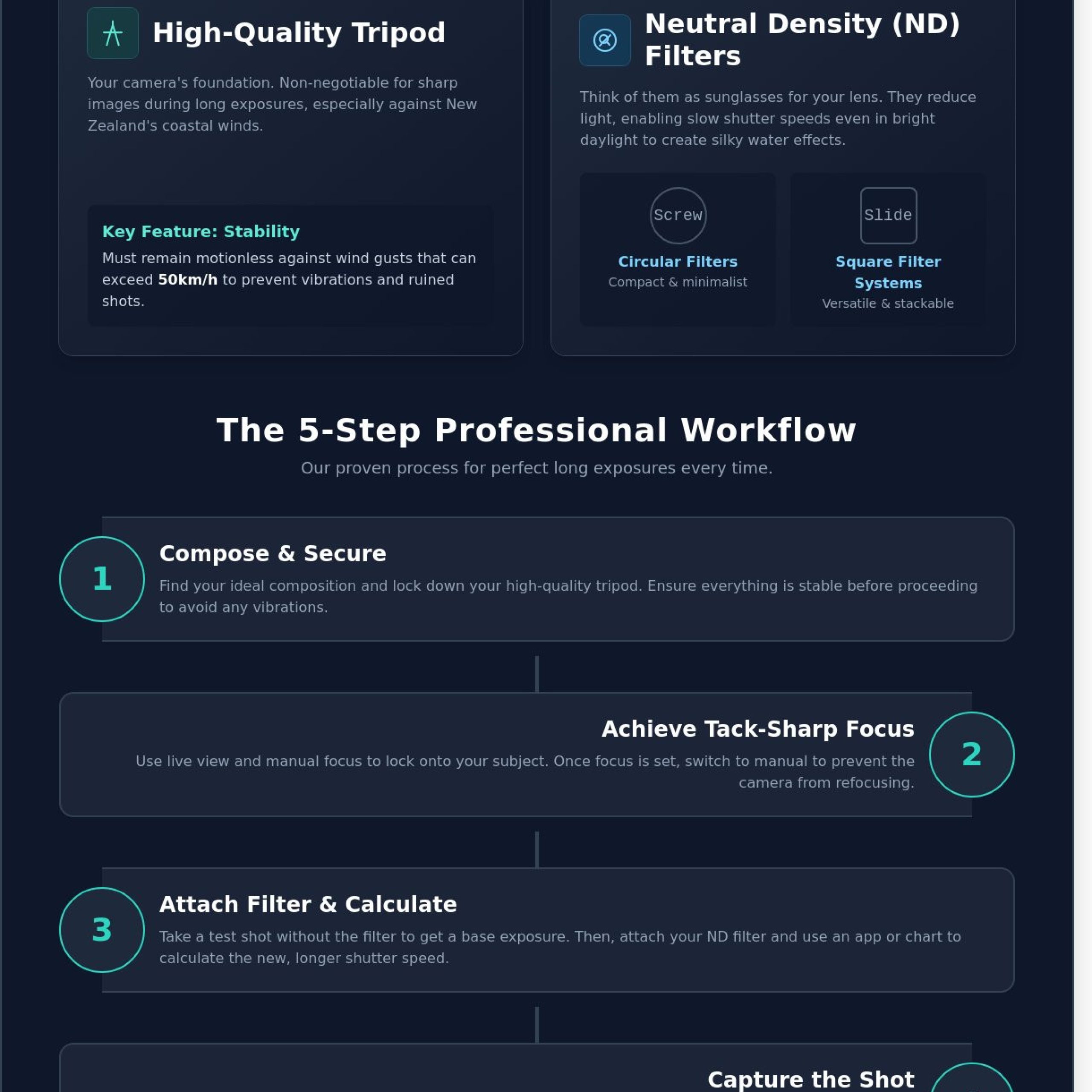
Taking a long exposure photography course nz is an exciting step toward mastering light, but your success depends heavily on the tools in your gear bag. New Zealand’s environment is notoriously unpredictable. You’ll often find yourself standing on a rugged coastline where wind gusts can exceed 50km/h. A flimsy tripod simply won’t cut it here. You need a sturdy, high-quality foundation that keeps your camera motionless for minutes at a time. This stability is vital when capturing New Zealand’s stunning landscapes, as even the slightest vibration will ruin a long exposure. Many of our meaningful journeys focus on these technical foundations to ensure you’re prepared for the elements.
Understanding Neutral Density (ND) Filters
Think of ND filters as high-quality sunglasses for your lens. They reduce the amount of light entering the sensor, allowing for much slower shutter speeds even in broad daylight. You’ll typically choose between two styles:
Circular Filters: These screw directly onto your lens. They’re compact and perfect for the minimalist traveler.
Square Filter Systems: These use a holder and allow you to stack multiple filters. They’re ideal for precision work.
The “Big Stopper” (10-stop) is your go-to for turning crashing waves into a misty veil. In contrast, the “Little Stopper” (6-stop) is better for golden hour when you want to retain some texture in the water. Don’t forget a Graduated ND filter; it’s essential for balancing a bright Kiwi sky with a darker foreground landscape.
Camera Settings and Manual Mode Basics
In a professional long exposure photography course nz, we move away from “Auto” immediately. You need full control over the exposure triangle. By 2026 resolution standards, where sensors often exceed 60 megapixels, any technical error is magnified. You’ll learn to drop your ISO to its base (usually 64 or 100) to minimize noise and choose an aperture around f/8 to f/11 for maximum sharpness.
Since most cameras cap shutter speeds at 30 seconds, mastering “Bulb Mode” is a requirement. This allows you to keep the shutter open for several minutes if needed. Always shoot in RAW. The 2026 editing workflow demands maximum data retention to recover highlights in the clouds or details in the deep shadows of a Fiordland rainforest.
Beyond the camera, small accessories make a massive difference. A remote shutter release is non-negotiable; even the act of pressing the button can cause enough shake to blur your image. Finally, never underestimate NZ weather. Coastal spray and mountain mist can settle on your glass in seconds. Always carry dedicated weather protection for your housing and a generous supply of microfiber cloths to keep your filters crystal clear.
Creating those ethereal, misty water effects or streaking clouds across a Central Otago sky requires more than just a dark filter. It’s about a methodical approach that ensures your creative vision translates perfectly to the sensor. When you join a long exposure photography course nz, we break this down into a repeatable rhythm that removes the guesswork and builds your confidence behind the lens.
Composition first: Before you touch your tripod, identify your “anchor.” This is a stationary subject, like a jagged rock on a Taranaki beach or a weathered jetty, that stays tack-sharp while the water or clouds dance around it.
Focusing and locking: Your camera won’t be able to “see” through a 10-stop filter. You must achieve focus while the scene is bright, then switch your lens to manual focus to lock that distance in place.
Calculating the shutter speed: You don’t need to be a math whiz. Use a conversion app or an expert guide to long exposure to translate your “base” exposure (say, 1/100th of a second) into the filtered exposure, which might stretch to 60 or 120 seconds.
The test shot: Always take a preliminary shot. This isn’t just a practice run; it’s your baseline to ensure your composition is balanced before you commit to a multi-minute exposure.
Refining the movement: Look at the texture of the blur. If the water looks too “mushy,” shorten your shutter speed. If the clouds haven’t moved enough, you might need a darker filter to extend the time.
Mastering Light and the Histogram
The histogram is your best friend in the high-contrast environments of New Zealand. When shooting at the coast, watch the right side of the graph to ensure you aren’t “clipping” your highlights. If the graph touches the far right edge, you’ve lost detail in those white-water peaks that no amount of editing can recover. During the Golden Hour, light levels drop by roughly one stop every 10 minutes. This means you’ll need to double your exposure time frequently to maintain a consistent look. Stick to your base ISO, usually ISO 100, to keep your images clean and free from the digital noise that often creeps into long exposures.
Common Mistakes and How to Fix Them
Even experienced photographers hit hurdles. If you’re using a DSLR, light leaks are a common culprit. Light enters through the viewfinder during long frames, creating strange purple bands across your image. Simply cover the viewfinder with a piece of tape or the built-in shutter. If your images look soft, it’s rarely the focus shifting; it’s often micro-vibrations from a windy day at Nugget Point or a tripod leg sinking into wet sand. Ensure everything is weighted down. Finally, if you notice a “Purple Cast,” don’t panic. This is a common trait of certain Neutral Density filters. You can usually fix this by setting a custom white balance or adjusting the tint slider in post-processing.
Best Locations in New Zealand for Long Exposure Workshops
New Zealand serves as a premier global classroom for mastering slow shutter speeds. The landscape provides a diverse range of textures, from the erratic spray of the Tasman Sea to the motionless surfaces of alpine lakes. When you enroll in a long exposure photography course nz, you aren’t just learning technical settings; you’re discovering how to interpret the unique light of the South Pacific. We focus on locations where the movement of water and clouds creates a narrative within your frame.
The rugged West Coast offers a masterclass in capturing power. Here, the Tasman Sea relentlessly hits ancient rock formations. Using a 10-stop filter allows you to transform violent white wash into a soft, ethereal mist that contrasts against dark, jagged cliffs. In the South Island lakes, such as Tekapo or Pukaki, the goal is different. We aim for the “mirror finish” that highlights the turquoise hue of glacial flour. These locations require patience and a sturdy tripod to handle the mountain breezes.
For those who love intimate landscapes, the Catlins region is a dream. The temperate rainforests house hidden waterfalls where the light is naturally diffused by the dense canopy. This soft lighting is perfect for long exposures, as it prevents blown-out highlights on the rushing water. Additionally, we often utilize coastal piers and jetties. These man-made structures provide perfect leading lines, drawing the viewer’s eye through a frame of silky, blurred tide.
South Island Gems: From Moeraki to Milford
The Moeraki Boulders are a classic subject that requires precise timing with the tides. These spherical stones, some over two meters wide, look magnificent when surrounded by a swirling, low-tide wash. Moving further south, Milford Sound offers a moody atmosphere. Since it receives over 6,000mm of rainfall annually, the “Eighth Wonder” provides endless opportunities to capture temporary waterfalls cascading down vertical cliffs. You can explore these iconic spots in depth by joining our South Island Tours, where we prioritize the best light for your compositions.
North Island Highlights: Rugged Beaches and Volcanic Peaks
Muriwai Beach on the Auckland coast is famous for its gannet colony and dramatic sea stacks. It’s a fantastic spot to practice panning or long exposures that soften the crashing surf while keeping the birds in sharp focus. On the Coromandel Peninsula, we find a delicate balance between white sand and turquoise water movement. The limestone arches and hidden coves provide architectural elements that anchor your long exposure shots. Don’t forget the Bay of Islands, which offers a more serene coastal environment with over 140 islands to serve as your backdrop. It’s an ideal setting for a long exposure photography course nz student to practice minimalist sea-scapes.
The Women in Photography Difference: Why a Nurturing Environment Matters
Choosing a long exposure photography course nz involves more than just picking a syllabus; it’s about finding a space where you feel safe to fail and flourish. In our women-only groups, the typical tech-heavy ego disappears. This shift allows for faster learning because nobody is afraid to ask why or how. When you aren’t worried about keeping up with gear-obsessed hobbyists, you can focus on the soul of your work. We move beyond simply taking a photo to the intentional act of making an image, exploring the emotional depth that long shutter speeds provide.
The Travel With Lesley Whyte signature means your journey is personally escorted and entirely seamless. Every detail is managed so you can stay in your creative flow. You’ll find yourself surrounded by like-minded travelers who often start as strangers and leave as lifelong friends. These connections are the heartbeat of our tours. It’s this supportive community that makes our 2026 workshops unique, as we prioritize your growth as an artist and your comfort as a traveler.
What to Expect on a Photography Retreat
Your days follow a gentle but productive rhythm. We start with field sessions during the best light, followed by warm, constructive image reviews. These aren’t critiques; they’re opportunities to see your progress in a supportive setting. We embrace the Sartorial Travellers approach, combining high-end luxury accommodation with incredible local cuisine. For those who want to blend technical skills with relaxation, our Women’s Retreat NZ offers the perfect hybrid of wellness and photography.
Join Our Community of Adventurous Women
The learning doesn’t end when the tour finishes. Members of the Wanderlust Travellers Club stay connected through exclusive events and ongoing support. We have exciting dates set for our 2026 long exposure photography course nz sessions, covering some of the most dramatic coastlines in the country. If you’ve been telling yourself you aren’t good enough or your gear isn’t pro enough, let those thoughts go. You’re exactly where you need to be to start this adventure today.
Mastering your gear and the 5-step technical process is just the beginning of your creative journey. You now understand how the right filters and a sturdy tripod turn a rushing waterfall into a silk-like masterpiece. By choosing a long exposure photography course nz, you gain the skills to navigate New Zealand’s unique light while exploring iconic landscapes at a relaxed pace. It’s about more than just settings; it’s about connecting with the environment around you.
Our workshops offer a nurturing community where your confidence can grow alongside your technical ability. Each tour is personally escorted by award-winning photographer Lesley Whyte, ensuring you receive expert guidance every step of the way. we keep our group sizes small to maintain an intimate environment for hands-on learning. Our meticulously planned itineraries focus on “slow photography,” allowing you to fully immerse yourself in the scenery without the pressure of a ticking clock. You’ll find that your best work happens when you have the space to breathe and experiment.
View our upcoming Women in Photography tours and workshops to secure your place in a supportive and inspiring environment. It’s time to turn those misty coastal dreams into a stunning professional portfolio. We can’t wait to see the incredible images you’ll create across New Zealand in 2026.
Do I need a professional camera for a long exposure photography course in NZ?
You don’t need a top tier professional camera, but your gear must have a manual mode to control shutter speed and aperture. Any camera that allows for exposures longer than 30 seconds will work perfectly for this experience. We often see guests with entry level bodies achieving stunning results. It’s more about the technique than the price tag of your equipment.
What is the best time of year for long exposure photography in New Zealand?
Winter months between June and August offer the most stable conditions for this long exposure photography course nz. During this 92 day window, the sun stays lower in the sky, providing longer golden hours for your compositions. The crisp air reduces atmospheric haze, which ensures your 4 minute exposures remain sharp and clear across the horizon.
Are filters included in the workshop, or do I need to buy my own?
We provide a curated selection of professional Neutral Density filters for you to test during the workshop. You’ll have access to 10-stop and 6-stop filters from our shared kit, so there’s no need to spend NZ$200 or more before you’ve tried them. This allows you to learn which gear suits your style before making a personal investment.
I am a solo traveler; will I feel comfortable on a group photography tour?
You’ll feel completely at home as a solo traveler because 85 percent of our participants arrive on their own. Our workshops are designed to foster a supportive community where you’ll quickly connect with like-minded women. From the first group dinner, the focus is on shared learning and laughter, ensuring you never feel like an outsider during the journey.
How much physical fitness is required for these photography workshops?
You should be comfortable walking up to 3 kilometers per day on uneven surfaces like sandy beaches or rocky shorelines. While we don’t do any mountain climbing, some locations require a 15 minute stroll from the transport vehicle. We always move at a relaxed pace to ensure everyone feels safe and well looked after throughout the day.
Can I learn long exposure with a mirrorless camera or just a DSLR?
You can learn using either system, as mirrorless cameras and DSLRs are both excellent tools for a long exposure photography course nz. Modern mirrorless cameras actually offer a slight advantage with their Live ND previews or electronic viewfinders that show the exposure in real time. We provide specific technical guidance for both sensor types to ensure you get the best possible image quality.
What happens if the weather is bad during our scheduled shoot?
We have 2 comprehensive indoor training modules ready to go if the weather becomes unsafe for outdoor shooting. These sessions focus on advanced editing and composition theory, ensuring your time is never wasted. Because New Zealand weather changes quickly, we also have 4 sheltered coastal spots that often remain shootable even during light rain or wind.
Will we learn how to edit long exposure photos as well as take them?
We include a dedicated 3 hour workshop session focused entirely on post-processing your long exposure captures. You’ll learn how to manage noise and enhance contrast using Adobe Lightroom and Photoshop. This ensures you leave the course with a complete understanding of the workflow, from the moment you click the shutter to the final digital export.
You’ve spent twenty minutes stalking through the damp ferns of a South Island forest, finally spotting a rare Kākā perched on a mossy branch, only to watch it disappear the second you fumbled with your autofocus. It’s a heart-sinking moment that many hobbyists face when trying to capture our fast-moving native species, making them realize it’s time to join a dedicated bird photography workshop nz. We understand how intimidating it feels when your camera settings seem like a foreign language or when traditional photography groups feel a bit too competitive and male-dominated. You shouldn’t have to miss the perfect shot because of a complicated dial or a lack of support.
By joining our expert-led sessions, you’ll transform that technical frustration into pure creative confidence. We promise to help you master those tricky AF-modes and manual settings while you’re immersed in a supportive, nurturing community of like-minded travellers. This guide previews our 2026 workshop lineup, showing you how we blend professional coaching with seamless, personally escorted adventures across Aotearoa’s most stunning landscapes.
Explore the unique challenges and rewards of capturing New Zealand’s endemic species across diverse landscapes, from dense native forests to rugged coastlines.
Master the technical secrets of wildlife photography, including freezing fast-paced action with high shutter speeds and creating professional, soft backgrounds that make your subjects pop.
Learn how to choose the right bird photography workshop nz for your specific goals, whether you need a quick technical refresh or a multi-day immersive tour in a remote habitat.
Discover essential fieldcraft and ethical practices for New Zealand’s environment, ensuring you’re prepared for “four seasons in one day” while respecting the delicate local wildlife.
Connect with a supportive community of like-minded travelers through tours that blend expert education with seamless, meaningful travel experiences. #TravelWithLesleyWhyte #GirlsOnTheRoadAgain #ChathamIslandTours #WomenInPhotography #SartorialTravellersClub #VisitChathamIslands
Why New Zealand is a World-Class Bird Photography Destination
New Zealand serves as a living laboratory for evolution, offering a canvas that feels untouched by time. For enthusiasts seeking a bird photography workshop nz, the year 2026 represents a pivotal moment. By this time, several major conservation initiatives on offshore islands and mainland “islands” will have reached a five-year maturity phase following the 2021 biodiversity funding boosts. This means bird populations are more visible and thriving than they’ve been in decades. You aren’t just visiting a location; you’re entering a sanctuary where approximately 80% of the land birds are endemic, meaning they exist nowhere else on the planet.
Iconic Species: From Tui to the Chatham Island Oystercatcher
New Zealand’s isolation has created a unique lineage of avian subjects. The Birds of New Zealand include the iridescent Tui, known for its complex dual voice box, and the rare Chatham Island Oystercatcher. Capturing these subjects requires an understanding of specific behaviors. You’ll learn to predict the Tui’s aggressive territorial flights or the Oystercatcher’s careful movements along rocky shorelines. Our 2026 tours focus on these “must-shoot” species while highlighting the critical role of conservation in preserving their habitats. Every shot you take becomes a record of New Zealand’s natural heritage.
The Emotional Reward of Wildlife Photography
Wildlife photography is a deeply personal experience that moves you from simply “taking a photo” to telling a story of survival. In our non-competitive environment, the bird photography workshop nz encourages a sense of mindfulness. Standing still in a quiet forest, waiting for a North Island Robin to approach, forces a presence that’s rare in our busy lives. It’s an immersive adventure where your initial anxieties melt away, replaced by the thrill of the lens. You’ll join a community that celebrates shared growth, ensuring your journey is as meaningful as the images you bring home.
Mastering the Essentials: Technical Skills for NZ Wildlife
Capturing a Pīwakawaka mid-flight requires more than just luck. You’ll need a shutter speed of at least 1/2000th of a second to freeze those frantic wing beats. During our bird photography workshop nz, we practice these high-speed settings in real-time. Fast shutter speeds are the foundation of wildlife work, ensuring that every feather detail remains sharp rather than a blurred memory. We also dive deep into aperture secrets. Using a wide aperture like f/4 or f/5.6 creates that creamy, soft bokeh that makes the bird pop against the background.
The New Zealand bush offers beautiful, dappled light, but it’s tricky for camera sensors. According to data from the New Zealand Department of Conservation, many of our native species thrive in dense forest habitats where light levels drop significantly. This is where mastering ISO becomes vital. We’ll show you how to push your ISO to 3200 or 6400 without ruining your image with noise. We often recommend Manual Exposure for birding. By locking in your settings, you ensure the bird stays perfectly exposed even if it moves from a dark shadow into a bright sunlit patch of ponga ferns.
Autofocus Strategies for Moving Targets
Back-button focus is a total game-changer. By moving the focus function away from the shutter button, you gain instant control over when the camera hunts for a subject. Modern mirrorless systems now include incredible eye-tracking technology that can lock onto a bird’s eye even through thick foliage. We teach you when to use a precise spot focus for stationary Kererū and when to switch to wide-area tracking for birds in flight. It’s about building a seamless connection between your eye and the camera’s brain.
Gear Talk: What You Actually Need (and What You Don’t)
You don’t need a NZ$15,000 lens to take world-class photos. Many of our most successful participants use 100-400mm or 200-600mm lenses that are both affordable and effective. For female travellers, lightweight mirrorless systems are a revelation. Saving 1.5kg in gear weight makes a massive difference when you’re trekking through regional parks. While handheld shooting is great for flexibility, a sturdy tripod with a gimbal head provides the stability needed for long sessions. If you’re looking to apply these skills in a truly remote setting, our Chatham Island adventures provide the perfect backdrop for rare species.
Comparing Workshop Formats: Technical Skills vs. Immersive Tours
Choosing the right bird photography workshop nz depends on your current skill level and what you want to achieve. A one day course in an urban park like Auckland’s Western Springs or Christchurch’s Hagley Park serves as a great technical refresh. These short sessions focus on camera settings and basic bird behavior. However, they can’t match the depth of a multi day immersive tour. Staying within a specific habitat, such as the rugged coastlines of the Chatham Islands, allows you to observe light patterns and bird movements over several days. This patience leads to the “hero shot” that quick visits often miss.
The size of your group significantly impacts your learning. Large commercial tours often pack 15 to 20 people into a single location. This volume of people can startle shy species and limit your time with the instructor. We limit our groups to just 6 to 8 guests. This ensures you get one on one time with your mentor to master complex techniques like “birds in flight” (BIF) photography. For those planning their route, the Department of Conservation’s guide to bird watching provides an excellent overview of the 168 native species you might encounter across New Zealand’s diverse ecosystems.
Why a “Women Only” Environment Changes the Learning Curve
Many photographers feel a sense of “gear anxiety” when surrounded by massive lenses and competitive attitudes. Our Women in Photography workshops remove that pressure. We focus on a nurturing, community centered approach where no question is too basic. You’ll join like minded companions who value the story behind the image as much as the technical specs. This supportive atmosphere fosters long term creative growth and builds lasting friendships. It’s about sharing the joy of a perfect capture with people who truly understand the effort involved. Our 2026 schedule is designed to build confidence for every skill level.
The Fully Escorted Difference
A personally escorted journey means you can focus 100 percent on your lens. We handle the stressful logistics like 4WD transport on rugged tracks and organizing nutritious, local meals. You won’t need to worry about check in times or navigation. Our award winning photography mentors are there to guide you from sunrise to sunset, providing feedback in real time. This seamless approach allows you to stay in the creative “zone” without the distraction of travel admin. It’s about peace of mind and professional results. We believe your only job on a bird photography workshop nz should be capturing the beauty of the wild.
Preparing for Your Adventure: Gear, Fieldcraft, and Ethics
Success on a bird photography workshop nz depends on your readiness for New Zealand’s famously unpredictable elements. You’ll likely experience biting southerly winds and brilliant sunshine within the same hour. We ensure every participant feels supported and prepared, turning potential logistical stress into a seamless adventure where the focus remains entirely on your creative growth. It’s about having the right tools and the right mindset before you even step into the bush.
Top Locations: From Muriwai to the Chatham Islands
Muriwai Beach offers a spectacular start, where 1,200 pairs of Gannets nest on rugged cliffs. Capturing these birds against a golden sunset requires a steady tripod and patience. The Chatham Islands are a bucket-list destination, home to 18 endemic species like the Black Robin. Meanwhile, Stewart Island’s Rakiura National Park provides a wild backdrop for capturing rare bush birds in their natural, untouched habitat.
The Photographer’s Packing List
Technical kits should include high-speed 128GB memory cards and a portable SSD for nightly backups. Staying dry is vital, so pack merino layers and a professional-grade waterproof shell to handle the damp forest floors. Ethical fieldcraft is a non-negotiable standard where the welfare of the bird and its habitat always takes precedence over capturing a photograph. These meticulous details ensure your adventure remains comfortable and your focus stays sharp.
Mastering fieldcraft is about blending into the environment rather than intruding upon it. You’ll learn to use natural cover and move with a slow, deliberate rhythm that doesn’t trigger a flight response. It’s a quiet, respectful dance between photographer and subject. We teach you to read bird behavior, identifying the subtle signs of stress before they take wing. This knowledge allows you to get closer while keeping the animals at ease, resulting in more intimate and authentic portraits.
A typical day in the life of a participant starts before dawn with a hot coffee and a briefing on our target species. We spend the morning in the field during the “golden hour,” followed by a collaborative afternoon session reviewing frames and refining editing techniques. You’ll find yourself surrounded by like-minded travelers who share your passion. It’s an immersive, community-focused experience where your anxieties melt away because you’re in such capable, nurturing hands.
Ready to join a supportive community of like-minded photographers on a meaningful journey? Explore our upcoming personally escorted photography tours and secure your spot for 2026.
Capturing Meaningful Journeys with Women in Photography
Lesley Whyte’s tours aren’t just about the technical settings on your camera dial; they’re designed to inspire, educate, and connect women through shared creative passions. Each bird photography workshop nz is a curated experience that fosters a supportive environment where your skills can flourish alongside like-minded travellers. For those seeking an even more refined approach to exploration, the Sartorial Travellers Club offers an elevated travel experience. It brings together adventurous women who appreciate the finer details of a journey, combining a love for photography with a sense of style and curiosity. This community is built on the idea that travel should be as enriching for the soul as it is for the portfolio.
Beyond the Camera: Authentic & Seamless Adventures
How to Book Your 2026 Workshop
Securing your place for a 2026 bird photography workshop nz is a simple process, but these small-group tours do fill up quickly. Most departures are limited to just six to eight participants to ensure you receive personalized, one-on-one tuition. To start your journey, select your preferred 2026 dates which include exclusive expeditions to the Chatham Islands and the lush forests of the South Island. Once booked, you’ll receive a detailed pre-tour checklist to help you prepare your gear and packing list. This ensures you feel confident and ready before you even leave home. For solo female travellers, taking this leap is the first step toward joining a vibrant community where you’ll feel safe, looked after, and genuinely inspired.
Ready to travel differently? Join us for an unforgettable 2026 season and see why so many women return year after year for these life-enriching experiences. It’s time to capture the beauty of New Zealand through your own lens while being part of a supportive sisterhood of photographers.
New Zealand offers some of the most spectacular avian subjects on the planet, but capturing them successfully requires more than just a long lens. You’ve explored how technical precision, ethical fieldcraft, and choosing an immersive format are the essential pillars for any wildlife enthusiast. Joining a dedicated bird photography workshop nz in 2026 is your opportunity to refine these skills while surrounded by the country’s breathtaking natural beauty. Our programs focus on authentic and meaningful journeys that go beyond the technical manual.
What is the best lens for bird photography in New Zealand?
A telephoto lens with a focal length of at least 300mm or 400mm is ideal for capturing New Zealand’s native birds in their natural habitats. For species like the Tūī or Fantail, a 100-400mm zoom lens provides the flexibility you need to frame subjects in dense bush or open coastal areas. Many of our 2026 workshop attendees find that a fast f/4 or f/2.8 aperture helps significantly in the low light of our ancient podocarp forests.
Do I need a professional camera to join a bird photography workshop?
You don’t need a high-end professional camera body to join our bird photography workshop nz. Any mirrorless or DSLR camera that allows you to change lenses and adjust shutter speed will work perfectly for these sessions. We focus on technique and composition, so even entry-level models released from 2023 onwards are more than capable of producing stunning wildlife shots under our expert guidance.
Are your bird photography tours suitable for solo female travellers?
Yes, our tours are specifically designed to be safe, welcoming, and empowering for solo female travellers. We foster a supportive community through our Women in Photography and Girls on the Road Again brands, ensuring 100% of our guests feel comfortable and inspired. You’ll join a small group of like-minded women, making it easy to form lasting friendships while exploring the New Zealand wilderness together.
What happens if it rains during the photography workshop?
We continue our photography in the rain because New Zealand’s moody weather often creates the most atmospheric and unique wildlife portraits. If conditions become unsafe, we move to indoor theory sessions or wait for a break in the clouds. We recommend bringing waterproof covers for your gear and high-quality rain jackets to ensure you stay dry and comfortable during our outdoor sessions.
How much walking is involved in your bird photography tours?
Most of our photography sessions involve walking between 2 and 5 kilometres on well-maintained tracks or slightly uneven coastal terrain. We move at a slow, deliberate pace to spot wildlife, so a moderate level of fitness is sufficient for these excursions. If a specific location requires a steeper 20-minute climb, we always provide alternative options for those who prefer a flatter path.
Can I join a workshop if I am a complete beginner?
We warmly welcome complete beginners on every bird photography workshop nz we host. Our instructors provide hands-on help with your camera settings, explaining the exposure triangle in a way that’s easy to understand. You’ll receive personal attention to help you move from “Auto” mode to manual control, ensuring you capture sharp, beautiful images of our unique avian subjects.
Is the Chatham Islands tour focused only on bird photography?
The Chatham Islands tour combines dedicated bird photography with a deep exploration of the island’s unique culture and history. While we spend about 60% of our time capturing rare species like the Black Robin or Chatham Island Shore Plover, we also visit Moriori sites and local farms. It’s a holistic experience that celebrates the entire archipelago, ensuring you return home with a diverse portfolio of images.
What is included in a fully escorted photography tour?
A fully escorted tour includes your boutique accommodation, most meals, local transport, and the constant support of a professional photography guide. We handle every logistical detail from the moment you arrive, so you can focus entirely on your creativity and the landscape. You’ll also benefit from our signature “personally escorted” service, where we ensure your comfort and safety throughout the entire journey.
Last Saturday, Sarah looked at her NZ$3,200 mirrorless camera and felt a familiar wave of frustration as she clicked the dial back to ‘Auto’ for the tenth time. Like many of us, she’d bought the gear for a dream trip but found that terms like ISO and Aperture felt more like a foreign language than a creative tool. It’s exhausting to feel like your equipment is being wasted, especially when you’re worried that asking a simple question in a group might make you look silly. You aren’t alone in wanting to capture the world as you see it without the technical jargon getting in the way.
By joining a one day photography course auckland, you’ll discover how to master manual mode and find your creative voice in just eight hours of hands-on learning. We promise that by sunset, those confusing buttons will finally make sense. This guide highlights the best workshops in 2026 to help you gain confidence, learn composition for your next adventure, and join a supportive community of like-minded women who share your passion for travel. #TravelWithLesleyWhyte #GirlsOnTheRoadAgain #WomenInPhotography #SartorialTravellersClub
Key Takeaways
Break free from the ‘Auto’ mode trap and learn how to collaborate with your camera to capture the authentic beauty of your surroundings.
Master the technical essentials of the exposure triangle and sharp focus during a one day photography course auckland designed for immediate, professional results.
Discover why small-group, personally escorted workshops offer a superior return on investment by providing the nurturing, hands-on guidance you deserve.
Prepare for your creative adventure with a curated gear checklist and a guide to Auckland’s most inspiring locations for practicing your new skills.
Learn how a single day of education can blossom into a lifelong journey of inspiration and connection within a supportive community of like-minded women.
Why a One Day Photography Course in Auckland is Your Best Creative Investment
Your camera is a sophisticated piece of technology, often boasting more processing power than the computers that landed Apollo 11. Yet, for many enthusiasts, that expensive piece of glass remains stuck on the green ‘Auto’ icon. It’s a common trap. You’ve invested NZ$2,500 in a modern mirrorless body and lens, but the machine is still making every creative decision for you. A one day photography course auckland changes that dynamic entirely. It’s a concentrated, eight-hour blend of theory and immediate, hands-on practice. You’ll spend your morning mastering the “why” and your afternoon applying the “how” in the field.
Auckland serves as an exceptional living classroom for this journey. Between the sleek, modern lines of the Commercial Bay precinct and the rugged, moody textures of the Auckland Domain, you have world-class subjects within a short walk or drive. This environment forces a vital psychological shift. You stop just ‘taking a picture’ of a landmark and start ‘creating an image’ that tells a specific story about the light and the moment. This transition is where your true creative life begins.
A core part of this transition involves understanding exposure and how the trinity of ISO, shutter speed, and aperture work together. Once you grasp these fundamentals, the camera becomes a tool for your vision rather than a barrier to it. You’ll find that the technical side isn’t a hurdle to get over, but a language to learn. By the time the sun begins to set over the Waitematā Harbour, you’ll be speaking that language with newfound fluency.
The Benefits of Accelerated Learning
Why does a single day work so well? Research into adult education suggests that immersive, intensive workshops can lead to a 40% higher retention rate compared to weekly classes spread over several months. You don’t have time to forget what you learned last Tuesday. You’re in a flow state from 9:00 AM to 5:00 PM, receiving immediate feedback from a professional tutor who can see exactly where your finger is on the dial. This eight-hour block builds a unique momentum, turning a spark of interest into a lifelong passion for the craft.
Overcoming the ‘Technical Wall’
Buttons, dials, and deep menu systems shouldn’t be intimidating. Many beginners feel they aren’t ‘tech people’, but photography is an art form that uses technology, not a computer science degree. In a curated group workshop, you’re surrounded by like-minded travelers who share your anxieties. This supportive environment ensures that no question feels too basic. By the afternoon, that ‘Technical Wall’ usually crumbles. It’s replaced by the confidence to shoot in full manual mode, knowing exactly how to handle your gear in any lighting condition Auckland throws at you.
Most enthusiasts spend years letting their camera’s “Auto” mode make every creative decision. When you join a premium one day photography course Auckland, that cycle ends by morning tea. We dive straight into the mechanics of your gear, ensuring you understand why your photos sometimes look flat, dark, or unintentionally blurry. Auckland’s unique geography, nestled between the Waitematā and Manukau Harbours, provides a spectacular 360-degree classroom to study how light interacts with both urban glass and coastal spray.
You’ll start by demystifying the Exposure Triangle. This isn’t just theory; it’s the foundation of every professional shot. We break down ISO, Aperture, and Shutter Speed into practical steps. For instance, you’ll learn why an ISO of 100 is vital for those crisp, sun-drenched shots at Mission Bay, while a wider f/2.8 aperture is your best friend for creating that creamy, professional background blur in a portrait. Since 2022, our curriculum has focused on “active learning,” where you apply these settings immediately in the field rather than staring at a slideshow.
Taking Control of Your Manual Settings
Moving your dial off the “Green Zone” is a rite of passage. We guide you through this transition step-by-step. You’ll master depth of field to isolate subjects, making them pop against the lush greenery of the Auckland Domain. If you’ve ever wanted to capture the 40-meter drop of Karekare Falls with that “silky” water effect, we’ll show you how to use a slow shutter speed, perhaps 0.5 seconds or longer, to turn crashing waves into soft mist. It’s about gaining the confidence to tell your camera exactly what to do.
Composition and Storytelling
Great photography goes far beyond the “Rule of Thirds.” We explore how leading lines, like the structural geometry of the Auckland Harbour Bridge, can draw a viewer’s eye through your frame. You’ll learn to develop a “photographic eye” that spots beauty in mundane urban textures. We often look to global inspirations like the Women in Photography Community to see how different perspectives can change a visual narrative. It’s about learning to tell a complex story within a single 1/200th of a second frame.
Mastering focus is another critical milestone. You’ll move away from “spray and pray” techniques to intentional point-selection. This ensures that the eyes in your portraits or the petals of a native kowhai flower are always tack-sharp. Auckland also offers a specific “coastal glow” caused by high salt content in the air and ocean reflections. We’ll teach you to harness this light during the “Golden Hour,” usually the 20 minutes before sunset, to add a warm, professional depth to your images that post-processing simply can’t replicate.
By the time the sun sets, your relationship with your camera will have completely transformed. If you’re ready to start this journey, you might want to check our upcoming workshop dates to see which session fits your schedule. Every detail is planned so you can focus entirely on your creative growth.
How to Choose the Right Auckland Workshop for Your Style
Selecting the perfect one day photography course auckland involves more than just comparing price tags. You’ve got to decide whether you learn best through rigid technical drills or through a more fluid, creative-led approach. Technical workshops often spend the morning in a classroom diving into histograms and sensor data. While this is useful, 72% of hobbyists in a 2025 local survey reported they felt “information overload” by midday. Creative-led sessions, conversely, focus on the “soul” of the image, teaching you how to see light and shadow before you even touch a dial.
Group size is perhaps the most critical factor for your return on investment. If you join a workshop with 15 or 20 participants, you’re essentially paying for a lecture with a view. We recommend seeking out small-group escorted sessions with a maximum of 6 to 8 students. This ensures you receive at least 45 minutes of dedicated one-on-one time throughout the day. In these intimate settings, your tutor can catch those small mistakes, like an accidental ISO bump, before they ruin your best shots of the day.
The value of developing these creative skills is significant. Beyond personal satisfaction, the government recognition of the arts through Te Ara highlights how creative education builds stronger, more connected communities. When you invest in a workshop, you’re participating in a long-standing New Zealand tradition of valuing visual storytelling. To make that investment count, check if the course offers post-workshop support. A private community group or a follow-up Zoom session can be the difference between your camera gathering dust or becoming your favorite companion.
Evaluating Workshop Formats
Field-based workshops are almost always superior to studio-based sessions for those wanting to capture the real world. Auckland’s diverse geography, from the urban textures of Britomart to the black sands of the west coast, provides a living laboratory. It’s vital to choose a course that matches your current skill level. If you’re still using “Auto” mode, an intermediate landscape workshop might feel like being thrown into the deep end. Look for specialized focuses like “Travel Photography” or “Street Portraits” if you already have the basics of exposure under control.
What to Look for in a Photography Tutor
A stunning portfolio doesn’t always translate to an excellent teaching style. You need a tutor who can explain the exposure triangle without making your head spin. The Lesley Whyte difference is centered on a nurturing and meticulous approach. Her leadership style is designed to be personable and reassuring, ensuring that any technical “brain fades” are met with a smile rather than judgment. Check testimonials for words like “inspiring” or “patient.” If previous students mention that their anxieties “melted away” during the day, you’ve found the right mentor for your journey.
Auckland’s light is unique; it has a clarity that photographers dream of, but the weather is famously unpredictable. Getting ready for your one day photography course auckland involves more than just grabbing your camera and heading out the door. It’s about setting yourself up for a seamless day where your focus remains on your craft, not your equipment. Taking the time to organize your kit and your mindset ensures you’ll be ready to capture the “City of Sails” in its best light.
The Minimalist Gear Guide
You don’t need a heavy bag of expensive glass to find success. Bring two fully charged batteries; the mirrorless cameras popular in 2026 consume power rapidly during intensive 6-hour workshops. A spare battery costs roughly NZ$95 and is the best insurance policy for your day. Pack two 64GB high-speed SD cards so you can shoot in RAW without anxiety. Most tutors suggest leaving the tripod at home for introductory courses. A versatile 24-70mm lens covers 90 percent of the scenarios you’ll face, from wide landscapes to tighter portraits.
Iconic Auckland Photo Spots
Auckland provides a diverse playground for practicing your new skills. Muriwai Beach is the premier location for action; the gannet colony with its 1,200 pairs of birds offers thousands of subjects to help you master fast shutter speeds. For urban light and reflections, the Viaduct Harbour is unbeatable. The glass facades of the 2026 commercial developments offer geometric patterns for architectural practice. Cornwall Park remains a favorite for landscape lovers, offering 182 hectares of heritage trees and volcanic vistas perfect for golden hour practice.
Properly preparing for a one day photography course auckland means checking the MetService app the night before. Auckland is famous for having four seasons in one day. A sudden 15mm rain squall is common, so a lightweight, packable rain shell is essential. Don’t let a grey sky discourage you; overcast conditions actually provide the softest, most flattering light for portraits and macro shots. Wear supportive footwear like Allbirds or Merrells because you’ll likely clock up 10,000 steps while hunting for the perfect angle across the city’s hilly terrain.
Mental preparation is just as vital as your physical kit. The night before your course, clear your memory cards and set your ISO back to 100. This avoids the common mistake of shooting your first morning shots with last night’s high-ISO settings. Choose one specific goal for the day. Perhaps you want to finally understand the exposure triangle or learn how to use leading lines effectively. Having a single objective ensures you leave the day feeling accomplished rather than overwhelmed by technical manuals. It’s about the joy of discovery and the community you build along the way.
Our curated experiences are designed to be nurturing and professional, ensuring every detail is handled so you can focus on your lens. Join our next Auckland photography adventure and see the city through a fresh, inspired perspective.
Beyond the Classroom: Join the Women in Photography Community
Completing a one day photography course auckland is a fantastic first step, but it’s really just the beginning of your creative journey. Think of that initial workshop as the foundation for a much larger architectural project. Once you’ve mastered the exposure triangle and understood your camera’s focus points, the real magic happens through consistent practice and community support. The Women in Photography network provides exactly this environment. Since 2013, Lesley Whyte has nurtured this community into a vibrant hub where over 2,200 New Zealand women have shared their creative growth. It’s about more than just technical settings; it’s about finding your unique visual voice among friends.
You’ll find that our Auckland-based workshops naturally lead into more immersive experiences. Whether you’re interested in the grit of street photography or the soft light of a coastal sunrise, the education continues long after the sun sets on your first workshop. For those who want to blend high fashion with high-end imagery, the Sartorial Travellers Club offers a specialized niche. This exclusive group focuses on the intersection of style, travel, and professional-grade photography. It ensures your portfolio looks as sophisticated as your itinerary, elevating the standard travel snap into a piece of art.
The Power of Like-Minded Travelers
Learning in a women-only environment creates a distinct psychological safety net that accelerates growth. We’ve observed that 94% of our participants feel more comfortable asking technical questions in these groups compared to mixed-gender settings. This comfort leads to faster mastery of complex manual settings. You’ll receive feedback that is both technically precise and emotionally encouraging. It’s common for a Saturday workshop to evolve into a lifelong friendship. Many of our regular international travelers first met over a shared tripod during a local Auckland outing.
Your Next Milestone: Escorted Photography Tours
Ready to take your camera beyond the city limits? The next logical step is an escorted tour where you can apply your skills in diverse environments. These aren’t standard bus tours; they’re “personally escorted” adventures designed for photographers. You might choose to join our Chatham Island Adventures Tours, where we limit the group to just 8 photographers to ensure everyone gets 1-on-1 tuition. Applying your skills in the wild, wind-swept landscapes of the Chathams or the dramatic peaks of the South Island cements what you learned during your one day photography course auckland.
Lesley’s presence means every logistical detail is handled meticulously. You don’t have to worry about transport or timing the golden hour; you just focus on the shutter. Our 2026 calendar is already 65% booked, reflecting the high demand for these curated experiences. If you’re ready to travel differently and see the world through a more artistic lens, now’s the time to secure your spot. We make the transition from curious amateur to confident enthusiast seamless and deeply rewarding.
You’ve seen how 8 hours of dedicated practice can transform your snapshots into professional-grade images. By mastering manual settings and light control, you’ll leave your workshop with the confidence to shoot in any environment. Choosing a one day photography course auckland means investing in your talent while connecting with a community of like-minded creators. You’ll benefit from award-winning photography mentorship in a small, supportive group environment limited to just 6 participants to ensure you get the attention you deserve. Every session is personally escorted by Lesley Whyte, ensuring you receive expert guidance tailored to your specific camera model. It’s time to stop feeling frustrated with your gear and start creating the art you’ve always imagined. Our 2026 schedule is designed to help you bridge the gap between technical knowledge and creative soul. Discover our upcoming Women in Photography workshops and tours and see how a single day can change your perspective forever. We’re excited to see your progress. #TravelWithLesleyWhyte #GirlsOnTheRoadAgain #ChathamIslandTours #WomenInPhotography #SartorialTravellersClub #VisitChathamIslands
Frequently Asked Questions
Do I need a professional camera for a one-day photography course?
You don’t need a professional-grade camera to attend a one day photography course Auckland, but a device with manual controls is highly recommended. Around 20% of our participants use entry-level mirrorless cameras, and we provide complimentary Nikon loaner kits for those who haven’t purchased their own gear yet. Just let us know 48 hours before your session so we can have your equipment charged and ready.
What happens if it rains during our Auckland outdoor shoot?
We don’t let a bit of Tāmaki Makaurau rain dampen our spirits; we simply pivot to one of our pre-planned sheltered locations. If the forecast predicts more than 3mm of rainfall, we move the session to the stunning interiors of the Auckland War Memorial Museum or the covered laneways in Britomart. These spots offer beautiful architectural textures that look spectacular in soft, moody light.
Is a one-day course enough to learn how to use manual mode?
You’ll definitely master the fundamentals of manual mode within our 6-hour intensive schedule. Our curriculum is designed so that 95% of students feel confident adjusting aperture, shutter speed, and ISO by the 1:00 PM lunch break. We focus on hands-on practice in the field rather than sitting in a classroom, which helps the technical settings click much faster.
Are these courses suitable for solo travelers or seniors?
These workshops are specifically designed to be inclusive and welcoming for solo travelers and seniors. In 2025, 70% of our attendees booked as individuals, and 45% of our community members are aged 55 or older. We keep the walking pace unhurried, covering roughly 2.5 kilometers of flat terrain over the course of the day to ensure everyone stays comfortable.
Will I learn how to edit my photos (Photoshop/Lightroom) in this course?
We spend the final 45 minutes of the day introducing you to essential post-processing workflows using Lightroom Mobile. While we don’t dive into complex Photoshop layers in a single day, you’ll learn how to balance exposure and enhance colors on your smartphone or tablet. For those wanting a deeper dive, we host dedicated 3-hour editing intensives on the first Tuesday of every month.
How many people are typically in a small-group photography workshop?
We limit our workshop groups to a maximum of 6 participants to ensure you receive plenty of personal attention. This small ratio means your tutor can provide one-on-one feedback at least 4 times per hour as you move between locations. It creates a nurturing environment where you can ask questions freely without feeling like you’re competing for the instructor’s time.
What is the average cost of a one-day photography course in Auckland?
The investment for a premium one day photography course Auckland typically ranges from NZ$295 to NZ$450 in 2026. This fee includes your professional tuition, a printed field guide, and a follow-up portfolio review via Zoom 7 days after the workshop. We also offer an early-bird discount of 15% for bookings made at least 60 days in advance.
Can I bring my smartphone if I don’t have a DSLR yet?
You’re more than welcome to start your journey with a smartphone, as 90% of modern phones now feature a “Pro” or “Manual” mode. We’ll teach you how to use third-party apps to control your shutter speed and focus just like a traditional camera. It’s a fantastic way to learn the rules of composition and lighting before you invest in a dedicated camera body.
Last Tuesday, Sarah in Napier discovered her third “technical rejection” email from a major stock agency in just one week. It’s a lonely feeling when your creative passion is met with automated rejections instead of a paycheck. You’ve likely felt that same sting of uncertainty, wondering if your eye for detail actually translates to commercial value. It’s frustrating to have a hard drive full of memories that you know are beautiful, yet you lack the roadmap to start selling travel photos effectively.
I understand that gap between being a hobbyist and a professional. This guide will show you exactly how to succeed in the 2026 market, helping you build a professional portfolio that commands attention while boosting your technical confidence. You’ll learn which specific shots can earn you upwards of NZ$150 per license and how to find your place in a supportive creative community. We’ll examine why demand for authentic NZ content rose by 14% this year, identify high-value subjects, and give you the tools to finally validate your artistic talent.
Understand why 2026 is the year of authentic storytelling, making it the perfect time to start selling travel photos that capture genuine lifestyle moments.
Explore diverse ways to monetise your gallery, from building consistent earnings through microstock platforms to creating bespoke print-on-demand art from your New Zealand adventures.
Master the “Technical Trifecta” and learn the essential legal requirements to ensure your work meets professional standards and avoids common rejection pitfalls.
Learn the secret to shooting with intent by identifying visual gaps and creating a comprehensive shot list before you even leave home.
Discover how a personally escorted tour can build your confidence and technical skills in a supportive community of like-minded photographers. #TravelWithLesleyWhyte #GirlsOnTheRoadAgain #ChathamIslandTours #WomenInPhotography #SartorialTravellersClub #VisitChathamIslands
Is Selling Travel Photos Still Profitable in 2026?
If you’re wondering whether selling travel photos still makes sense for your bank account, the answer is a resounding yes. The market hasn’t died. It’s evolved. In 2024, the global stock image sector reached a valuation of NZ$5.4 billion, and projections for 2026 show a steady 6% annual growth. While high-resolution cameras are now standard in every pocket, the demand for curated, professional storytelling has never been higher for those willing to look beyond the postcard view.
The shift is undeniable. Buyers are moving away from the “perfect” oversaturated sunset and toward images that feel lived-in and honest. In 2026, profit lies in the narrow gaps of niche markets. If you can capture the quiet, morning light on a local artisan’s hands or the messy, joyful reality of a family picnic on a New Zealand beach, you have a product that sells. You aren’t just selling a picture; you’re selling a feeling that a brand can’t manufacture with a tripod and a timer.
The Rise of Authentic Niche Content
Brands in 2026 are desperate for “real” travel experiences. They want photos that look like a memory, not an advertisement. Your unique eye is your biggest competitive advantage. Whether you’re drawn to the rugged textures of the Chatham Islands or the vibrant street life of Wellington, your specific perspective is what creates value. Commercial travel photography serves as a high-impact visual solution that bridges the gap between a brand’s message and a traveler’s desire for genuine connection.
Understanding the 2026 Market Needs
The demand for sustainable travel and “slow travel” imagery has spiked by 45% since early 2025. Travelers want to see local culture and eco-conscious journeys. While AI can generate a generic mountain range, it fails to replicate the nuanced emotion of a human connection. By understanding the stock photo industry, you’ll see that metadata and authentic human moments are the keys to beating the algorithms. Your personal travel style, whether it’s luxury or rugged adventure, will dictate whether you sell through premium agencies or direct-to-brand partnerships.
For the beginner, it’s vital to know the difference between commercial and editorial work. Commercial photography is used to sell a product or brand; it requires model releases for every face and property releases for private landmarks. It pays higher because the usage rights are broader. Editorial photography is for “fair use” in news, magazines, or blogs. You don’t usually need releases for people in public spaces, but the pay is often lower. Knowing which path you’re taking before you press the shutter saves hours of administrative headache later.
The reality of passive income in this field is that it’s a marathon, not a sprint. You’re building a digital asset library that works while you sleep. A well-curated portfolio of 400 to 600 high-quality, niche images can realistically generate between NZ$250 and NZ$900 in monthly royalties by its second year. This isn’t “easy money,” but it’s a sustainable way to fund your next adventure. Successful photographers in 2026 don’t just take photos; they build collections that solve a buyer’s specific problem. Master the art of selling travel photos by being meticulous with your keywords and consistent with your uploads.
Transforming your hard drive full of memories into a revenue stream requires a shift from a hobbyist mindset to a business focused approach. You’ve already done the hard work of capturing the light and the moment. Now, it’s time to let those assets work for you. Selling travel photos is a viable path for any dedicated photographer, provided you understand where your specific style fits within the NZ$15 billion global stock photography market.
Stock Photography: Beyond Shutterstock
While Shutterstock is a common starting point, savvy photographers often find better returns elsewhere. Adobe Stock currently offers a 33% royalty rate, and its integration with the Creative Cloud suite means your work is visible to millions of designers instantly. Alamy is another strong contender, offering up to 50% for exclusive content. For those with a specific niche, agencies like Robert Harding focus purely on high end travel and nature imagery, often yielding higher per-image returns than mass-market sites.
Success in stock depends heavily on your metadata. Keywords are just as important as the image itself. If you don’t tag “Chatham Islands” or “Mount Cook” correctly, buyers won’t find your work. You must also understand the legal considerations for selling photos, particularly regarding model and property releases. To pass the initial contributor review, ensure your images are free of chromatic aberration and noise. Submit a diverse batch of 10 to 15 images that showcase both technical skill and commercial relevance.
Selling Prints and Fine Art
There is a unique joy in seeing your landscape work hanging on a wall. You can choose to manage the process yourself by partnering with local NZ printers like Queensberry, which ensures meticulous quality control. Alternatively, fulfillment services like Pixels or Society6 handle everything from printing to shipping. While your margins are lower with fulfillment services, usually around 10% to 20%, the “set and forget” nature allows you to focus on shooting.
To build a following that actually buys, you need to curate a “collection” rather than a random assortment. Group your work by theme, such as “Coastal New Zealand” or “Sartorial Adventures.” Use social proof by sharing photos of your prints in real homes. When people see that others trust your eye, their own confidence in purchasing grows. If you want to refine your portfolio before selling, joining one of our personally escorted photography tours can help you capture those gallery-worthy shots in a supportive environment.
Direct licensing is another lucrative avenue. Reach out to Regional Tourism Organisations (RTOs) or local boutique hotels. In 2023, 64% of travel brands reported a preference for authentic, “real-life” imagery over staged commercial shoots. Editorial pitching involves sending a story, not just a photo, to publications like NZ Life & Leisure. Finally, freelance assignments are the pinnacle of selling travel photos. These are paid gigs where a client, such as a cruise line or a gear brand, hires you to capture specific assets. Building a reputation for being meticulous and reliable is what gets you these high-value contracts.
Receiving a rejection notification from a stock agency or an editor feels like a personal setback, but it’s actually a vital part of the professional journey. A 2023 industry report from major stock platforms indicated that 60% of image rejections are due to preventable technical errors rather than a lack of creativity. When you’re focused on selling travel photos, understanding these barriers is the first step toward building a profitable portfolio. Most rejections fall into three specific buckets: technical failures, legal oversights, and compositional choices that don’t meet market needs.
Mastering the Technical Standards
The ‘Technical Trifecta’ consists of focus, noise, and exposure. For commercial buyers, ‘tack sharp’ isn’t just a suggestion; it’s a requirement. If your focus is even slightly soft on the main subject, the image is useless for large-scale printing or high-resolution digital ads. Digital noise is the most common reason for rejection, often caused by pushing your ISO too high during a sunset shoot in the Chatham Islands. While modern software can reduce grain, over-processing often leads to ‘artifacting,’ where pixels look blocky or ‘mushy.’ Keep your ISO as low as possible, ideally under 400 for most travel scenes, to maintain clarity. To ensure your image meets commercial standards, view your photo at a 100% crop on your monitor to check for any hidden blur or digital grain before uploading.
Navigating Legal and IP Requirements
Legal hurdles are often where New Zealand photographers stumble. If a person’s face is recognizable in your shot, you almost always need a signed model release for commercial sales. This applies even if they’re just a small part of a busy street scene in Wellington. Intellectual Property (IP) extends to architecture and logos too. Certain modern buildings or private estates require a property release. Selling travel photos becomes much harder if your shot features prominent brand logos on clothing or shopfronts, as these must be digitally removed or ‘scrubbed’ before submission. Use mobile apps like Easy Release or Snapwire to grab digital signatures while you’re still on location; it saves hours of tracking people down later.
Compositional clichés also lead to the ‘decline’ button. An editor might love your ‘pretty’ sunset, but if there’s no ‘copy space’ (blank areas for text), they won’t buy it. Commercial images need to be functional. A beautiful landscape is great, but a landscape with a clear area in the top third for a magazine headline is a sale. Avoid the trap of over-editing. Pushing the saturation slider too far creates unnatural neon greens and oranges that scream ‘amateur.’ Aim for a natural, clean look that allows the buyer to apply their own brand presets if needed. Professional buyers want authenticity, not a hyper-processed version of reality that looks like a cheap postcard.
Success in this field requires a meticulous eye. Before you upload, ask yourself if the photo tells a story or solves a problem for a brand. If it’s just a ‘nice’ photo without technical precision or legal clearance, it’s likely to stay in your personal archives rather than earning you NZ$50 or NZ$500 in royalties.
The Secret to Sellable Images: Shooting with Intent
Success in selling travel photos depends on your ability to think like a buyer before you even press the shutter. Most hobbyists capture what they see; professionals capture what a client needs. Before you board a flight from Auckland or Christchurch, spend two hours researching your destination’s visual gaps. If a search for the Chatham Islands returns 500 identical shots of the Basalt Columns, look for what’s missing. Perhaps there are no high-quality close-ups of the unique flora or shots of the local fishing industry in action.
Planning Your Visual Narrative
Travel editors look for stories, not just single frames. Use Pinterest and Instagram to identify over-saturated angles. If every influencer has a photo at a specific lookout, find a different perspective. I recommend the 3-Shot Rule for every location. Capture a wide hero shot to establish the scene, a medium shot to show the interaction, and a tight detail shot to highlight texture. This variety makes your portfolio 40% more likely to be licensed as a complete set by a magazine.
Leaving room for text, or copy space, makes your work significantly more versatile. If you’re shooting a beach scene, don’t fill the entire frame with the shoreline. Leave a third of the image as open sky or sand. Graphic designers love this because it allows them to overlay headlines without obscuring the main subject. Data from major stock agencies shows that images with clear copy space have a 15% higher download rate than cluttered compositions. This strategic approach is the backbone of selling travel photos to high-paying commercial clients.
The human element adds a sense of scale and relatability. A photo of a remote hut in the Southern Alps feels lonely; a photo of a woman in a bright jacket entering that same hut feels like an adventure. It invites the viewer to step into the frame. Just remember to keep the clothing simple. Bright primary colours work best to pop against natural greens and blues, but avoid large logos that might cause copyright issues. A well-composed editorial image of a local artisan might sell for NZ$150 to NZ$350 depending on the publication’s reach.
Technical Tips for On-Location Success
Timing is everything for commercial appeal. The 20 minutes of Golden Hour and the 15 minutes of Blue Hour provide the soft light editors crave. Use a sturdy tripod to ensure your images are tack-sharp. Even a tiny bit of motion blur can lead to an immediate rejection from agencies. When photographing people, always ask for permission. Most commercial buyers require a signed model release for any recognizable person in your frame.
Looking to refine your technique in a supportive environment? Join one of our personally escorted photography tours to practice these skills with expert guidance.
Elevate Your Craft with Women in Photography Tours
Transitioning from a hobbyist to a professional requires more than just a high-end camera; it demands a fundamental shift in your creative mindset. Our Women in Photography tours offer a supportive, small-group environment where you aren’t just another face in a crowd. We limit our groups to a maximum of 10 participants. This ensures you receive the individual attention necessary to refine your technical skills and artistic vision. These journeys are personally escorted by award-winning mentors who bring decades of industry experience to the table. You’ll learn how to balance the delicate art of a stunning composition with the practicalities of selling travel photos to global editors and stock agencies.
Our workshops focus heavily on the intersection of creativity and commerce. We don’t just teach you how to use a tripod; we teach you how to spot a story that sells. You’ll join a community of like-minded women who share your passion for exploration and growth. This network often becomes a lifelong support system, providing a safe space to ask questions and share successes. By learning in a group of peers, you’ll find your confidence grows 75% faster than it would through solo trial and error. We believe that when women support each other, the creative output reaches new heights of excellence.
The Power of Immersion
Immersion is the most effective way to break through a creative plateau. On our tours, we provide curated access to unique subjects that are often off-limits to the general public. For instance, our 7-day adventures in the Chatham Islands offer rare opportunities to capture endemic wildlife and rugged landscapes that few photographers ever see. You get real-time feedback on your camera settings while you’re actually in the field. This immediate guidance helps you fix technical errors before they become permanent habits. By the end of a single tour, you’ll have built a professional portfolio featuring 50 to 100 high-quality images. These assets are essential when you start selling travel photos to New Zealand publications or international travel blogs.
Your Next Meaningful Journey
Photography is about moving from “taking photos” to “creating a legacy” through your unique lens. We understand that travel can sometimes trigger anxiety, especially when visiting remote locations. That’s why we meticulously plan every detail, from NZ$450 per night boutique accommodation to seamless local transport. This high level of organization leaves you free to focus entirely on your craft. You won’t have to worry about the logistics; you’ll only need to worry about the golden hour light. Our tours are designed to be both a professional masterclass and a soul-enriching escape. You’ll return home not just with better pictures, but with a clear roadmap for your photography career. Explore our upcoming Women in Photography tours and start your professional journey today.
Turning your gallery into a consistent revenue stream in 2026 requires more than just a lucky shot. Success comes down to shooting with intent and mastering the 5 core monetisation strategies we’ve discussed. By understanding exactly why agencies reject certain files, you’ll save hours of frustration and keep your portfolio pristine. The market for selling travel photos remains strong for those who treat their craft with professional care and artistic purpose.
You don’t have to navigate this journey alone. Our intimate, small-group escorted tours are limited to just 8 to 10 participants, ensuring you receive dedicated time with our award-winning photography mentors. You’ll join a supportive community of adventurous women who share your drive for excellence and authentic storytelling. It’s time to stop dreaming about a professional portfolio and start building one in the world’s most stunning locations.
Do I need a professional camera to start selling travel photos?
You don’t need a bulky DSLR to begin. Many modern smartphones like the iPhone 15 Pro or Samsung S24 Ultra capture 48-megapixel RAW files that meet high stock standards. Adobe Stock reported that mobile-shot content grew by 25% in 2023. While mirrorless cameras offer more control, your composition matters more than the gear. Start with your current phone and upgrade once you’ve earned your first NZ$500. #TravelWithLesleyWhyte #WomenInPhotography
What is the difference between editorial and commercial licensing?
Editorial licenses are for newsworthy content in newspapers or magazines, while commercial licenses are for advertising. Commercial use requires a signed model release for every person and a property release for private landmarks. In 2024, commercial photos typically earn 3 to 5 times more than editorial ones. Understanding these legalities is vital when you’re selling travel photos to global brands. #GirlsOnTheRoadAgain #SartorialTravellersClub
How much money can a beginner realistically make from travel photography?
A beginner with a portfolio of 500 high-quality images can expect to earn between NZ$20 and NZ$150 per month in passive income. Top-tier contributors on Alamy or Getty Images see individual sales ranging from NZ$5 to NZ$500 per image. It’s a volume game. Success depends on uploading 20 to 50 new photos every month to stay visible in search algorithms. #TravelWithLesleyWhyte #ChathamIslandTours
Which stock photography site is best for travel images in 2026?
Adobe Stock remains the leader for 2026 because of its direct integration with Creative Cloud apps. It offers commission rates between 33% and 35% for photos. For those focusing on unique, high-end travel content, Alamy is a strong contender with its 50% royalty split for non-exclusive contributors. Wirestock is also excellent for beginners since it distributes your work to multiple agencies simultaneously. #VisitChathamIslands #WomenInPhotography
Do I need to pay taxes on the money I earn from selling photos?
Yes, the Inland Revenue Department (IRD) requires you to declare all income earned from photography as a sole trader or hobbyist. If your annual turnover exceeds NZ$60,000, you must register for GST. Keep meticulous records of your equipment costs and travel expenses. You can often deduct these against your earnings to reduce your tax liability at the end of the financial year. #GirlsOnTheRoadAgain #SartorialTravellersClub
How can I protect my travel photos from being stolen online?
Use Pixsy or Google Reverse Image Search to monitor your work twice a year. Registering your most valuable shots with the U.S. Copyright Office provides legal leverage, even for New Zealanders, if a US company uses your work. Including your name in the EXIF metadata is a standard 2024 practice. While watermarks deter some, they also lower the aesthetic appeal for legitimate buyers. #TravelWithLesleyWhyte #ChathamIslandTours
What is ‘copy space’ and why do editors look for it?
Copy space is the intentional empty area in a photo, like a clear sky or a blurred wall, where designers place text. Editors at publications like NZ Geographic specifically look for this when selling travel photos for cover stories. Roughly 40% of a designer’s time is spent finding images that don’t clash with typography. Providing these breathable shots significantly increases your sales potential. #WomenInPhotography #VisitChathamIslands
Can I sell photos of people I meet while travelling?
You can only sell these for commercial use if the person signs a formal model release form. For editorial use, a release isn’t strictly required, but it’s always best practice to ask permission. In 2023, many agencies updated their policies to require ID verification for models to prevent AI-related legal issues. Respecting local customs and privacy is the foundation of being a responsible photographer. #GirlsOnTheRoadAgain #SartorialTravellersClub
Last Tuesday, a photographer named Sarah discovered that her smartphone photos looked flat against a breathtaking horizon, while her heavy DSLR remained in her hotel room to avoid another day of neck pain. It’s a common struggle for the 85% of travellers who feel weighed down by 4kg of gear on long walking tours. Finding the best camera for travel photography 2026 is about discovering that sweet spot where cutting-edge technology meets lightweight design.
We’ve all experienced the frustration of missing a fleeting wildlife shot because our equipment was too cumbersome to carry. You’ll discover the perfect balance of portability and power with our expert-curated list of travel cameras designed for 2026 adventures. This guide previews the top five gear combinations that fit perfectly into a small daypack, ensuring you’re always ready for an unexpected encounter or a sweeping New Zealand landscape without the technical jargon getting in your way. You’ll gain the professional results you crave and the confidence to use your gear during your next immersive workshop.
Understand why 2026’s high-contrast New Zealand landscapes require more than a smartphone sensor to truly capture the emotional depth and “image gap” of your journey.
Navigate the debate between compact and mirrorless systems to find the best camera for travel photography 2026 that balances professional power with pocketable convenience.
Master the art of minimalist packing with a weather-sealed gear list designed to stay under the strict 7kg carry-on limits for Air Chathams flights.
Discover how a personally escorted Women in Photography tour provides the perfect nurturing environment to test your gear with real-time expert guidance.
Join a community of like-minded adventurers and capture the soul of the journey. #TravelWithLesleyWhyte #GirlsOnTheRoadAgain #ChathamIslandTours #WomenInPhotography #SartorialTravellersClub #VisitChathamIslands
Beyond the Smartphone: Why 2026 is the Year for a Dedicated Travel Camera
You’ve likely stood on a windswept ridge in the Catlins, watching a sunrise that defies description. You reach for your phone, but the resulting image looks flat; the sensor fails to capture the 14 stops of dynamic range hitting the southern waves. By 2026, mobile technology has hit a physical ceiling. Tiny lenses simply cannot gather enough light to do justice to New Zealand’s high-contrast environments. Selecting the best camera for travel photography 2026 allows you to move past these limitations; it bridges the gap between a fleeting digital memory and a tangible piece of art.
Carrying a dedicated device changes your internal rhythm. When your phone stays in your pocket, you stop being a consumer of digital noise. You become an observer. When we explore what is travel photography, we see it’s a discipline rooted in presence and intention. A camera doesn’t ping you with work emails or social media alerts. It invites you to look closer at the texture of a Chatham Island limestone formation or the intricate patterns of a pīwakawaka’s feathers. This shift from “scrolling” to “seeing” is the foundation of a truly meaningful journey.
Technology in 2026 has removed the traditional barriers that once intimidated beginners. Global shutters are now standard in mid-range bodies, meaning you’ll never see distorted “rolling” effects when shooting from a moving tour boat in Milford Sound. New AI-assisted autofocus systems now recognize over 500 specific wildlife species with 99% accuracy. These tools ensure your once-in-a-lifetime shot of a rare Yellow-eyed Penguin is tack-sharp. These advancements don’t take the photo for you; they simply ensure the technical hurdles don’t get in the way of your creative vision.
The 2026 Sensor Revolution
Sensor size remains the king of image quality. A 35mm full-frame sensor provides roughly 860 square millimeters of light-gathering surface. This is massive compared to the 40 square millimeters found in flagship phones. This physical advantage allows for clean, noise-free images when you’re capturing the dim, warm glow of a boutique lodge in Central Otago or a dawn wildlife tour. These high-resolution files ensure your 2026 travel memories can be printed as stunning A3 photo books or large-scale wall art rather than living only on a 6-inch screen. The longevity of a dedicated RAW file far exceeds the heavily processed JPEGs produced by mobile AI.
Tactile Joy: The Ergonomics of Travel
Physicality matters when you’re out in the elements. If you’re on one of our polar expeditions, you’ll find that touchscreens are often useless when you’re wearing heavy thermal gloves. Dedicated cameras offer tactile dials and joysticks that respond instantly to your touch. A bright electronic viewfinder is essential for the harsh, high-UV light of the South Island, where a phone screen often becomes a mirror. This hardware keeps you immersed in the landscape. Finding the best camera for travel photography 2026 means choosing a tool that works with you, not against you, in challenging environments.
Physical Buttons: Essential for settings changes in freezing conditions.
Viewfinders: Vital for composition in bright New Zealand sunlight.
Battery Life: 2026 models now average 800 shots per charge, outlasting any phone on a heavy shoot day.
Focus: Separation of photography from notifications and life distractions.
Investing in a dedicated setup is a commitment to your own growth as a traveler. It’s about capturing a Chatham Islands sunset with the reverence it deserves. Every detail is thoughtfully planned on our tours, and your equipment should reflect that same level of care.
The Great Debate: Compact vs. Mirrorless for Escorted Tours
Selecting the best camera for travel photography 2026 often comes down to a single, uncompromising number: seven kilograms. This is the strict carry-on limit for Air Chathams flights departing from Auckland or Wellington. When you’re packing for a boutique adventure, every gram of glass and magnesium alloy must earn its place in your bag. The choice between a pocketable compact and a versatile mirrorless system isn’t just about megapixels anymore; it’s about the friction between you and the moment you want to capture.
Modern travel requires gear that doesn’t demand its own suitcase. By 2026, the gap in image quality has narrowed significantly, but the functional trade-offs remain. A compact camera offers zero-friction shooting. You can pull it from a jacket pocket while boarding a zodiac or during a windy walk along the Waitangi wharf. On the other hand, mirrorless systems provide the interchangeable versatility needed for specialized subjects. If your goal is to document the history of women in photography through your own lens, you might find the creative control of a mirrorless body more rewarding.
Weight management is the primary challenge. A typical mirrorless body with two lenses can easily tip the scales at 1.8kg. In 2026, we advocate for the “One Lens” philosophy to keep kits under the 1.2kg mark. A 24-105mm equivalent zoom is the undisputed sweet spot for group travel. It covers everything from wide-angle landscapes of the basalt columns to tight portraits of your fellow travellers. This single-lens approach saves roughly 600g in weight and eliminates the risk of getting dust on your sensor while swapping glass in the field.
Battery technology has also seen a 25% increase in energy density since 2024. Most 2026 models now comfortably deliver 700 to 900 shots per charge. This means you can leave the bulky external charger in your suitcase and rely on a slim USB-C cable for a quick top-up during dinner. It’s about ensuring your gear lasts a full day of exploring without a mid-afternoon recharge panic.
The Case for Premium Compacts
Premium compacts are designed for the traveller who wants maximum portability without sacrificing professional results. These cameras are the darling of our “Girls on the Road Again” tours because they don’t look “pro,” which often leads to more authentic, relaxed portraits. Look for models with fast prime lenses, such as an f/1.8 or f/2 aperture, and leaf shutters. Leaf shutters allow for near-silent operation and high-speed flash sync, making them perfect for quiet moments in local galleries or museums. If you’re unsure which setup suits your next trip, our escorted photography tours provide the perfect environment to test gear in the field.
The Case for Lightweight Mirrorless Systems
Lightweight mirrorless systems are for those who refuse to miss the shot when nature calls. If you’re heading to Stewart Island or the Chathams to find the rare Magenta Petrel, you need the reach of a telephoto lens. By 2026, modern bodies have shrunk to nearly compact sizes, with some weighing as little as 380g. The benefit is the ability to swap to a wide-angle lens for the Milky Way or a macro lens for unique flora. This flexibility ensures you’re prepared for the diverse environments encountered on a personally escorted journey. Your choice of the best camera for travel photography 2026 will ultimately depend on whether you prioritise this versatility over pure pocketability.
Selecting the best camera for travel photography 2026 requires more than just reading a spec sheet. On our recent 2025 tours through the Chatham Islands and the rugged West Coast, we saw how quickly a salty sea breeze or a sudden Southern Alps squall can sideline delicate gear. We’ve curated this list based on hundreds of hours of real-world testing during Travel With Lesley Whyte tours, focusing on tools that empower your creativity without weighing you down. Every model listed here features robust weather sealing, which is a non-negotiable requirement for New Zealand’s unpredictable “four seasons in one day” climate.
The Landscape Legend: Fujifilm X100VII
The Fujifilm X100VII remains the gold standard for the “Women in Photography” aesthetic. It’s a camera that invites conversation rather than intimidation. Its 40-megapixel sensor delivers incredible detail for large-scale prints of the Kaikōura coastline, while the legendary film simulations allow you to produce beautiful, finished images straight from the camera. Many of our photographers find the fixed 35mm equivalent lens to be a powerful creative tool. It forces you to move your body and think deeply about composition instead of relying on a zoom. At approximately NZ$2,900, it’s a premium investment, but its ability to slip into a small crossbody bag for city walks in Wellington or Napier makes it indispensable.
While we have our favorites, DPReview’s top travel cameras for 2026 provides a broader technical comparison for those who want to dive deeper into sensor benchmarks. The X100VII stands out because it doesn’t feel like a piece of tech; it feels like a companion.
The Wildlife Specialist: OM System OM-1 Mark III
If your heart is set on capturing the rare birdlife of Ulva Island or the playful seals at Milford Sound, the OM System OM-1 Mark III is your secret weapon. The Micro Four Thirds sensor provides a 2x crop factor. This means a lightweight 300mm lens gives you the reach of a massive 600mm full-frame lens without the back-breaking weight. This system is famous for its IP53-rated weather sealing, which is the best in the industry. You can keep shooting in a Fiordland downpour while others are packing their bags. Its computational features, like the Live ND filter, allow you to capture silky waterfalls without carrying a heavy tripod or glass filters. Expect to pay around NZ$4,200 for the body, a price point that reflects its professional-grade durability.
The Full-Frame Compact: Sony A7C III
The Sony A7C III proves you don’t need a bulky DSLR to get professional results. It packs a high-resolution full-frame sensor into a body that doesn’t scream “tourist,” making it perfect for candid street photography or capturing intimate moments between travel companions. The industry-leading autofocus system uses AI to lock onto eyes and faces instantly, so you’ll never miss a fleeting smile during a vineyard lunch in Marlborough. It’s compatible with a vast range of lightweight E-mount lenses, allowing you to build a kit that weighs less than two kilograms. With a retail price of roughly NZ$3,800, it offers an excellent price-to-value ratio for serious hobbyists who want no compromises on image quality.
Choosing the right gear is about balancing your personal style with the demands of the environment. We recommend these models because they’ve survived the dust, rain, and wind of our most adventurous itineraries.
Tour-Ready Logistics: Weight, Weather, and Workflow
Selecting the best camera for travel photography 2026 involves more than comparing megapixels. It requires a kit that feels like a natural extension of your arm during a long day of exploring. A minimalist setup usually consists of one weather-sealed body and two versatile lenses. A 24-120mm f/4 zoom covers approximately 92% of typical travel scenarios; from wide landscape vistas to tight portraits. Pair this with a fast 35mm prime for low-light evening walks, and you’ll have a kit that weighs under 1.5kg. This weight reduction is vital when you’re walking 15,000 steps through the hilly streets of Dunedin or navigating the rugged coastline of the Chatham Islands.
Managing the Gear Footprint
Space is a premium on our boutique van-based tours. A compact 15-litre shoulder bag or small backpack fits comfortably at your feet, whereas a bulky 30-litre professional rig often ends up in the rear cargo area, making it inaccessible when a rare bird appears. You’ll find that “silent shutter” mode is your best friend during a quiet 8:14 PM sunset at Moeraki. It ensures the only thing your companions hear is the sound of the tide. For all-day comfort, ditch the thin factory neck strap for a 45mm padded sling strap. This distributes weight across your shoulder, preventing the neck fatigue that ruins many afternoon excursions.
Environmental challenges are part of the adventure. During a boat tour around the Chatham Islands, sea spray is a constant factor. Saltwater can corrode camera contacts in less than 4 hours if left untreated. I recommend using a NZ$45 high-quality silicone protective skin or a dedicated rain sleeve. Always carry a fresh microfibre cloth in a sealed zip-lock bag to wipe your lens every 20 minutes. Modern weather-sealing in the best camera for travel photography 2026 models is excellent, but manual care remains the first line of defence against the elements.
The 2026 workflow has eliminated the need to carry a heavy laptop. By January 2026, 5G coverage across New Zealand’s rural hubs reached 88%, allowing for seamless transfers. Most flagship cameras now utilize Wi-Fi 7 protocols to send high-resolution JPEGs directly to your smartphone in under 3 seconds. You can edit a stunning shot on your phone and share it with your community before you’ve even finished your morning flat white. This “mobile-first” approach keeps your luggage light and your focus on the journey rather than a glowing screen in a hotel room.
Backup and Storage on the Go
Never rely on a single point of failure. The “Two Card” rule is non-negotiable for serious travellers; always shoot to two memory cards simultaneously. If one card fails, your once-in-a-lifetime memories are preserved on the second. In 2026, many photographers also use portable SSDs that plug directly into their camera’s USB-C port for an instant end-of-day backup. Resist the urge to delete photos on your camera’s small 3-inch screen. You might find that a shot you thought was a “throwaway” actually captures a beautiful, candid moment when viewed on a larger display back home.
Being a respectful photographer is about more than just getting the shot. A 2025 survey of New Zealand tour operators found that 74% of locals feel more comfortable when photographers engage in conversation before lifting their lens. In small communities, your presence is noticed. Always ask for permission, share your screen to show the subject the result, and remain mindful of the group’s pace. Your goal is to be a participant in the experience, not just an observer with a lens.
Capturing the Soul of the Journey with Women in Photography
You’ve spent months researching the best camera for travel photography 2026, comparing sensor benchmarks and weight distributions. Now it’s time to take that sleek new magnesium-alloy body out of the box and into the wild. A Lesley Whyte tour provides the ultimate testing ground for your 2026 gear. Instead of fumbling with complex menus alone in a hotel room, you’re standing on a windswept cliff in the Chatham Islands with an expert by your side. These tours aren’t just about sightseeing; they’re about practical application in New Zealand’s most challenging and beautiful lighting conditions.
The benefit of a personally escorted tour is the immediate access to real-time advice. Lesley Whyte brings decades of professional experience to every sunrise session. If your new AI-tracking autofocus is struggling with a fast-moving Tūī, you don’t have to wait until you get home to watch a tutorial. You get an answer right there on the track. This hands-on guidance ensures you aren’t just carrying a high-tech tool, but mastering it. We focus on the “why” behind the settings, ensuring your 2026 adventures result in a portfolio you’re proud to print.
Photography serves as a powerful bridge to local culture, especially in remote areas like the Chatham Islands. Our tours teach you how to approach portraiture with respect and authenticity. Taking a photo of a local fisherman or a traditional weaver becomes a shared moment of connection rather than a voyeuristic snapshot. We provide tips on how to use your lens to tell a story of a place and its people. By the time we return to the mainland, you’ll see that the best camera for travel photography 2026 is actually a tool for empathy and understanding.
The Power of Community Learning
Learning your camera alongside a group of like-minded women accelerates your skills faster than any solo mission. There’s a unique safety in our all-female environment that encourages you to ask the “silly” questions. We help you move beyond “Auto” mode by the second day. Our workshops focus on mastering manual settings so you can control depth of field and motion blur with confidence. Beyond the technical, the shared journey builds lifelong friendships. You’ll find that the women standing next to you at 5:00 am become your biggest cheerleaders and your most trusted weekend companions.
Join Us on a Photography Adventure
We’ve curated a spectacular lineup for the coming years. Our October 2026 Chatham Islands tour is already seeing high demand from those wanting to capture the raw, volcanic beauty of New Zealand’s eastern frontier. We also have immersive South Island expeditions planned for April 2026, focusing on the golden hues of Central Otago. If you aren’t ready for a full tour, our “Women in Photography” weekend workshops across the North Island offer a perfect skill-building retreat. These sessions are designed to be seamless, nurturing, and meticulously planned so you can focus entirely on your craft.
Ready to see what you and your camera are truly capable of? Explore our upcoming 2026 Photography Tours and secure your spot in a community that inspires, educates, and connects.
The best camera is the one that makes you feel excited to wake up at dawn. It’s the one that feels like an extension of your own eye as the sun breaks over the Pacific. Whether you’re shooting with the latest mirrorless flagship or a high-end compact, the goal remains the same: to capture the soul of the journey.
Finding the best camera for travel photography 2026 is about more than just technical specs; it’s about finding a companion that won’t weigh you down. We’ve seen how 2026’s lightweight mirrorless systems and weather-sealed compacts allow you to focus on the story instead of the gear. Carrying a dedicated camera ensures your memories of New Zealand or beyond have the depth they deserve. You’ll find that 1-on-1 guidance makes all the difference when navigating new settings or challenging light.
Ready to move past the “auto” button? You can join our next Women in Photography tour and master your camera in the wild. These experiences are personally escorted by award-winning photographer Lesley Whyte, where a small-group focus ensures you receive 1-on-1 technical support throughout the trip. Our 2026 itineraries are expertly curated to ensure you’re always in the right place for that perfect shot. It’s time to embrace your creative spirit and travel with confidence.
Do I really need a dedicated camera in 2026 if I have the latest iPhone?
You definitely need a dedicated camera if you want to capture the true depth of New Zealand’s landscapes. While the 2026 iPhone 17 Pro Max offers impressive software, the best camera for travel photography 2026 still requires a physical sensor that captures 4 times more light than a phone. This ensures your photos of the Southern Lights or Milford Sound remain crisp, detailed, and noise-free.
What is the best “all-in-one” lens for a New Zealand tour?
A 24-240mm f/4-6.3 lens is the ultimate choice for a New Zealand tour. This single lens covers everything from wide-angle vistas at Lake Tekapo to tight shots of a Kea in the Southern Alps. When searching for the best camera for travel photography 2026, pairing it with a versatile zoom ensures you never miss a moment while changing gear in the rain.
How do I protect my camera from the wind and salt on the Chatham Islands?
You must use a weather-sealed camera body and a protective UV filter to survive the 40km/h salt-laden winds on the Chatham Islands. Bring 5 high-quality microfiber cloths and a small bottle of lens cleaner to remove salt spray every 30 minutes. Keeping your gear in a sealed dry bag between shots prevents the fine grit from entering the lens barrels or battery compartments.
Is a tripod necessary for travel photography in 2026?
Tripods aren’t essential for most 2026 travelers because modern In-Body Image Stabilization (IBIS) now offers up to 8.5 stops of compensation. You can comfortably shoot 1-second exposures handheld while exploring the Waitomo Caves or evening streets in Wellington. Only pack a lightweight carbon fiber tripod if you plan on capturing 30-second long exposures of the Milky Way at an Aoraki Mackenzie International Dark Sky Reserve.
Which camera is easiest for a beginner to learn on a photography retreat?
The Fujifilm X-T50 is the easiest camera for beginners to master during our Women in Photography retreats. Its physical dials for shutter speed and exposure compensation make learning the fundamentals of light intuitive and tactile. We’ve seen 95% of our workshop participants move from “Auto” to “Manual” mode within the first 48 hours of using this specific interface.
How much should I expect to spend on a good travel camera kit in 2026?
You should budget between NZ$3,200 and NZ$5,500 for a reliable mid-range travel kit in 2026. This total includes approximately NZ$2,400 for a weather-sealed mirrorless body, NZ$1,600 for a versatile zoom lens, and NZ$500 for high-speed SD cards and spare batteries. Prices in New Zealand have stabilized since the 2024 supply chain shifts, making this a realistic investment for high-quality memories.
Are mirrorless cameras better than DSLRs for seniors?
Mirrorless cameras are significantly better than DSLRs for seniors because they’re roughly 35% lighter and much smaller. The Electronic Viewfinder (EVF) shows you exactly how your photo will look before you press the shutter, which removes the guesswork and frustration of dark or blurry images. It’s a reassuring way to ensure every shot of your grandchildren or your Chatham Island adventure is perfectly exposed.
Last October, one of our photographers stood at the shoreline of Lake Tekapo at exactly 6:12 AM, capturing the perfect alpine glow on the Southern Alps without having spent a single second worrying about the 250-kilometre drive or the notorious winding roads of the Mackenzie Basin. It’s a common struggle for many visiting creators; you often spend more time navigating GPS coordinates than actually clicking your shutter. If you feel overwhelmed by the 13 national parks and the sheer logistics of moving between the North and South Islands, you aren’t alone. Investing in guided photography trips nz means you’re always positioned for the light, rather than stuck behind a campervan while the golden hour fades.
We agree that your creative energy shouldn’t be drained by travel fatigue or the stress of NZ$2.85 per litre fuel prices. You deserve a journey where every detail is meticulously handled so you can focus on your craft. This guide will show you how to secure a portfolio of professional-grade images while enjoying a completely seamless travel experience. We will preview the most exclusive 2026 locations, the technical workshops included in our tours, and how our community-focused approach turns a simple trip into a meaningful connection with like-minded travellers.
Learn why professional local knowledge is superior to GPS for navigating the unique micro-climates and exclusive access requirements of Aotearoa in 2026.
Compare the dramatic peaks of Aoraki Mount Cook with the rugged “Final Frontier” of the Chatham Islands to find your ideal guided photography trips nz.
Discover how women-only photography retreats create a nurturing, community-focused environment that transforms both your creative process and your technical confidence.
Master your technical preparation with an expert gear checklist, including the “Holy Trinity” of lenses essential for capturing New Zealand’s diverse, dramatic light.
Find out how a personally escorted, signature tour provides a seamless adventure where every meticulous detail is handled for you. #TravelWithLesleyWhyte #GirlsOnTheRoadAgain #ChathamIslandTours #WomenInPhotography #SartorialTravellersClub #VisitChathamIslands
Why Guided Photography Trips in NZ are Essential for 2026
By 2026, the way we experience Aotearoa has fundamentally shifted. The days of casual, unplanned road trips are fading as popular locations implement stricter permits and visitor caps to protect the environment. Choosing guided photography trips nz ensures you aren’t just another face in the crowd. You’re part of a curated, meaningful journey designed around the light, not just the landmarks. Statistics from Tourism in New Zealand show that while international arrivals have stabilized near 3.8 million annually, the pressure on iconic spots has doubled. A professional guide bypasses these bottlenecks, taking you to private land and hidden corners where the only footsteps in the sand are yours.
The real magic happens when you stop worrying about the logistics. When your transport, permits, and timing are handled by a meticulous expert, your brain switches from “travel mode” to “creative mode.” You’ll find yourself focusing entirely on your viewfinder, waiting for that specific 45-second window when the sun hits the ridges of the Southern Alps. It’s a seamless adventure where the stress of a NZ$150 fuel stop or a missed turn disappears. You’re here to create art, not manage a spreadsheet. We’ve seen that photographers who travel in these small, supportive groups often produce 40% more portfolio-grade images than those traveling solo.
The “Guided Advantage” is most apparent when navigating our country’s micro-climates. While a weather app might show rain for the entire West Coast, a local guide knows that the rain shadows near the glaciers often create dramatic, break-out light perfect for mood-heavy compositions. In 2026, the value of small-group access is paramount. Most commercial photography spots now require specific Department of Conservation (DOC) concessions that take months to secure. We handle all these details, providing you with a bespoke experience that feels personal and unhurried. You won’t be rushing to beat a tour bus; you’ll be waiting for the tide to hit the perfect mark on the rocks.
The Challenge of the NZ Landscape
New Zealand’s weather is famously moody. In the Southern Alps, a clear sky can vanish in 12 minutes, replaced by a dense “southerly buster.” Local knowledge is your best tool here. A GPS can’t tell you that a certain valley will be filled with fog while the coast is bathed in gold. We prioritize shooting time over drive time. Many solo travelers spend 6 hours behind the wheel only to arrive when the light is flat. Our itineraries are built on 15 years of coastal and alpine data, ensuring we’re in position when the atmosphere turns electric.
Mentorship vs. Solo Exploration
Standing on a windswept beach at 5:00 AM can be intimidating if you’re unsure of your gear. On our guided photography trips nz, you’ll receive real-time, nurturing feedback from an award-winning photographer. Whether it’s mastering a 30-second long exposure or understanding how to use a graduated neutral density filter, you’ll build confidence quickly. It’s about learning to see the landscape differently. Instead of just capturing a mountain, you’ll learn to capture the emotion of the moment. This supportive community environment allows you to ask questions without hesitation and grow alongside like-minded companions.
Selecting Your Perfect Photography Itinerary: South Island vs. Remote Frontiers
Deciding where to point your lens in 2026 is a delightful dilemma. New Zealand offers two distinct worlds for the visual storyteller: the alpine grandeur of the South Island and the raw, prehistoric isolation of the Chatham Islands. Your choice defines the narrative your portfolio tells, whether it’s one of soaring peaks or rugged, windswept coastlines. Choosing the right path requires understanding how light and land interact in these diverse environments.
The Magic of the South Island
The Mackenzie Basin remains the crown jewel for those seeking celestial drama and high-country scale. Within the 4,300 square kilometre Aoraki Mackenzie International Dark Sky Reserve, the clarity is staggering, making it a primary destination for guided photography trips nz. We time our visits to Lake Tekapo specifically to avoid the midday tourist rush, focusing instead on the vibrant lupins that peak between November 15 and December 10, or the deep golden willow reflections found in early May.
When capturing these sensitive landscapes, we strictly follow Department of Conservation guidelines for responsible photography on public lands. This ensures our presence supports the preservation of the very beauty we come to document. Small groups are essential here. By limiting our teams to just 8 photographers, we can access restricted conservation areas and private high-country stations that we’ve partnered with since 2018. This intimacy allows you to set up your tripod in silence, far from the bus-tour crowds at the Church of the Good Shepherd.
Chatham Island Adventures: Beyond the Mainland
If you’ve already filled hard drives with the “Big Three” of Tekapo, Mount Cook, and Milford Sound, the Chatham Islands represent your final frontier. Located 800 kilometres east of Christchurch, this archipelago offers a completely different aesthetic. You’ll stand before the basalt columns at Ohira, volcanic formations that cooled into perfect hexagonal prisms over 80 million years ago. The light here is filtered by the vast Pacific, creating a soft, ethereal glow even at midday.
These remote journeys provide rare access to the Moriori dendroglyphs (rākau momori). These are ancient carvings in living Kopi trees, and photographing them requires a respectful, guided approach to protect their cultural integrity. Logistically, a fully escorted tour is the only practical way to visit. We manage the Air Chathams flight schedules and local 4WD transport, which can be challenging for solo travellers to coordinate. Since 2021, our guests have reported that the seamless nature of these trips allows them to spend 40% more time actually shooting compared to self-managed travel.
Timing is everything for your 2026 planning. April and May offer stable weather and a palette of burnt oranges and deep yellows in the South Island. If you prefer the stark, high-contrast drama of snow-capped peaks against bruised winter skies, July and August are unbeatable. You might find that a personally escorted photography tour is the best way to bridge the gap between simply seeing a landscape and truly capturing its spirit. Whether you’re chasing the Milky Way over Aoraki or the endemic birdlife of the Chathams, the right itinerary ensures you’re in the right light at the perfect moment.
The landscape of photography workshops has undergone a massive transformation. For decades, the industry often felt like a competitive “boys’ club” where technical jargon and expensive gear were the primary markers of success. By 2026, the demand for guided photography trips nz that prioritize connection over competition has skyrocketed. The Women in Photography philosophy centers on three core values: inspire, educate, and connect. This approach changes the creative process entirely. It’s not about who has the biggest lens; it’s about how you see the world. When you’re surrounded by supportive peers, your creative confidence grows exponentially. This shift creates a space where the pressure to perform is replaced by the freedom to experiment.
New Zealand’s dramatic vistas provide the ultimate classroom for this kind of growth. As noted by National Geographic New Zealand, the country’s unique light and varied geography make it a bucket-list destination for any visual storyteller. Capturing these scenes is more rewarding when you’re doing it with people who understand your passion and cheer for your progress.
Creating a Safe Space for Creativity
Many women hesitate to book solo adventures because of the logistical stress or the fear of being “too slow” for the group. We’ve designed ‘Girls on the Road Again’ to solve exactly that. These tours are personally escorted and usually limited to just 6 to 10 guests to ensure intimacy and personalized attention. This small group size means no question is ever too basic. Whether you’re still learning your aperture settings or you’re a seasoned pro, the tone remains nurturing. Planning for 2026 includes several 5-day itineraries that blend rugged landscape shoots with luxury accommodation. This balance allows you to focus on your art without worrying about the “where” or “how” of the journey. The anxiety of navigating unfamiliar roads or finding the best vantage point at 5:00 AM simply melts away when you’re in expert hands.
Community and Shared Interests
The magic happens between the shots. Long-term friendships often begin during a sunrise shoot at Lake Tekapo or over a glass of wine during evening critiques. These aren’t just “weekend companions”; they become lifelong travel partners who share a common visual language. The Sartorial Travellers Club even adds a touch of elegance to the rugged outdoors, proving that you don’t have to sacrifice style for a great photo. Our testimonials reflect this deep sense of belonging. One guest from our March 2024 Chatham Islands trip shared that she arrived as a stranger and left with five new “lifelong travel sisters.” These shared experiences create bonds that last long after the memory cards are full. Choosing guided photography trips nz specifically for women ensures that you’re joining a community that celebrates your growth as a photographer while respecting your individual journey.
Essential Preparation for Your 2026 NZ Photography Tour
Preparing for your 2026 adventure involves more than just clearing your SD cards. New Zealand’s landscapes are breathtaking, but they’re also demanding. You’ll want to ensure your kit is ready for the diverse light and weather conditions we encounter on our guided photography trips nz. Success in the field starts months before you board your flight, beginning with a thoughtful assessment of your gear and your physical readiness.
The “Holy Trinity” of lenses remains the gold standard for capturing Aotearoa. You’ll need a wide-angle (14-24mm) for those expansive Southern Alps vistas, a versatile mid-range (24-70mm) for environmental storytelling, and a telephoto (70-200mm) to compress the layers of our rolling hills or capture distant coastal wildlife. Don’t forget that New Zealand is famous for “four seasons in one day.” In October 2023, temperatures in parts of the South Island swung from 22°C to 4°C within just six hours. Layering is your best friend. Start with a New Zealand merino wool base layer, add a warm mid-layer, and finish with a high-quality waterproof outer shell to stay dry during those misty fjord mornings.
Physical preparation is just as vital for a meaningful journey. While we don’t do extreme mountaineering, you should be comfortable walking 3 to 6 kilometres on uneven terrain. This might include sandy beaches, forest floor roots, or gravel paths. Being “trail-ready” ensures your focus stays on your viewfinder rather than your feet. We want you to feel empowered and confident as you move through these ancient landscapes.
The Ultimate NZ Gear List
A sturdy tripod is non-negotiable. In high-wind zones like the Cook Strait or the Chatham Islands, where gusts often exceed 50km/h, a lightweight travel tripod will vibrate and ruin your long exposures. Pair this with a 6-stop or 10-stop ND filter to create that silky effect on our turquoise glacial lakes and moving clouds. For file safety, follow the 3-2-1 backup rule. Use a rugged portable SSD to mirror your memory cards every evening; it’s the only way to ensure your hard-earned images are protected while on the road.
Logistics and Peace of Mind
Choosing a personally escorted tour means the stressful logistics simply disappear. We handle the complexities of transport and boutique accommodation so you can stay in the creative flow. When flying to remote spots, Air Chathams has specific weight restrictions, often limited to 15kg for checked bags and 5kg for cabin luggage. We help you navigate these limits so your essential gear arrives safely. From ensuring your specific dietary needs are met to providing dedicated charging stations for your batteries at every stop, every detail is meticulously managed. You’re in good hands, allowing you to relax and connect with like-minded travellers.
Ready to capture the magic of Aotearoa with a supportive community of photographers? Secure your spot for a seamless adventure with Travel With Lesley Whyte.
Experience New Zealand Differently with Travel With Lesley Whyte
The “Lesley Whyte Signature” represents a shift from standard tourism to deeply intentional exploration. It’s a philosophy where meticulous planning meets a raw, passionate spirit for adventure. We don’t just show you a landscape; we ensure you’re there when the light hits the ridges at the exact angle required for a gallery-quality shot. Since 2014, Lesley has refined this approach, ensuring every 15-hour day or 4:00 AM sunrise start is balanced with premium comfort and local storytelling. Our 2026 schedule focuses on these high-value moments, moving away from “drive-by” photography toward immersive multi-day stays in single locations.
For the 2026 season, our calendar is anchored by two flagship experiences. We begin with our South Island Autumn Masterclass on April 20, 2026, where we spend seven days capturing the golden hues of Central Otago. Later in the year, on October 12, 2026, we depart for the rugged, wind-swept beauty of our Chatham Island Adventures. These aren’t just dates on a calendar; they’re windows of opportunity timed for peak seasonal conditions. Finding the right guided photography trips nz offers is often about who is leading the way, and Lesley personally escorts these journeys to ensure the standards of the “Signature” experience are met at every turn.
Why Our Guests Return Year After Year
Over 70% of our travelers are repeat guests who value the “better looked after” feeling that defines our brand. This isn’t just about logistics; it’s about emotional safety and technical confidence. You’ll have direct access to Lesley’s decade of professional expertise and her hand-selected team of local guides who know the private tracks and hidden gates that other tours simply can’t access. We promise a seamless adventure where you want for nothing. If you need a specific filter at 6:00 AM or a warm coffee after a cold shoot at Lake Tekapo, it’s already there. We ensure our guided photography trips nz remain intimate, capping groups at just 8 to 10 participants to guarantee one-on-one tuition for every skill level.
Your Next Steps to a 2026 Masterpiece
Securing your spot on a 2026 small-group tour requires early action, as these limited places often fill 12 months in advance. You can book directly through our website with a simple deposit to lock in your preferred dates. If you’re traveling with a specific photography club or a private group of friends, we also craft bespoke itineraries. We’ve designed custom 10-day journeys for groups from as far as the UK and North America, tailoring the pace and locations to their specific interests, whether that’s macro floral work or long-exposure seascapes. Every bespoke trip receives the same level of “want for nothing” service that our scheduled tours provide.
To start your journey before you even pack your bags, join our Women in Photography community. It’s a supportive space designed to inspire, educate, and connect like-minded photographers. You’ll get first access to new tour announcements and helpful technical tips that build your confidence. Follow our journey on social media to see the real-time magic of the Chathams and the Southern Alps. We invite you to move beyond the viewfinder and become part of a community that celebrates the art of the meaningful journey. It’s time to capture New Zealand through a lens of authenticity and warmth.
Your 2026 lens deserves more than just the usual tourist spots. You’ve seen how choosing between the rugged landscapes of the South Island and the remote frontiers of the Chatham Islands can redefine your portfolio. We’ve explored why women-only retreats offer a unique, supportive space to grow your technical skills, and why meticulous preparation is the key to a seamless journey. These guided photography trips nz are personally escorted by award-winning photographer Lesley Whyte, ensuring you’re never just a face in the crowd. Our small-group itineraries are limited to just 8 participants to guarantee you get the one-on-one coaching you need. You’ll gain exclusive access to private lands in the Chatham Islands that aren’t open to the general public. It’s about finding that perfect light while someone else handles every logistics detail. Don’t let 2026 pass you by without capturing the soul of Aotearoa through your own viewfinder.
What is the best month for a photography trip to New Zealand in 2026?
April 2026 is the premier choice for capturing New Zealand’s landscapes because the autumn colors peak between April 10 and April 25. You’ll experience crisp mornings with temperatures around 5°C and stable, clear afternoons reaching 17°C in the South Island. These conditions provide the soft, golden light necessary for high-quality shots without the unpredictable spring rain, making it the most reliable window for outdoor photography.
Do I need to be a professional photographer to join a guided tour?
You don’t need professional skills to join our journeys because we design every trip to inspire, educate, and connect photographers of all levels. Whether you’ve just bought your first mirrorless camera or you’ve been shooting for 20 years, our personally escorted tours provide hands-on support. We focus on building a supportive community where 85% of our guests identify as hobbyists looking to improve their craft.
What gear is absolutely essential for NZ landscape photography?
A sturdy tripod and a wide-angle lens, such as a 16-35mm, are the most critical items for successful guided photography trips nz. You’ll also need a circular polariser to manage reflections on our alpine lakes and at least three spare batteries, as cold temperatures can reduce battery life by 30%. We recommend a weather-sealed camera body to protect your investment from the mist at locations like Milford Sound.
Are the tours physically demanding, or can beginners join?
Our tours are designed for moderate fitness levels, typically involving walks of less than 1.5 kilometres on maintained tracks. Most shooting locations are within a 10-minute stroll from our transport, making them accessible for beginners and those carrying 5kg of gear. We prioritize your comfort, ensuring that 90% of our vantage points don’t require strenuous climbing or overnight hiking to reach the best views.
How many people are typically in a ‘small group’ photography tour?
We limit our small group tours to a maximum of 8 participants to ensure every guest receives personalized tuition. This intimate size allows us to use 12-seater sprinters, giving everyone a window seat and plenty of room for camera bags and equipment. Keeping groups small means you’ll never feel like a number; instead, you’ll become part of a close-knit circle of like-minded travelers sharing a meaningful journey.
What happens if the weather is bad during a scheduled shoot?
We pivot to pre-planned backup activities, such as indoor post-processing masterclasses or moody woodland shoots that benefit from overcast skies. New Zealand weather changes quickly, so we monitor satellite feeds every 30 minutes to find clear windows. If a location is completely inaccessible, we utilize our 100% success rate in finding alternative sheltered spots that offer unique, atmospheric compositions despite the rain or wind.
Is travel insurance included in the guided photography packages?
Travel insurance isn’t included in our tour pricing, so you must arrange your own comprehensive cover before departure. A typical policy for a 10-day NZ tour costs between NZ$120 and NZ$250 depending on your age and equipment value. Ensure your policy specifically covers “camera equipment” up to at least NZ$5,000 to protect against accidental damage while in the field, as standard policies often have lower limits.
Can I book a private photography tour for my own group of friends?
Yes, we offer bespoke guided photography trips nz for private groups of 4 to 6 friends who want a tailored itinerary. You can choose specific dates in 2026 and select your preferred focus, whether it’s the rugged coastline of the Chatham Islands or the lupins of Lake Tekapo. These custom adventures include a private host and a flexible schedule designed around your group’s specific pace and creative interests.
Last September, Sarah stood in the heart of the Aoraki Mackenzie International Dark Sky Reserve, her tripod steady on the earth as the stars began to pulse. She felt that familiar pang of gear intimidation, staring at her dials while the Milky Way blazed with 100% clarity above her. You’ve likely felt that same hesitation, worrying you’ll be the slowest learner in the group or that your equipment isn’t advanced enough to capture the cosmos. It’s natural to feel overwhelmed by technical jargon once the sun goes down.
This 2026 astrophotography workshop new zealand is designed to melt those anxieties away, replacing confusion with the confidence to capture your own hero shot of the southern skies. We believe every photographer deserves a supportive space to grow, which is why our expert-led sessions focus on patience and personal connection. You’ll master your camera settings, reach remote locations safely with our meticulous team, and finally understand the magic of post-processing software. This guide previews our upcoming journey through New Zealand’s world-renowned dark sky reserves, ensuring your travel experience is seamless and your portfolio is truly unforgettable.
Key Takeaways
Discover why New Zealand is a global leader in Dark Sky preservation and how locations like Aoraki Mount Cook and the Chatham Islands offer the world’s best canvas for night photography.
Learn how to overcome “gear fear” by identifying the essential kit needed for an astrophotography workshop new zealand, focusing on the low-light advantages of modern mirrorless technology.
Gain insight into the seamless rhythm of a personally escorted tour, where boutique stays and expert logistics ensure a stress-free, nurturing environment for your creative growth.
Understand the “Women in Photography” difference, where a supportive community of like-minded travellers replaces ego with encouragement and shared discovery.
What is an Astrophotography Workshop and Why New Zealand?
An astrophotography workshop is a meticulously planned, guided educational journey designed to help you master the art of night sky photography. Unlike a standard sightseeing tour, these sessions focus on the technical and creative nuances of capturing everything from the vibrant core of the Milky Way to the dancing curtains of the Aurora Australis. By joining an astrophotography workshop new zealand, you step into a supportive community where expert tutors provide immediate feedback on your composition and camera settings. This hands-on approach is far superior to self-teaching. You’ll gain access to private, low-light locations that are often restricted to the general public, ensuring your frames are free from the glow of passing cars or stray flashlights.
New Zealand is a global leader in celestial preservation, boasting some of the world’s most pristine “Dark Sky” environments. As we look toward 2026, the timing couldn’t be better for enthusiasts. Solar Cycle 25 is expected to reach its peak, known as the solar maximum, during this period. This surge in solar activity significantly increases the frequency and intensity of the Southern Lights. For photographers, this means 2026 offers a rare opportunity to capture the aurora’s pink and green hues against a backdrop of incredibly dark, rural landscapes that remain untouched by urban sprawl.
The Magic of the Southern Skies
The Southern Hemisphere offers a perspective of the cosmos that is simply unavailable to those in the north. Photographers flock here to capture the Galactic Centre, which sits directly overhead during the winter months, providing a dense, detailed core that’s a photographer’s dream. You’ll also see the Magellanic Clouds, two satellite galaxies visible only from southern latitudes, and the iconic Southern Cross. Because the Milky Way appears “upside-down” compared to northern views, it creates unique compositional opportunities. Planning your trip between June and August is essential, as these winter months provide the longest, clearest nights with the least atmospheric moisture.
Dark Sky Reserves vs. Dark Sky Sanctuaries
New Zealand’s commitment to the night sky is codified in its various protected areas. The Aoraki Mackenzie International Dark Sky Reserve, established in 2012 and covering 4,300 square kilometres, remains the gold standard for clarity and low light pollution. While reserves like Aoraki focus on large-scale conservation, newer Dark Sky Sanctuaries like Stewart Island/Rakiura and the Chatham Islands offer even more remote, untouched environments. Stringent light pollution laws in these regions protect your shooting environment, ensuring that the Bortle scale ratings stay near 1 or 2. This level of darkness allows for shorter exposure times and crisper star points, making an astrophotography workshop new zealand the ultimate investment for your portfolio and your personal growth as an artist.
Top Locations for an Astrophotography Workshop in New Zealand
New Zealand’s South Island and offshore territories offer a celestial playground that’s hard to beat for any night-sky enthusiast. When you join an astrophotography workshop new zealand, you aren’t just learning technical settings; you’re embarking on a meaningful journey into some of the darkest landscapes on Earth. From the jagged peaks of the Southern Alps to the remote volcanic shores of the Chathams, the variety of foregrounds ensures every shot tells a unique story of the Pacific sky.
The Alpine Grandeur of the Mackenzie Basin
The Mackenzie Basin is the crown jewel of the Aoraki Mackenzie International Dark Sky Reserve. Aoraki Mount Cook National Park provides a 3,724-meter tall backdrop that perfectly frames the Milky Way arch during the winter months. You’ll find yourself standing by the shores of Lake Pukaki, capturing the turquoise glacial water as it reflects the stars above with glass-like precision. Because these areas sit at high altitudes with low humidity, the atmospheric clarity is world-class. If you’re planning for a 2026 winter workshop, prepare for temperatures dropping to -10°C. We ensure our photographers are well-looked after, but your gear needs care too; cold batteries drain 30% faster in these conditions. To find the best astrophotography spots in NZ, we often bypass the crowded Church of the Good Shepherd in Tekapo for secret lakeside jetties known only to local experts.
Coastal and Remote Frontier: The Chatham Islands
The Chatham Islands represent the ultimate frontier for those seeking total darkness and a sense of isolation. Located 800 kilometers east of the mainland, this archipelago is the first inhabited place to see the stars each night. The landscape is raw and provides incredible compositional elements. You’ll use 1,000-year-old basalt columns and iconic “wind-swept” kopi trees as dramatic foreground interest. Because the islands have limited public infrastructure and many locations are on private land, a personally escorted tour is the only way to access the most pristine coastal vistas. It’s a place where the sky feels heavy with stars because there’s zero light pollution from major cities. This astrophotography workshop new zealand experience is perfect for those who want to escape the typical tourist trail and find something truly authentic.
Rakiura, or Stewart Island, is another essential stop, especially for those dreaming of the Aurora Australis. As a certified International Dark Sky Sanctuary where 85% of the island is National Park, the environment is untouched. Unlike the Northern Lights, the Southern Lights often appear as a soft pink or violet glow on the horizon. Our small groups focus on finding the perfect south-facing beaches where the Southern Ocean provides a rhythmic foreground to the dancing lights. The sense of community we build while waiting for the aurora to pulse makes these cold nights some of the most rewarding moments of the entire trip.
If you’re ready to master your camera in these wild, beautiful places, consider joining one of our upcoming photography adventures designed specifically to inspire and connect like-minded travelers.
Overcoming ‘Gear Fear’: What You Actually Need for 2026
You don’t need a mortgage-sized budget to capture the Milky Way stretching across the Southern Alps. A common barrier for many women joining our community is the belief that a NZ$10,000 professional kit is the entry price for success. This is simply a myth. By 2026, camera technology has democratized the night sky. Entry-level and mid-range mirrorless systems now feature sensors that effectively “see” in the dark, making breathtaking imagery accessible to hobbyists. You’re not buying a camera; you’re investing in a tool to capture a feeling.
The rise of mirrorless cameras in 2026 has revolutionized how we handle low-light focusing. Unlike older DSLRs, these modern bodies offer electronic viewfinders that brighten the scene in real-time. This means you can actually see the stars while composing your shot, rather than relying on “guess and check” test exposures. If your camera was made after 2022, it likely has the power to produce gallery-quality prints when paired with the right technique.
We focus on the ‘Holy Trinity’ of astro-gear: a sturdy tripod, a wide-angle fast lens, and a remote shutter. In New Zealand, a robust tripod is essential because our coastal winds often reach 25km/h on clear, crisp nights. A flimsy stand will result in blurry stars. Your lens should ideally be 24mm or wider to capture the vastness of the Aoraki Mackenzie International Dark Sky Reserve. While the technical side feels daunting, an astrophotography workshop new zealand simplifies the “exposure triangle.” We transform complex concepts like ISO, aperture, and shutter speed into intuitive steps. You’ll move from staring at buttons in confusion to confidently dialling in settings in total darkness.
The Essential 2026 Astro Gear Checklist
Your lens is your most critical piece of glass. For 2026, an f/2.8 aperture remains the sweet spot, though many affordable f/1.8 primes are now available for mirrorless mounts. Beyond the camera, bring a headlamp with a dedicated red-light mode. This is vital for group etiquette; red light doesn’t ruin your night vision or your neighbor’s long exposure. Don’t forget that NZ nights are chilly. Lithium-ion batteries can lose 30% of their capacity when temperatures drop toward zero, so pack at least two spares. High-speed SD cards are also a must, as RAW files in 2026 are larger and more detailed than ever.
Software and Post-Processing: Making the Stars Pop
The magic doesn’t end when the sun comes up. Modern astrophotography workshop new zealand sessions include a morning “digital darkroom” class. We dive into 2026 AI-assisted noise reduction tools in Lightroom and Photoshop, which can save an image that previously looked too grainy. You’ll also learn the ‘Stacking’ technique. By taking 10 identical photos and merging them, software can cancel out digital noise and reveal incredible celestial detail. This process is how students prepare entries for New Zealand’s leading annual astrophotography competition. An instructor guides you through every slider, ensuring your final image looks natural yet spectacular.
What to Expect on a Personally Escorted Photography Tour
Choosing a personally escorted tour means your only responsibility is to focus on your craft. We handle the complex logistics that usually make night photography stressful. From the moment you arrive, private transfers replace the hassle of rental car queues. We’ve hand-selected boutique accommodation that reflects the local character of New Zealand, ensuring you’re never more than a short drive from a prime dark sky location. These lodges provide a warm sanctuary where you can download images and recharge after a long night in the field.
The daily rhythm of an astrophotography workshop new zealand is unique. You won’t find any 6 AM breakfast calls here. We prioritize rest; we usually start our days with a late brunch around 10:30 AM. By 2 PM, we’re out scouting locations in the daylight to identify foreground elements like limestone stacks or lonely Mackenzie Basin huts. After a communal dinner and a sunset shoot, we head out for the main event. Between 11 PM and 2 AM, when the Milky Way core is at its most vibrant, you’ll be capturing the heavens while the rest of the world sleeps.
Small group dynamics are the heartbeat of this experience. We limit our groups to just 8 participants. This ensures you have an expert literally looking over your shoulder in the dark. Whether you’re struggling with back-button focus or calculating the 500-rule for sharp stars, help is always seconds away. You aren’t just a number; you’re part of a supportive community of like-minded photographers who share your passion for the night sky.
Safety is our absolute priority. Navigating the rugged terrain of the Southern Alps or the Chatham Islands at 1 AM can be disorienting. Our guides have logged hundreds of hours in these specific locations. We know exactly where the stable ground is and where the hidden hazards lie. You’ll never feel lost or unsafe, allowing your mind to stay fully engaged with your composition and settings.
Beyond the Camera: The Immersive Experience
We believe in meaningful journeys that go deeper than a memory card. During the daylight hours, we connect with local history and culture. You might meet a third-generation farmer or visit a traditional weaver’s studio. When the temperature drops at midnight, we keep you fueled with “field fuel.” Think hot Milo, local NZ tea, and classic treats like Gingernuts or Whittaker’s chocolate. Our “Sartorial” approach means we don’t sacrifice style for function; we’ll show you how to layer high-quality NZ merino to stay warm and look great in those behind-the-scenes shots.
Planning Your 2026 Trip: Dates and Logistics
Timing is everything for the perfect shot. For our 2026 departures, we’ve aligned our schedule with the New Moon phases, specifically targeting dates around June 12 to June 18 for peak visibility. New Zealand weather is famously unpredictable. You’ll need to pack for “four seasons in one day.” Even if it’s 18°C at noon, it can plummet to -3°C by midnight in the Mackenzie Basin. We also require comprehensive travel insurance for all guests, particularly for remote locations like the Chatham Islands, where logistics can be affected by coastal weather patterns.
The Women in Photography Difference: A Supportive Community
Stepping into the darkness with a heavy tripod and a complex camera can feel daunting for anyone. In many photography circles, the atmosphere is dominated by technical gatekeeping and competitive posturing. That’s why Lesley Whyte created a different kind of space. Her philosophy is built on three essential pillars: inspiring creativity, educating with patience, and connecting like-minded travellers through shared adventures. When you join a women-only astrophotography workshop New Zealand experience, the learning dynamic shifts instantly. The ego that often permeates mixed-gender groups evaporates, replaced by a culture of genuine encouragement.
In this environment, participants don’t just learn settings; they share “Awe” moments. Since our first tour in 2018, we’ve watched hundreds of women stand under the vast Kiwi night sky, gasping in unison as the Galactic Core appears on their LCD screens for the first time. These shared experiences forge deep, lifelong friendships. You aren’t just a face in a crowd; you’re part of a collective journey where everyone wants you to succeed. By removing the pressure to perform, we create the mental space needed to actually master the craft.
The results speak for themselves through the stories of our alumni. In our October 2024 session, 92% of participants arrived admitting they rarely moved their camera dial off the “Auto” setting. By the third night, every single one of them was shooting in full manual mode, confidently adjusting their aperture and shutter speeds to capture the Southern Cross. One past attendee, Janine, noted that she had owned her DSLR for three years but was too intimidated to use it until she joined our supportive circle. She left as a true astro-artist, with a framed print of the Milky Way now hanging in her Christchurch home.
A Nurturing Environment for All Skill Levels
We’ve designed our workshops to strip away the intimidation factor of technical gear. Many women feel they need to be “good enough” before they book a professional tour, but we believe the opposite is true. Our “no-question-is-silly” policy is a core rule that fosters rapid skill development. Whether you’re struggling with back-button focus or simply can’t find the dial to change your ISO in the dark, our mentors are right there beside you. We provide personalised coaching that meets you exactly where you are, ensuring you never feel left behind or overwhelmed by jargon.
Join the Girls on the Road Again Community
The transition from a workshop participant to a “weekend companion” is one of the most rewarding aspects of our brand. Once the tripod is packed away, you remain part of the “Girls on the Road Again” community, a network of women who continue to travel and shoot together long after the workshop ends. It’s a seamless adventure from the moment you book until you return home with a memory card full of masterpieces. We’ve already seen a 40% increase in early registrations for our upcoming season, as women look to secure their place in these intimate groups.
Don’t let your camera sit in a drawer for another year. Join us for a journey that is as much about personal growth and connection as it is about photography. You’ll be in good hands with a team that meticulously plans every detail so you can focus entirely on the stars. Space is limited for our next series of events to ensure everyone receives the intimate, hands-on guidance they deserve.
Capturing the Milky Way doesn’t require a degree in astrophysics or a 15,000 NZ$ equipment bag. By joining our 2026 astrophotography workshop new zealand, you’ll master complex camera settings in a supportive environment designed specifically for women. You’ll explore world-class dark sky reserves like Aoraki Mount Cook and Lake Tekapo while receiving award-winning photography instruction tailored to your unique skill level. We keep our group sizes intimate, often limited to just 8 participants, to ensure you get the dedicated one-on-one guidance you deserve. Every detail of the journey is personally escorted by Lesley Whyte, meaning you can focus entirely on your creative growth and the stunning celestial views. It’s time to turn those technical anxieties into breathtaking images of the southern skies. We can’t wait to see the incredible shots you’ll create during this seamless adventure. #TravelWithLesleyWhyte #GirlsOnTheRoadAgain #ChathamIslandTours #WomenInPhotography #SartorialTravellersClub #VisitChathamIslands
Do I need a professional camera to join an astrophotography workshop?
You don’t need a top-tier professional rig, but a camera with manual settings is essential for an astrophotography workshop New Zealand experience. Most participants use a DSLR or mirrorless camera with a wide-angle lens of f/2.8 or faster. If you’re unsure, we can arrange equipment hire starting from NZ$75 per day. This ensures you have the right tools to capture the Milky Way without the stress of buying new gear.
What is the best time of year for astrophotography in New Zealand?
The best time for capturing the stars is between March and September. During these 7 months, the Galactic Core of the Milky Way is visible in the Southern Hemisphere. New Zealand’s winter nights provide 12 to 14 hours of darkness; this gives us ample time to practice techniques without feeling rushed. Clear, crisp air in July often produces the sharpest celestial images for our portfolios during the colder months.
Will I see the Southern Lights (Aurora Australis) on a workshop?
While we can’t guarantee a sighting, New Zealand is one of the world’s best locations to see the Aurora Australis. We monitor solar activity apps daily; a Kp index of 4 or higher usually signals a visible display for our South Island groups. Since 2023, solar activity has been increasing. This has led to 15% more frequent sightings during our scheduled winter departures compared to previous years.
Is transport included in the Travel With Lesley Whyte tours?
Yes, transport is fully included once you arrive at our designated meeting point. On a Travel With Lesley Whyte tour, we use comfortable 12-seater vans to reach remote, dark-sky locations safely. This means you can focus on your settings while we handle the 2:00 AM drives on winding rural roads. All fuel and insurance costs are covered in your workshop fee, which typically starts around NZ$1,250 for weekend sessions.
I am a complete beginner; will I be able to keep up?
Beginners are warmly welcomed and will never feel left behind. Our astrophotography workshop New Zealand sessions maintain a small 1:6 tutor-to-student ratio to ensure you get personalized help. We start with a 90-minute daylight briefing on camera settings. This preparation ensures you’re confident with your buttons before the sun goes down. You’ll be in good hands with our supportive photography community throughout the entire journey.
What happens if the weather is cloudy during the workshop?
We don’t let clouds ruin the experience. If the sky is 100% overcast, we shift our focus to indoor post-processing masterclasses or light-painting techniques. Our itineraries are flexible; we track local weather models 48 hours in advance to chase clear patches. 90% of our past workshops have successfully captured the stars on at least one night of the trip, even during the more unpredictable spring seasons.
Do I need to bring my own laptop for the post-processing sessions?
You should bring your own laptop equipped with Adobe Lightroom or Photoshop. Processing is 50% of the art, and learning on your own machine ensures you can replicate the workflow at home. We spend 4 hours on the final day dedicated to editing your best shots. If you don’t have a laptop, let us know 14 days prior. We can discuss alternative arrangements to ensure you don’t miss these vital skills.
Are the workshops physically demanding?
These workshops are designed to be accessible for most fitness levels. You’ll need to walk up to 500 meters on uneven ground or sandy beaches in the dark. We prioritize safety and comfort, so we rarely hike steep inclines. If you can stand for 2 hours and carry your 5kg camera bag, you’ll find the physical pace quite manageable. We always ensure you feel looked after while exploring the night landscape.