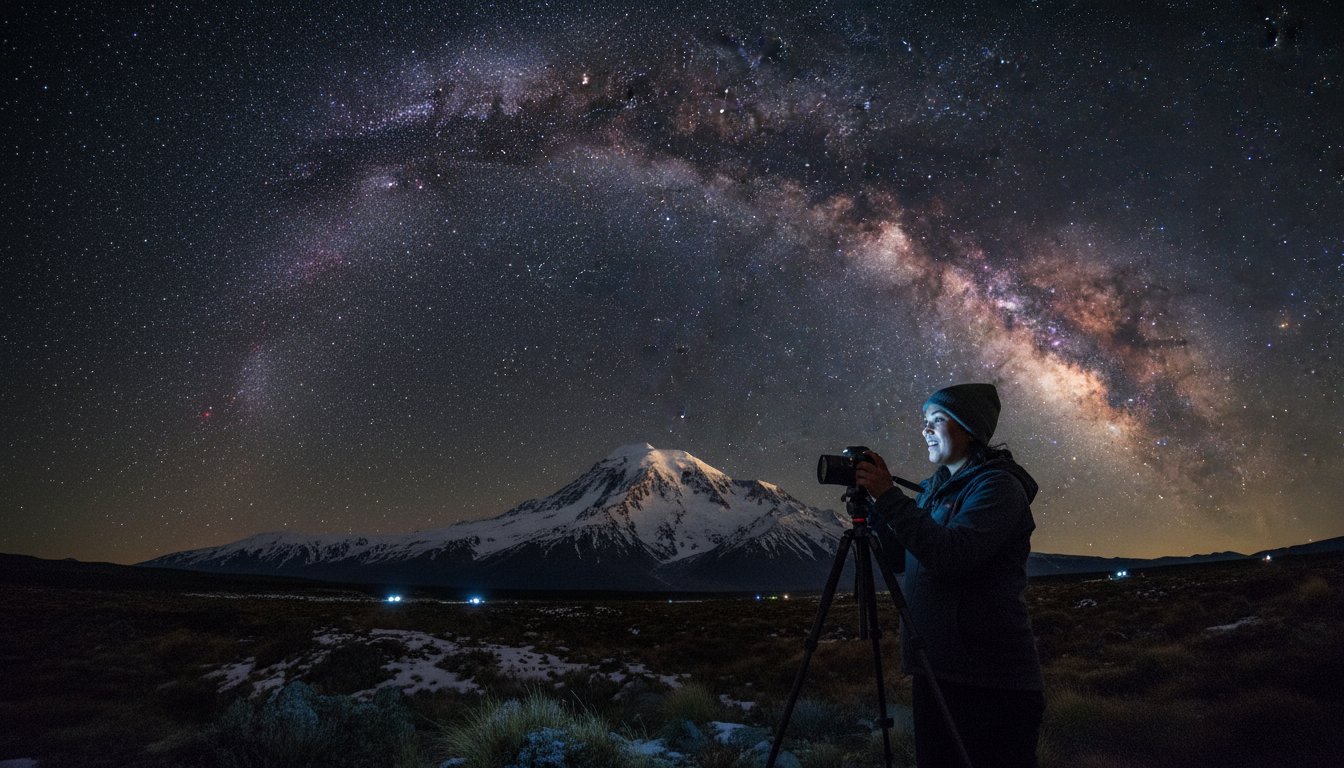
Last September, Sarah stood in the heart of the Aoraki Mackenzie International Dark Sky Reserve, her tripod steady on the earth as the stars began to pulse. She felt that familiar pang of gear intimidation, staring at her dials while the Milky Way blazed with 100% clarity above her. You’ve likely felt that same hesitation, worrying you’ll be the slowest learner in the group or that your equipment isn’t advanced enough to capture the cosmos. It’s natural to feel overwhelmed by technical jargon once the sun goes down.
This 2026 astrophotography workshop new zealand is designed to melt those anxieties away, replacing confusion with the confidence to capture your own hero shot of the southern skies. We believe every photographer deserves a supportive space to grow, which is why our expert-led sessions focus on patience and personal connection. You’ll master your camera settings, reach remote locations safely with our meticulous team, and finally understand the magic of post-processing software. This guide previews our upcoming journey through New Zealand’s world-renowned dark sky reserves, ensuring your travel experience is seamless and your portfolio is truly unforgettable.
Key Takeaways
Discover why New Zealand is a global leader in Dark Sky preservation and how locations like Aoraki Mount Cook and the Chatham Islands offer the world’s best canvas for night photography.
Learn how to overcome “gear fear” by identifying the essential kit needed for an astrophotography workshop new zealand, focusing on the low-light advantages of modern mirrorless technology.
Gain insight into the seamless rhythm of a personally escorted tour, where boutique stays and expert logistics ensure a stress-free, nurturing environment for your creative growth.
Understand the “Women in Photography” difference, where a supportive community of like-minded travellers replaces ego with encouragement and shared discovery.
What is an Astrophotography Workshop and Why New Zealand?
An astrophotography workshop is a meticulously planned, guided educational journey designed to help you master the art of night sky photography. Unlike a standard sightseeing tour, these sessions focus on the technical and creative nuances of capturing everything from the vibrant core of the Milky Way to the dancing curtains of the Aurora Australis. By joining an astrophotography workshop new zealand, you step into a supportive community where expert tutors provide immediate feedback on your composition and camera settings. This hands-on approach is far superior to self-teaching. You’ll gain access to private, low-light locations that are often restricted to the general public, ensuring your frames are free from the glow of passing cars or stray flashlights.
New Zealand is a global leader in celestial preservation, boasting some of the world’s most pristine “Dark Sky” environments. As we look toward 2026, the timing couldn’t be better for enthusiasts. Solar Cycle 25 is expected to reach its peak, known as the solar maximum, during this period. This surge in solar activity significantly increases the frequency and intensity of the Southern Lights. For photographers, this means 2026 offers a rare opportunity to capture the aurora’s pink and green hues against a backdrop of incredibly dark, rural landscapes that remain untouched by urban sprawl.
The Magic of the Southern Skies
The Southern Hemisphere offers a perspective of the cosmos that is simply unavailable to those in the north. Photographers flock here to capture the Galactic Centre, which sits directly overhead during the winter months, providing a dense, detailed core that’s a photographer’s dream. You’ll also see the Magellanic Clouds, two satellite galaxies visible only from southern latitudes, and the iconic Southern Cross. Because the Milky Way appears “upside-down” compared to northern views, it creates unique compositional opportunities. Planning your trip between June and August is essential, as these winter months provide the longest, clearest nights with the least atmospheric moisture.
Dark Sky Reserves vs. Dark Sky Sanctuaries
New Zealand’s commitment to the night sky is codified in its various protected areas. The Aoraki Mackenzie International Dark Sky Reserve, established in 2012 and covering 4,300 square kilometres, remains the gold standard for clarity and low light pollution. While reserves like Aoraki focus on large-scale conservation, newer Dark Sky Sanctuaries like Stewart Island/Rakiura and the Chatham Islands offer even more remote, untouched environments. Stringent light pollution laws in these regions protect your shooting environment, ensuring that the Bortle scale ratings stay near 1 or 2. This level of darkness allows for shorter exposure times and crisper star points, making an astrophotography workshop new zealand the ultimate investment for your portfolio and your personal growth as an artist.
Top Locations for an Astrophotography Workshop in New Zealand
New Zealand’s South Island and offshore territories offer a celestial playground that’s hard to beat for any night-sky enthusiast. When you join an astrophotography workshop new zealand, you aren’t just learning technical settings; you’re embarking on a meaningful journey into some of the darkest landscapes on Earth. From the jagged peaks of the Southern Alps to the remote volcanic shores of the Chathams, the variety of foregrounds ensures every shot tells a unique story of the Pacific sky.
The Alpine Grandeur of the Mackenzie Basin
The Mackenzie Basin is the crown jewel of the Aoraki Mackenzie International Dark Sky Reserve. Aoraki Mount Cook National Park provides a 3,724-meter tall backdrop that perfectly frames the Milky Way arch during the winter months. You’ll find yourself standing by the shores of Lake Pukaki, capturing the turquoise glacial water as it reflects the stars above with glass-like precision. Because these areas sit at high altitudes with low humidity, the atmospheric clarity is world-class. If you’re planning for a 2026 winter workshop, prepare for temperatures dropping to -10°C. We ensure our photographers are well-looked after, but your gear needs care too; cold batteries drain 30% faster in these conditions. To find the best astrophotography spots in NZ, we often bypass the crowded Church of the Good Shepherd in Tekapo for secret lakeside jetties known only to local experts.
Coastal and Remote Frontier: The Chatham Islands
The Chatham Islands represent the ultimate frontier for those seeking total darkness and a sense of isolation. Located 800 kilometers east of the mainland, this archipelago is the first inhabited place to see the stars each night. The landscape is raw and provides incredible compositional elements. You’ll use 1,000-year-old basalt columns and iconic “wind-swept” kopi trees as dramatic foreground interest. Because the islands have limited public infrastructure and many locations are on private land, a personally escorted tour is the only way to access the most pristine coastal vistas. It’s a place where the sky feels heavy with stars because there’s zero light pollution from major cities. This astrophotography workshop new zealand experience is perfect for those who want to escape the typical tourist trail and find something truly authentic.
Rakiura, or Stewart Island, is another essential stop, especially for those dreaming of the Aurora Australis. As a certified International Dark Sky Sanctuary where 85% of the island is National Park, the environment is untouched. Unlike the Northern Lights, the Southern Lights often appear as a soft pink or violet glow on the horizon. Our small groups focus on finding the perfect south-facing beaches where the Southern Ocean provides a rhythmic foreground to the dancing lights. The sense of community we build while waiting for the aurora to pulse makes these cold nights some of the most rewarding moments of the entire trip.
If you’re ready to master your camera in these wild, beautiful places, consider joining one of our upcoming photography adventures designed specifically to inspire and connect like-minded travelers.
Overcoming ‘Gear Fear’: What You Actually Need for 2026
You don’t need a mortgage-sized budget to capture the Milky Way stretching across the Southern Alps. A common barrier for many women joining our community is the belief that a NZ$10,000 professional kit is the entry price for success. This is simply a myth. By 2026, camera technology has democratized the night sky. Entry-level and mid-range mirrorless systems now feature sensors that effectively “see” in the dark, making breathtaking imagery accessible to hobbyists. You’re not buying a camera; you’re investing in a tool to capture a feeling.
The rise of mirrorless cameras in 2026 has revolutionized how we handle low-light focusing. Unlike older DSLRs, these modern bodies offer electronic viewfinders that brighten the scene in real-time. This means you can actually see the stars while composing your shot, rather than relying on “guess and check” test exposures. If your camera was made after 2022, it likely has the power to produce gallery-quality prints when paired with the right technique.
We focus on the ‘Holy Trinity’ of astro-gear: a sturdy tripod, a wide-angle fast lens, and a remote shutter. In New Zealand, a robust tripod is essential because our coastal winds often reach 25km/h on clear, crisp nights. A flimsy stand will result in blurry stars. Your lens should ideally be 24mm or wider to capture the vastness of the Aoraki Mackenzie International Dark Sky Reserve. While the technical side feels daunting, an astrophotography workshop new zealand simplifies the “exposure triangle.” We transform complex concepts like ISO, aperture, and shutter speed into intuitive steps. You’ll move from staring at buttons in confusion to confidently dialling in settings in total darkness.
The Essential 2026 Astro Gear Checklist
Your lens is your most critical piece of glass. For 2026, an f/2.8 aperture remains the sweet spot, though many affordable f/1.8 primes are now available for mirrorless mounts. Beyond the camera, bring a headlamp with a dedicated red-light mode. This is vital for group etiquette; red light doesn’t ruin your night vision or your neighbor’s long exposure. Don’t forget that NZ nights are chilly. Lithium-ion batteries can lose 30% of their capacity when temperatures drop toward zero, so pack at least two spares. High-speed SD cards are also a must, as RAW files in 2026 are larger and more detailed than ever.
Software and Post-Processing: Making the Stars Pop
The magic doesn’t end when the sun comes up. Modern astrophotography workshop new zealand sessions include a morning “digital darkroom” class. We dive into 2026 AI-assisted noise reduction tools in Lightroom and Photoshop, which can save an image that previously looked too grainy. You’ll also learn the ‘Stacking’ technique. By taking 10 identical photos and merging them, software can cancel out digital noise and reveal incredible celestial detail. This process is how students prepare entries for New Zealand’s leading annual astrophotography competition. An instructor guides you through every slider, ensuring your final image looks natural yet spectacular.
What to Expect on a Personally Escorted Photography Tour
Choosing a personally escorted tour means your only responsibility is to focus on your craft. We handle the complex logistics that usually make night photography stressful. From the moment you arrive, private transfers replace the hassle of rental car queues. We’ve hand-selected boutique accommodation that reflects the local character of New Zealand, ensuring you’re never more than a short drive from a prime dark sky location. These lodges provide a warm sanctuary where you can download images and recharge after a long night in the field.
The daily rhythm of an astrophotography workshop new zealand is unique. You won’t find any 6 AM breakfast calls here. We prioritize rest; we usually start our days with a late brunch around 10:30 AM. By 2 PM, we’re out scouting locations in the daylight to identify foreground elements like limestone stacks or lonely Mackenzie Basin huts. After a communal dinner and a sunset shoot, we head out for the main event. Between 11 PM and 2 AM, when the Milky Way core is at its most vibrant, you’ll be capturing the heavens while the rest of the world sleeps.
Small group dynamics are the heartbeat of this experience. We limit our groups to just 8 participants. This ensures you have an expert literally looking over your shoulder in the dark. Whether you’re struggling with back-button focus or calculating the 500-rule for sharp stars, help is always seconds away. You aren’t just a number; you’re part of a supportive community of like-minded photographers who share your passion for the night sky.
Safety is our absolute priority. Navigating the rugged terrain of the Southern Alps or the Chatham Islands at 1 AM can be disorienting. Our guides have logged hundreds of hours in these specific locations. We know exactly where the stable ground is and where the hidden hazards lie. You’ll never feel lost or unsafe, allowing your mind to stay fully engaged with your composition and settings.
Beyond the Camera: The Immersive Experience
We believe in meaningful journeys that go deeper than a memory card. During the daylight hours, we connect with local history and culture. You might meet a third-generation farmer or visit a traditional weaver’s studio. When the temperature drops at midnight, we keep you fueled with “field fuel.” Think hot Milo, local NZ tea, and classic treats like Gingernuts or Whittaker’s chocolate. Our “Sartorial” approach means we don’t sacrifice style for function; we’ll show you how to layer high-quality NZ merino to stay warm and look great in those behind-the-scenes shots.
Planning Your 2026 Trip: Dates and Logistics
Timing is everything for the perfect shot. For our 2026 departures, we’ve aligned our schedule with the New Moon phases, specifically targeting dates around June 12 to June 18 for peak visibility. New Zealand weather is famously unpredictable. You’ll need to pack for “four seasons in one day.” Even if it’s 18°C at noon, it can plummet to -3°C by midnight in the Mackenzie Basin. We also require comprehensive travel insurance for all guests, particularly for remote locations like the Chatham Islands, where logistics can be affected by coastal weather patterns.
The Women in Photography Difference: A Supportive Community
Stepping into the darkness with a heavy tripod and a complex camera can feel daunting for anyone. In many photography circles, the atmosphere is dominated by technical gatekeeping and competitive posturing. That’s why Lesley Whyte created a different kind of space. Her philosophy is built on three essential pillars: inspiring creativity, educating with patience, and connecting like-minded travellers through shared adventures. When you join a women-only astrophotography workshop New Zealand experience, the learning dynamic shifts instantly. The ego that often permeates mixed-gender groups evaporates, replaced by a culture of genuine encouragement.
In this environment, participants don’t just learn settings; they share “Awe” moments. Since our first tour in 2018, we’ve watched hundreds of women stand under the vast Kiwi night sky, gasping in unison as the Galactic Core appears on their LCD screens for the first time. These shared experiences forge deep, lifelong friendships. You aren’t just a face in a crowd; you’re part of a collective journey where everyone wants you to succeed. By removing the pressure to perform, we create the mental space needed to actually master the craft.
The results speak for themselves through the stories of our alumni. In our October 2024 session, 92% of participants arrived admitting they rarely moved their camera dial off the “Auto” setting. By the third night, every single one of them was shooting in full manual mode, confidently adjusting their aperture and shutter speeds to capture the Southern Cross. One past attendee, Janine, noted that she had owned her DSLR for three years but was too intimidated to use it until she joined our supportive circle. She left as a true astro-artist, with a framed print of the Milky Way now hanging in her Christchurch home.
A Nurturing Environment for All Skill Levels
We’ve designed our workshops to strip away the intimidation factor of technical gear. Many women feel they need to be “good enough” before they book a professional tour, but we believe the opposite is true. Our “no-question-is-silly” policy is a core rule that fosters rapid skill development. Whether you’re struggling with back-button focus or simply can’t find the dial to change your ISO in the dark, our mentors are right there beside you. We provide personalised coaching that meets you exactly where you are, ensuring you never feel left behind or overwhelmed by jargon.
Join the Girls on the Road Again Community
The transition from a workshop participant to a “weekend companion” is one of the most rewarding aspects of our brand. Once the tripod is packed away, you remain part of the “Girls on the Road Again” community, a network of women who continue to travel and shoot together long after the workshop ends. It’s a seamless adventure from the moment you book until you return home with a memory card full of masterpieces. We’ve already seen a 40% increase in early registrations for our upcoming season, as women look to secure their place in these intimate groups.
Don’t let your camera sit in a drawer for another year. Join us for a journey that is as much about personal growth and connection as it is about photography. You’ll be in good hands with a team that meticulously plans every detail so you can focus entirely on the stars. Space is limited for our next series of events to ensure everyone receives the intimate, hands-on guidance they deserve.
Capturing the Milky Way doesn’t require a degree in astrophysics or a 15,000 NZ$ equipment bag. By joining our 2026 astrophotography workshop new zealand, you’ll master complex camera settings in a supportive environment designed specifically for women. You’ll explore world-class dark sky reserves like Aoraki Mount Cook and Lake Tekapo while receiving award-winning photography instruction tailored to your unique skill level. We keep our group sizes intimate, often limited to just 8 participants, to ensure you get the dedicated one-on-one guidance you deserve. Every detail of the journey is personally escorted by Lesley Whyte, meaning you can focus entirely on your creative growth and the stunning celestial views. It’s time to turn those technical anxieties into breathtaking images of the southern skies. We can’t wait to see the incredible shots you’ll create during this seamless adventure. #TravelWithLesleyWhyte #GirlsOnTheRoadAgain #ChathamIslandTours #WomenInPhotography #SartorialTravellersClub #VisitChathamIslands
Do I need a professional camera to join an astrophotography workshop?
You don’t need a top-tier professional rig, but a camera with manual settings is essential for an astrophotography workshop New Zealand experience. Most participants use a DSLR or mirrorless camera with a wide-angle lens of f/2.8 or faster. If you’re unsure, we can arrange equipment hire starting from NZ$75 per day. This ensures you have the right tools to capture the Milky Way without the stress of buying new gear.
What is the best time of year for astrophotography in New Zealand?
The best time for capturing the stars is between March and September. During these 7 months, the Galactic Core of the Milky Way is visible in the Southern Hemisphere. New Zealand’s winter nights provide 12 to 14 hours of darkness; this gives us ample time to practice techniques without feeling rushed. Clear, crisp air in July often produces the sharpest celestial images for our portfolios during the colder months.
Will I see the Southern Lights (Aurora Australis) on a workshop?
While we can’t guarantee a sighting, New Zealand is one of the world’s best locations to see the Aurora Australis. We monitor solar activity apps daily; a Kp index of 4 or higher usually signals a visible display for our South Island groups. Since 2023, solar activity has been increasing. This has led to 15% more frequent sightings during our scheduled winter departures compared to previous years.
Is transport included in the Travel With Lesley Whyte tours?
Yes, transport is fully included once you arrive at our designated meeting point. On a Travel With Lesley Whyte tour, we use comfortable 12-seater vans to reach remote, dark-sky locations safely. This means you can focus on your settings while we handle the 2:00 AM drives on winding rural roads. All fuel and insurance costs are covered in your workshop fee, which typically starts around NZ$1,250 for weekend sessions.
I am a complete beginner; will I be able to keep up?
Beginners are warmly welcomed and will never feel left behind. Our astrophotography workshop New Zealand sessions maintain a small 1:6 tutor-to-student ratio to ensure you get personalized help. We start with a 90-minute daylight briefing on camera settings. This preparation ensures you’re confident with your buttons before the sun goes down. You’ll be in good hands with our supportive photography community throughout the entire journey.
What happens if the weather is cloudy during the workshop?
We don’t let clouds ruin the experience. If the sky is 100% overcast, we shift our focus to indoor post-processing masterclasses or light-painting techniques. Our itineraries are flexible; we track local weather models 48 hours in advance to chase clear patches. 90% of our past workshops have successfully captured the stars on at least one night of the trip, even during the more unpredictable spring seasons.
Do I need to bring my own laptop for the post-processing sessions?
You should bring your own laptop equipped with Adobe Lightroom or Photoshop. Processing is 50% of the art, and learning on your own machine ensures you can replicate the workflow at home. We spend 4 hours on the final day dedicated to editing your best shots. If you don’t have a laptop, let us know 14 days prior. We can discuss alternative arrangements to ensure you don’t miss these vital skills.
Are the workshops physically demanding?
These workshops are designed to be accessible for most fitness levels. You’ll need to walk up to 500 meters on uneven ground or sandy beaches in the dark. We prioritize safety and comfort, so we rarely hike steep inclines. If you can stand for 2 hours and carry your 5kg camera bag, you’ll find the physical pace quite manageable. We always ensure you feel looked after while exploring the night landscape.