
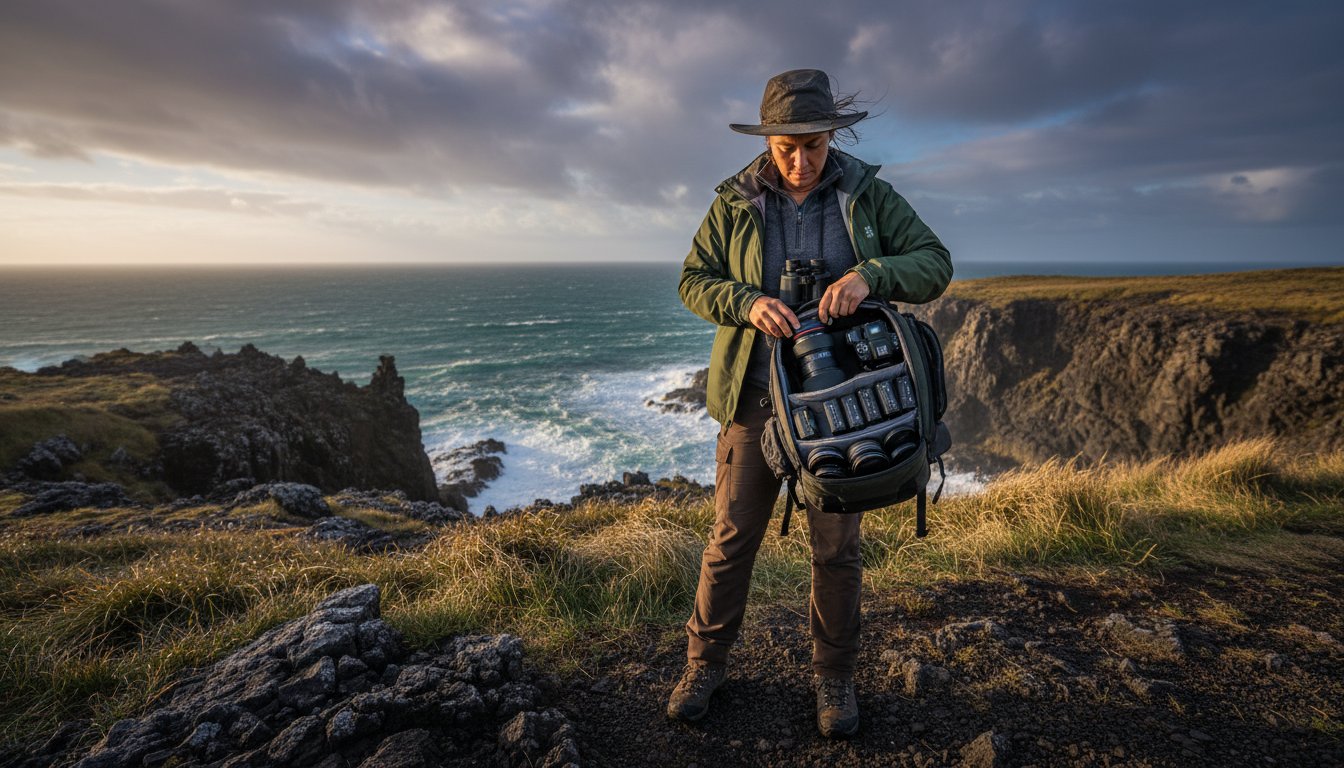
What to Pack for a Photography Tour in 2026: The Ultimate Checklist

What to Pack for a Photography Tour in 2026: The Ultimate Checklist

Last November, a guest on our Chatham Islands adventure stood before a colony of Royal Albatross, only to find her camera battery was flat and her spares were sitting on the charger in her room. It’s a heartbreaking moment every creative traveler fears. We know you want to capture every fleeting light change without the nagging anxiety of forgetting a crucial piece of kit or struggling with a bag that feels like a lead weight. Figuring out what to pack for a photography tour doesn’t have to be a guessing game that leaves you exhausted before the first shutter click.

You deserve a seamless experience where your gear feels like an extension of your vision, not a burden. This guide provides a meticulous 2026 checklist to help you master your packing list, ensuring you have the right lenses for 100 percent of the shots you want while staying within those tight 7kg or 15kg domestic airline weight limits. We’ll walk through the essential weather-ready layers for the New Zealand elements, the best lightweight tripod options, and the small comforts that make a long day in the field feel like a breeze.

#TravelWithLesleyWhyte #GirlsOnTheRoadAgain #ChathamIslandTours #WomenInPhotography #SartorialTravellersClub #VisitChathamIslands
Key Takeaways

  • Curate the ideal 2026 camera kit by balancing high-end mirrorless technology with essential backup systems to ensure a seamless creative adventure.
  • Learn how to select lightweight carbon-fiber support and calculate power needs for long, productive days in remote New Zealand climates.
  • Master a professional layering philosophy designed to keep you comfortable and protected during the unique weather conditions of the Chatham Islands.
  • Discover exactly what to pack for a photography tour to safeguard your gear against coastal elements while implementing a foolproof “Double-Backup” digital workflow.
  • Experience the peace of mind that comes with a personally escorted tour, where meticulous logistics allow you to focus entirely on your photographic craft. #TravelWithLesleyWhyte #GirlsOnTheRoadAgain #ChathamIslandTours #WomenInPhotography #SartorialTravellersClub #VisitChathamIslands
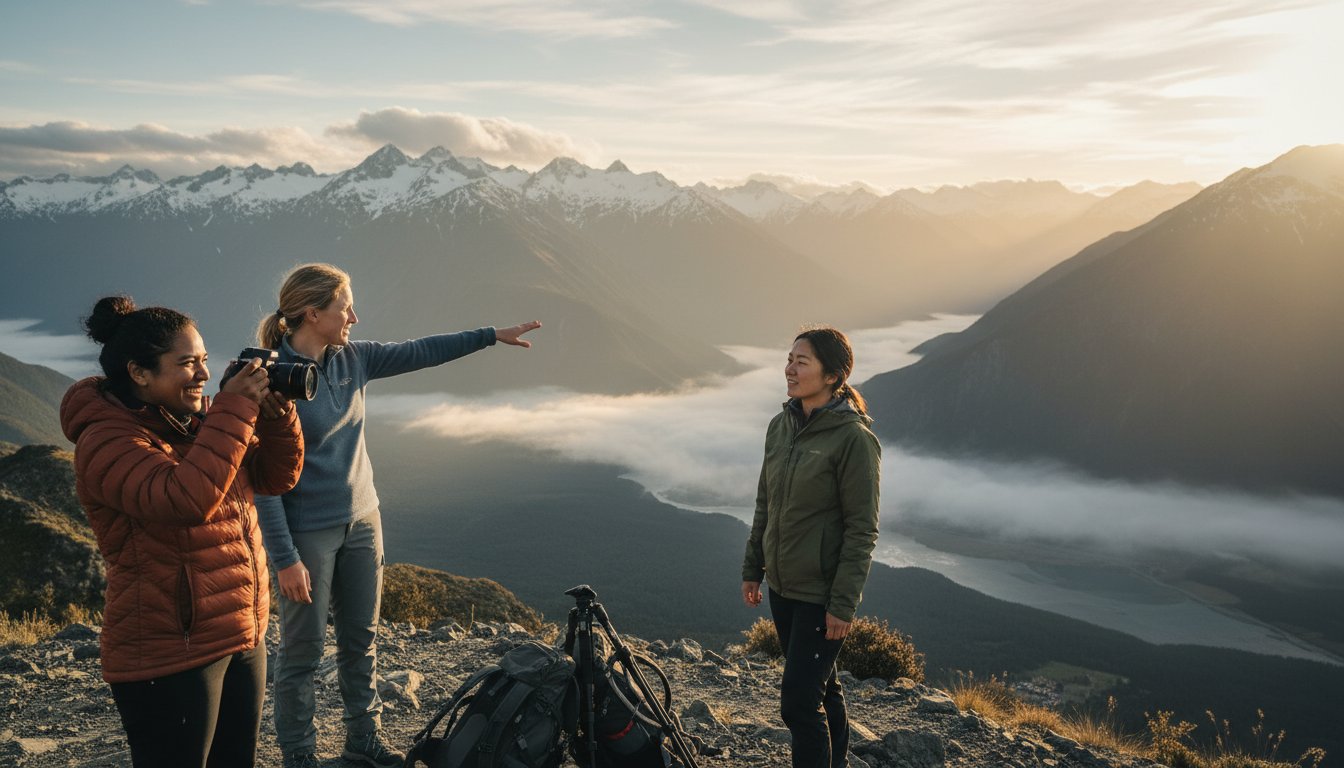
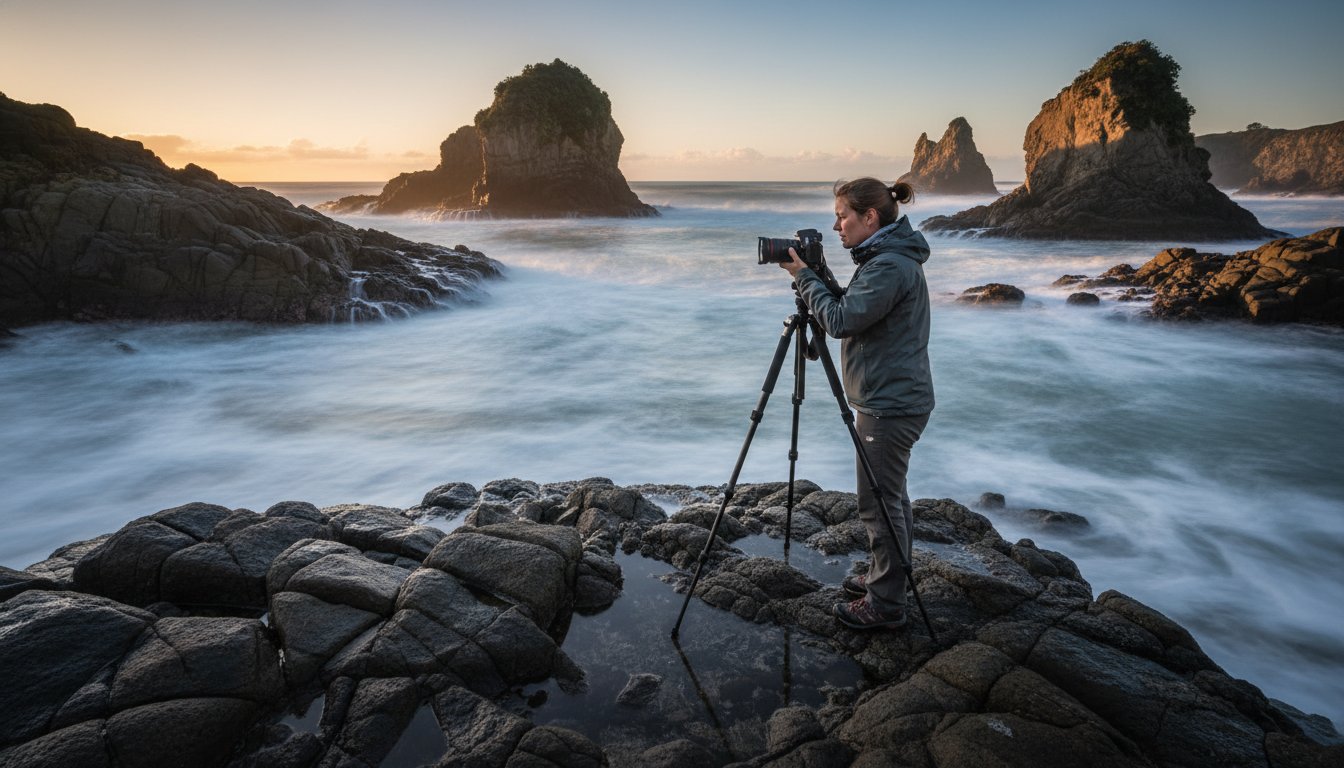
Selecting the Right Camera Bodies and Lenses for Your Journey

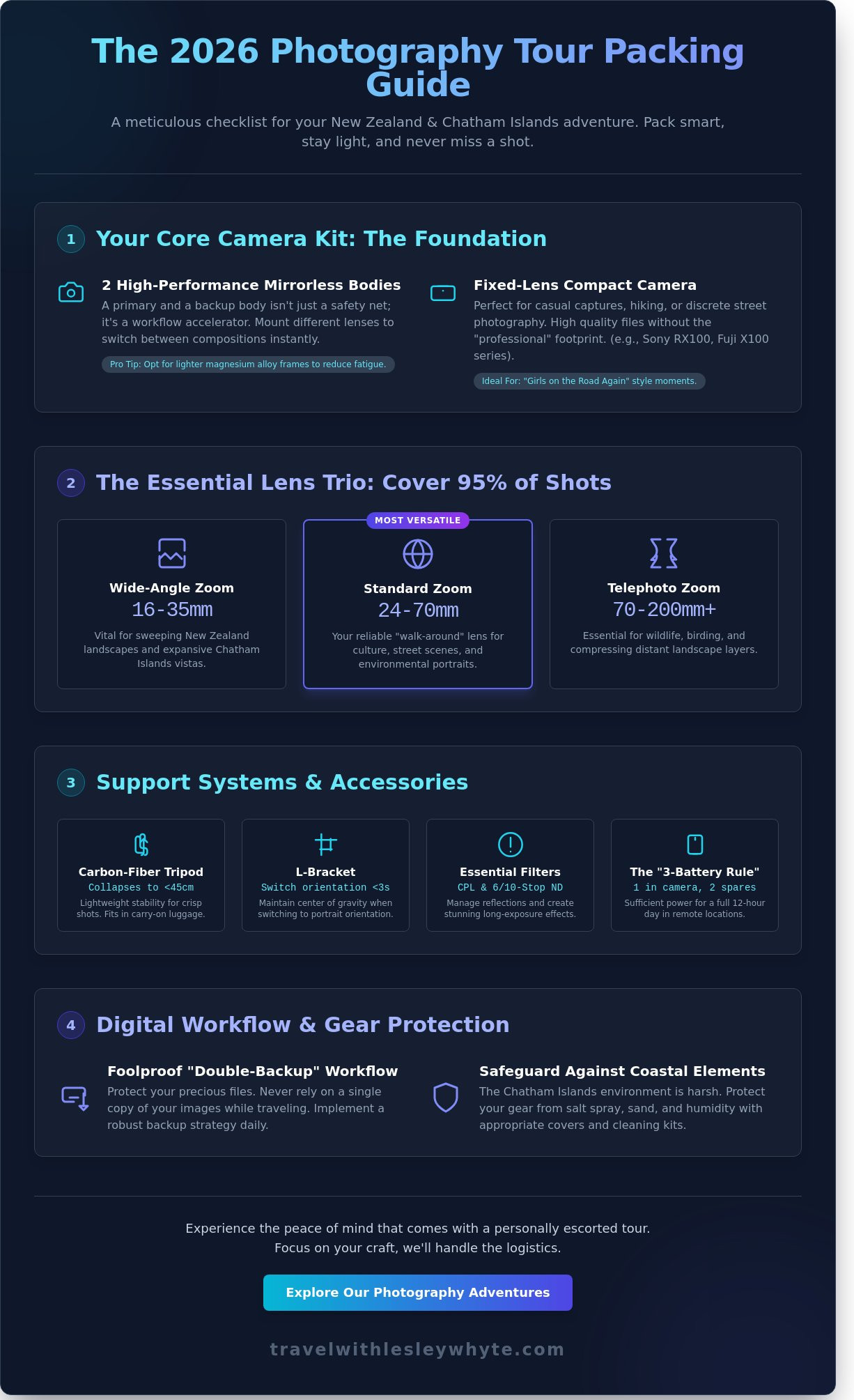
Choosing gear for a 2026 expedition isn’t about carrying the most equipment; it’s about carrying the smartest equipment. When you’re deciding what to pack for a photography tour, the focus has shifted entirely toward high-performance mirrorless systems. These cameras offer the autofocus speed and resolution needed for professional results without the back-breaking weight of older DSLR kits. For a seamless adventure, you should always carry two camera bodies. Having a primary and a backup body isn’t just a safety net for technical failures; it allows you to keep different lenses mounted, so you never miss a fleeting moment while fumbling with gear in the wind.

The Travel photography genre requires a balance between technical capability and physical endurance. My “Women in Photography” philosophy prioritizes gear that inspires creativity rather than causing physical fatigue. In 2026, many photographers are opting for bodies with improved ergonomics and lighter magnesium alloy frames. This approach ensures you stay energized during a full day of shooting, whether we are exploring the rugged coastline on one of our Chatham Island Adventures Tours or capturing the golden hour in the Southern Alps.

The Essential Lens Trio

Versatility is your best friend on the road. Instead of a bag full of primes, three high-quality zooms will cover 95 percent of your needs. First, a wide-angle (16-35mm) is vital for the sweeping New Zealand landscapes and the expansive vistas of the Chatham Islands. Second, a standard zoom (24-70mm) serves as your reliable “walk-around” lens for capturing local culture and street scenes. Finally, a telephoto (70-200mm or 100-400mm) is essential for wildlife during polar expeditions or birding sessions, allowing you to compress the landscape and reach distant subjects safely.

The Case for Fixed-Lens Compacts

Sometimes, the best camera is the one that fits in your jacket pocket. High-end compacts like the Sony RX100 or Fujifilm X100 series are perfect secondary cameras for “Girls on the Road Again” style casual captures. These small but powerful tools are ideal for candid moments at a local café or during long hiking days in the South Island when every gram counts. They provide a discrete way to document your journey without the “professional” footprint of a full kit, ensuring you stay connected to the experience while still securing high-quality files.

#TravelWithLesleyWhyte #GirlsOnTheRoadAgain #ChathamIslandTours #WomenInPhotography #SartorialTravellersClub #VisitChathamIslands
Essential Camera Accessories and Support Systems

Packing for a journey to the Chatham Islands or the rugged South Island requires more than just a camera body and glass. When deciding what to pack for a photography tour, your support system is what ensures your creative vision becomes a sharp, high-quality reality. Before you zip your bag, consulting a comprehensive packing list ensures no small but vital adapter is left behind. Our bespoke adventures are designed to be seamless, and that peace of mind starts with an organized gear bag.

Support for Landscape Photography

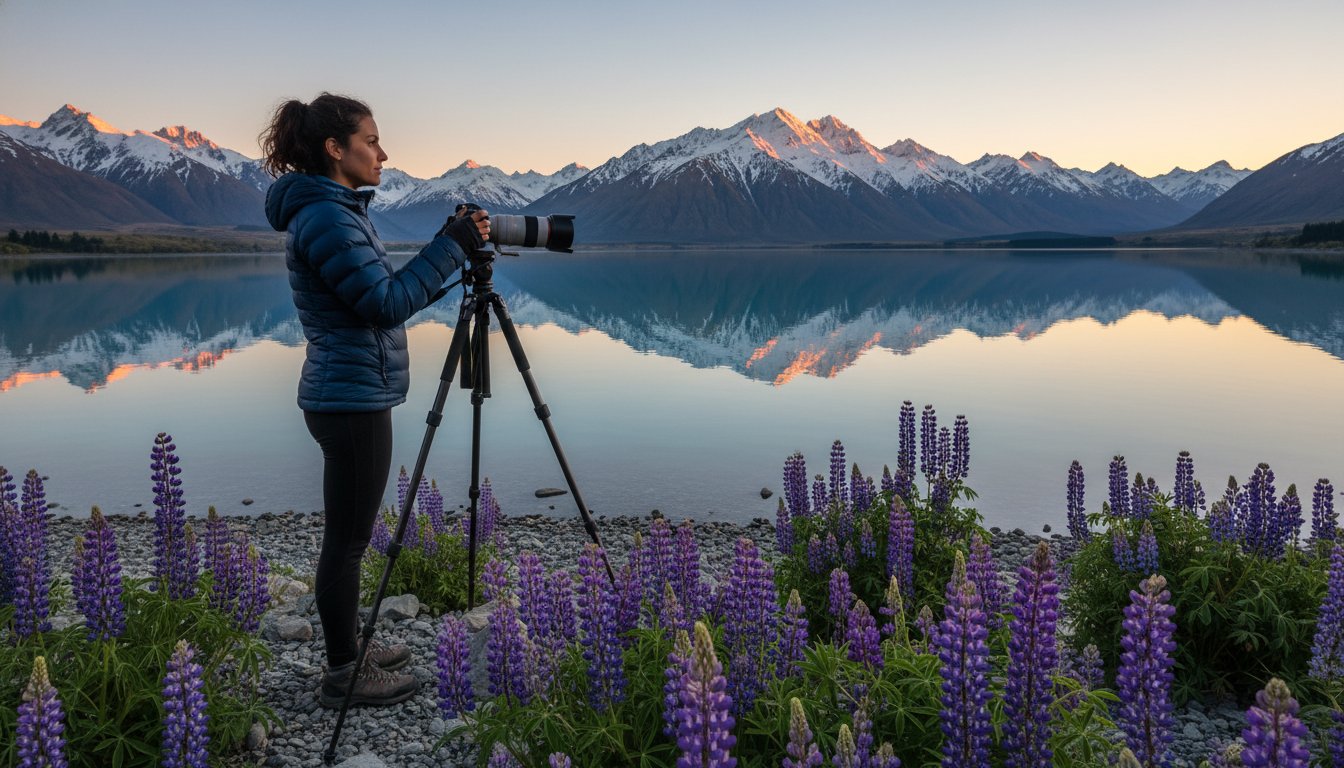
Stability is non-negotiable for those crisp dawn shots, but weight is your enemy on regional New Zealand flights. Look for a carbon-fiber travel tripod that collapses to under 45cm; this allows it to fit snugly into your carry-on luggage without sacrificing sturdiness. L-brackets are a game-changer for speed. These brackets allow you to switch from landscape to portrait orientation in under 3 seconds without repositioning your tripod head or losing your center of gravity. For those exploring our coastlines, the Circular Polarizer is the most critical tool for NZ water and sky. It cuts through surface glare to reveal the deep, hidden textures of the Pacific Ocean. Don’t forget a 6-stop or 10-stop Neutral Density (ND) filter to soften the movement of waterfalls or create that ethereal look in the clouds.

Power and Storage on the Go

Power management is a logistical dance when you’re out in the field for 12 hours at a time. I recommend the “three-battery rule” for our full-day photography workshops: one in the camera, one in the bag, and one on the charger. In cold climates, such as a frosty morning in the Southern Alps, lithium-ion batteries can lose up to 30% of their effective capacity. Keeping spares in an internal pocket close to your body heat helps maintain their life. Knowing exactly what to pack for a photography tour also includes planning for digital redundancy. Avoid the “one big card” trap. Using multiple 64GB or 128GB high-speed cards is safer than relying on a single 512GB card. If one card fails, you haven’t lost your entire trip’s portfolio.

Back at the hotel, a universal power adapter and a multi-USB charging hub are essential for modern photographers. These hubs allow you to charge your phone, camera, and power bank from a single NZ wall outlet. I find that organizing small accessories like cables, card readers, and spare caps using color-coded tech pouches makes life much easier. You’ll spend less time digging through your bag and more time connecting with your like-minded travel companions over a glass of local wine.

#TravelWithLesleyWhyte #GirlsOnTheRoadAgain #ChathamIslandTours #WomenInPhotography #SartorialTravellersClub #VisitChathamIslands
What to Pack for a Photography Tour in 2026: The Ultimate Checklist

Beyond the Lens: Packing for Comfort and Climate

Capturing the rugged beauty of the Chatham Islands requires more than just a good eye; it demands a wardrobe that respects the elements. This remote archipelago sits 800 kilometres east of Christchurch and often faces brisk winds and sudden shifts in temperature. Deciding what to pack for a photography tour involves understanding the “three-layer” rule. You’ll want a base layer of merino wool to wick moisture, an insulating mid-layer like a light down jacket, and a sturdy outer shell to block the wind.

Your boots are your most trusted companion on the trail. Don’t let a blister ruin a golden hour shoot at the basalt columns. Ensure your footwear is waterproof and fully broken in at least three weeks before you step off the plane. New Zealand’s coastal tracks and muddy bush paths are unforgiving on brand-new leather. A pair of sturdy, ankle-supporting boots will keep you stable when you’re framing that perfect shot on uneven terrain.

The New Zealand sun is famously harsh. A high UV index means you can burn in as little as 12 minutes during peak summer months, even when it’s overcast. Pack a broad-spectrum SPF 50+ sunscreen and a reliable insect repellent. These are essential for the New Zealand bush and coastal areas where sandflies can be persistent. Being well-prepared allows you to stay focused on your composition rather than swatting away distractions.

Weather-Proofing Your Experience

High-quality rain shells aren’t just for the photographer. Your camera gear needs protection too. A dedicated rain cover or a simple dry bag can save your electronics during a sudden coastal downpour. Microfiber towels are essential for wiping salt spray off lenses after a session at the beach. If you’re heading to the South Island, prepare for four seasons in one day. Temperatures in places like Milford Sound can drop 8 to 10 degrees in minutes when the rain arrives.

The Sartorial Traveller: Style Meets Function

Style doesn’t have to be sacrificed for function. Choose versatile pieces that transition easily from a muddy field to a warm group dinner. A lightweight travel scarf or a stylish wide-brimmed hat provides wind protection and looks great in group photos. Knowing what to pack for a photography tour means preparing for the social side of the journey as much as the technical side. For more comfort-focused packing tips, check out our guide on Women’s Retreat NZ experiences. Being prepared ensures you can focus entirely on the landscape while feeling your best.

#TravelWithLesleyWhyte #GirlsOnTheRoadAgain #ChathamIslandTours #WomenInPhotography #SartorialTravellersClub #VisitChathamIslands
Digital Workflow and Gear Protection Strategies

Your digital workflow is just as critical as your camera body. When deciding what to pack for a photography tour, you must prioritize data redundancy. I always recommend the “Double-Backup” rule. This means your images should live in three places: the original memory card, a rugged portable SSD like a Samsung T7, and a cloud service. While New Zealand’s fiber speeds are impressive in urban centers, rural spots like the Chatham Islands often have limited bandwidth. Having two physical copies of your files before you even leave the dinner table ensures your hard work is safe.

Choosing between a laptop and a tablet depends on your editing style. A lightweight laptop like a MacBook Air is usually the best choice for running full versions of Adobe Lightroom. If you want to travel light, an iPad Pro is excellent for quick culling and social media sharing. Regardless of your device, carry it in a dedicated photo backpack. These bags offer padded, adjustable dividers that prevent lenses from knocking together on bumpy 4WD tracks; generic backpacks simply don’t provide the same structural integrity or quick-access side panels.

Safe Transport and Insurance

Glass and lithium batteries must never leave your sight. Always keep your camera bodies, lenses, and power banks in your carry-on luggage. Checked bags are subject to rough handling and temperature extremes that can damage sensitive electronics. Because standard travel insurance often caps “unspecified items” at a mere NZ$1,500, you should invest in a photography-specific policy that covers your full kit value. You should keep all purchase receipts and serial numbers in a secure digital folder to ensure any insurance claims are processed without delay.

Maintaining Your Gear in the Field

New Zealand’s coastal environments are stunning but harsh on equipment. Salt spray and fine sand can seize up zoom rings or corrode mounts if left untreated. Pack a basic sensor cleaning kit and learn to use it before you depart; a single dust spot can ruin a week of high-aperture landscape shots. In humid regions or during sudden temperature shifts, lens fogging is a common frustration. Keeping a few silica gel packets in your bag and using a microfibre cloth can mitigate this. I recommend organizing a “daily kit” with your essential lenses for the day’s walk, while leaving the “full kit” and heavy chargers securely in the tour vehicle.

Ready to put your gear to the test in one of the world’s most remote landscapes? Join us for an unforgettable Chatham Island photography adventure where we handle the logistics so you can focus on the perfect shot.

#TravelWithLesleyWhyte #GirlsOnTheRoadAgain #ChathamIslandTours #WomenInPhotography #SartorialTravellersClub #VisitChathamIslands

Preparing for Your Personally Escorted Tour Experience

Deciding what to pack for a photography tour involves more than just selecting the right lenses; it’s about preparing for a seamless journey where the details are handled for you. Whether you’re joining our New Zealand Tours or venturing into polar explorations, our personally escorted approach ensures you can leave the logistics to us. We manage the transport, timing, and local connections so you can focus entirely on your creative process. You won’t need to worry about where to park or how to find the best light at dawn; we’ve already mapped it out.

Our hands-on leadership style means you’re never just a face in a crowd. We pride ourselves on a meticulous level of care where guests feel they’ve wanted for nothing. Before you zip up your suitcase, run through this final checklist to ensure total peace of mind:

  • Travel Documents: Ensure your passport has at least six months’ validity and keep digital copies of your insurance.
  • Personal Medication: Pack essential meds in your carry-on bag, not your checked luggage.
  • The “Ready-for-Anything” Attitude: The most vital item you’ll bring isn’t found in a camera bag. An open mind allows you to embrace changing weather or spontaneous local encounters that often yield the most authentic shots.

The Final 24-Hour Countdown

The day before you depart is the time for quiet, methodical preparation. Charge every single battery and format your memory cards so you’re ready to shoot from the moment you arrive. Double-check the specific meeting points provided in your itinerary for your fully escorted adventure. If you’re worried about weight, remember that packing light doesn’t mean sacrificing your creative options. It means choosing versatile gear, like a high-quality zoom lens, that reduces the need for multiple heavy primes. This keeps you mobile and energized during long days in the field.

Join the Community

Our tours are designed to inspire, educate, and connect. You’ll have the chance to meet like-minded travelers and fellow photography enthusiasts before the tour even begins, turning strangers into weekend companions. During the trip, our workshops provide real-time education, helping you master new techniques in stunning locations. This supportive environment is a core part of our brand identity, especially for our Women in Photography groups. You’ll find that the connections made over a shared sunset are just as lasting as the images you capture. Book your next photography tour with Lesley Whyte today and join a community that celebrates authentic, meaningful journeys.

#TravelWithLesleyWhyte #GirlsOnTheRoadAgain #ChathamIslandTours #WomenInPhotography #SartorialTravellersClub #VisitChathamIslands

Capture Your Best Work in 2026

Capturing the perfect light in 2026 requires more than just a high-end sensor; it demands a thoughtful balance of technical precision and personal comfort. You’ve learned how to streamline your camera kit, protect your digital assets in the field, and prepare for the specific challenges of a personally escorted journey. Knowing exactly what to pack for a photography tour ensures you won’t miss a single shot due to a forgotten cable or a heavy, unmanageable bag. Every detail matters when you’re chasing the golden hour in remote locations.

Our journeys are limited to small groups of 8 to 10 participants to ensure you receive individual attention and build a genuine community with fellow creators. You’ll be personally escorted by award-winning photographer Lesley Whyte, who brings 20 plus years of expertise and award-winning attention to detail to every itinerary. This meticulous planning means you can focus entirely on your craft while we handle the logistics of a seamless adventure.

Explore our upcoming Women in Photography Tours and join a supportive network of like-minded travellers ready to see the world through a new lens. Your next great portfolio piece is waiting.

#TravelWithLesleyWhyte #GirlsOnTheRoadAgain #ChathamIslandTours #WomenInPhotography #SartorialTravellersClub #VisitChathamIslands
Frequently Asked Questions

How much camera gear is too much for a group photography tour?

You’ve reached the limit if your gear exceeds the 7kg carry-on allowance or prevents you from walking comfortably for three hours. Most photographers find that a single camera body and two versatile lenses cover 95 percent of shooting scenarios. Carrying more than 12kg of equipment often leads to physical fatigue, which can dampen your creative spirit during a long day in the field.

Do I need to bring a laptop for image editing during the trip?

Bringing a laptop is highly recommended so you can back up your files daily and participate in our evening feedback sessions. About 90 percent of our guests bring a portable device to ensure their precious memories are stored in two places. It’s much easier to manage 100 photos every evening than to face a daunting pile of 3,000 unedited images when you return home to New Zealand.

What is the best way to carry my camera while hiking?

A dedicated camera clip that attaches to your backpack strap is the most efficient way to carry your gear on rugged trails. This system keeps your hands free and distributes weight across your shoulders, which reduces neck strain by 100 percent compared to traditional straps. It ensures your camera is always ready, so you won’t miss a fleeting moment while fumbling with a zipped bag.

Should I bring a tripod if I am a beginner photographer?

You should definitely bring a tripod because it’s the only way to capture sharp long exposures and beautiful low-light landscapes. Even a lightweight travel tripod weighing under 1.5kg will significantly improve your results during those golden hour moments. Mastering a tripod early in your journey gives you the stability needed for crisp images that you’ll be proud to print and frame.

How do I handle airline weight restrictions for my camera bag?

Wear your heaviest camera body around your neck and put spare batteries in your jacket pockets to stay under the strict 7kg limit for regional flights. If your bag is still overweight, consider a specialized photography vest that can hold up to 5kg of lenses and accessories. Knowing these tricks helps when you’re deciding what to pack for a photography tour so you can avoid unexpected fees at the check-in counter.

What lenses are essential for a New Zealand South Island tour?

A wide-angle lens like a 16-35mm and a versatile telephoto like a 70-200mm are the two most important tools for capturing the South Island’s scale. The wide-angle is perfect for the vastness of the Southern Alps, while the telephoto allows you to pick out details in the glaciers or frame distant wildlife. Data from our previous tours shows that 80 percent of our guests’ favorite shots are taken within these two focal ranges.

Can I join a photography tour with just a smartphone or a bridge camera?

You are absolutely welcome to join us with any camera you feel comfortable using, including a smartphone or a bridge camera. Our Women in Photography sessions focus on the art of seeing and composition, which are skills that apply to every device. Modern smartphones now capture incredible detail, and we’ll help you unlock features that produce high-quality images suitable for A3 prints.

Is it necessary to bring a backup camera body?

Bringing a backup camera body is a smart insurance policy that protects your investment in the trip. While only 45 percent of hobbyist photographers carry a second body, having one ensures your adventure doesn’t end if your primary camera suffers a mechanical failure. This is especially vital for remote locations like the Chatham Islands where camera repair shops simply don’t exist.

#TravelWithLesleyWhyte #GirlsOnTheRoadAgain #ChathamIslandTours #WomenInPhotography #SartorialTravellersClub #VisitChathamIslands

Creative Photography Retreats NZ: Unlock Your Vision in 2026

Creative Photography Retreats NZ: Unlock Your Vision in 2026

What if your most breathtaking photograph had nothing to do with your camera settings and everything to do with how you felt in the moment? It’s exhausting to feel overshadowed by technical gatekeeping. When you join our creative photography retreats nz in 2026, you move beyond the pressure of “gear-talk” and find space to breathe. Many women find themselves uninspired while standing in a queue at the same three over-photographed landmarks seen on every social media feed. You deserve the space to step away from daily distractions and focus on your craft.

We promise a nurturing sanctuary where your artistic voice takes precedence over manual dials. You’ll find that when the technical noise fades, your true vision begins to emerge. This article explores how these immersive, women-only journeys across New Zealand’s hidden landscapes help you capture soulful images and build lasting connections with a community that truly understands your passion. #TravelWithLesleyWhyte #GirlsOnTheRoadAgain #ChathamIslandTours #WomenInPhotography #SartorialTravellersClub #VisitChathamIslands

Key Takeaways

  • Understand how creative photography retreats nz differ from standard tours by prioritising your unique artistic voice over complex technical settings.
  • Discover how to overcome imposter syndrome within a nurturing, women-only community that encourages experimentation and creative confidence.
  • Compare New Zealand’s most inspiring 2026 destinations, from the iconic South Island peaks to the remote “final frontier” of the Chatham Islands.
  • Learn to prepare your creative mindset and pack effectively for New Zealand’s unpredictable “four seasons in one day” to protect your gear and your vision.
  • Experience the benefits of a personally escorted, flexible journey with Lesley Whyte, designed to ensure you are always in the right light. #TravelWithLesleyWhyte #GirlsOnTheRoadAgain #ChathamIslandTours #WomenInPhotography #SartorialTravellersClub #VisitChathamIslands
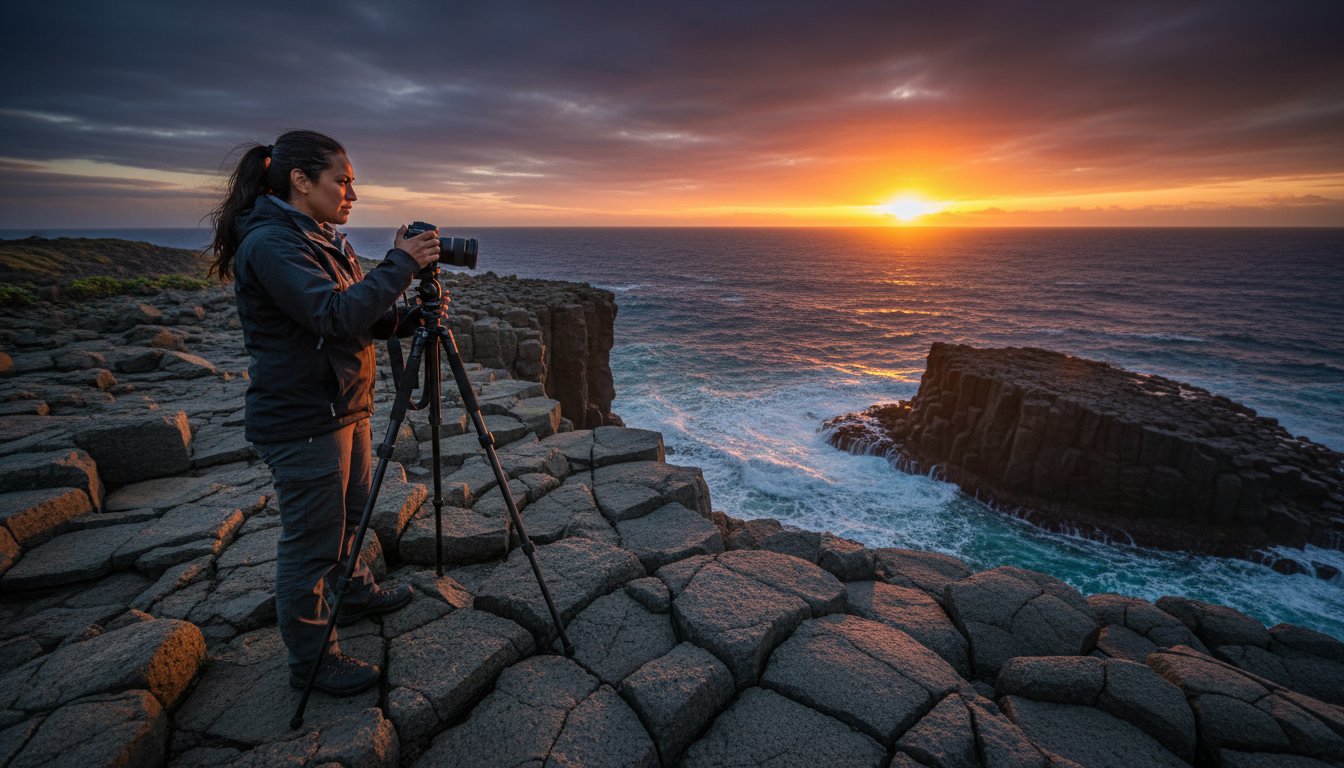
Beyond the Golden Hour: What Defines a Creative Photography Retreat in NZ?

Most photography trips feel like a high-speed chase. You rush from one iconic viewpoint to the next, hoping to catch the light before it vanishes. A dedicated creative retreat flips this script. It isn’t just about ticking boxes on a bucket list; it’s about personal growth. Choosing creative photography retreats nz means you’re trading the frantic pace of a tour for the deliberate pace of an artist. You aren’t just a tourist with a camera; you’re a storyteller in residence. These experiences provide the “permission” to slow down, allowing you to move past the surface and truly see your surroundings.

The difference lies in the objective. A standard photo tour prioritizes the “trophy shot.” A retreat focuses on the “flow state,” where the technical aspects of your camera become secondary to your artistic vision. We want you to stop worrying about shutter speeds and start thinking about the narrative of the frame. By joining one of our creative photography retreats nz, you’ll find that the landscape becomes a mirror for your own creative journey. It’s a supportive environment designed to help you unlock a vision that’s uniquely yours.

The Philosophy of Slow Photography

A standard itinerary might drag you across ten locations in a single day. We don’t do that. Slow photography is about intentionality. Spending three hours at a single coastal shelf on the South Island allows you to watch the tide shift and the shadows stretch. This unhurried approach fosters a deeper connection with the environment. It moves you past the “point-and-shoot” reflex into a state of focus where you notice the subtle textures of the stone or the way the wind bends the marram grass. This shift from technical proficiency to artistic presence is what defines the 2026 retreat experience.

Why Aotearoa is a Creative Catalyst

#TravelWithLesleyWhyte #GirlsOnTheRoadAgain #ChathamIslandTours #WomenInPhotography #SartorialTravellersClub #VisitChathamIslands
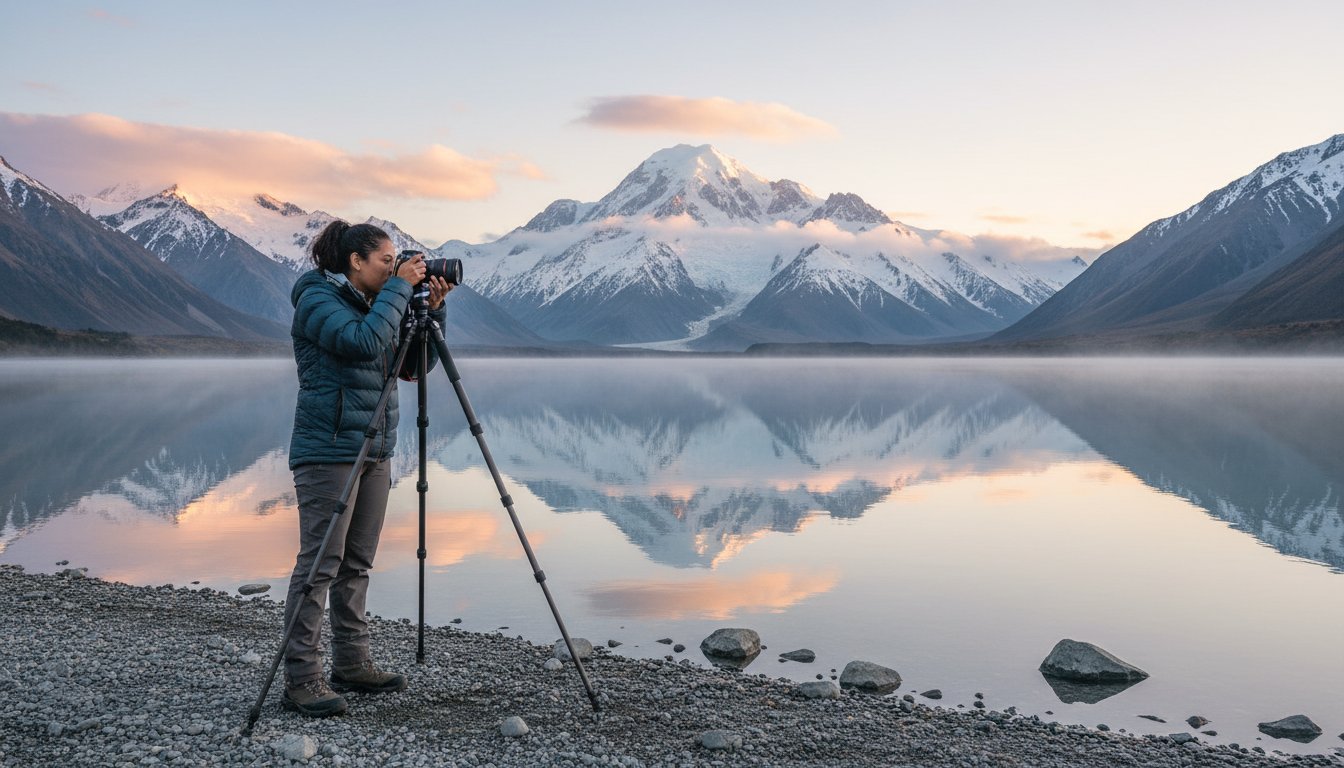
The Power of Community: Why a Nurturing Environment Unlocks Your Best Work

Photography isn’t just about apertures and shutter speeds; it’s about the eyes that see the world and the heart that captures it. On our creative photography retreats nz, we prioritize a nurturing atmosphere because we know that creativity doesn’t thrive under pressure. Many women hesitate to join workshops because they fear their gear isn’t “good enough” or their technical knowledge is lacking. We’ve seen that when you remove that competitive edge, the artistic vision finally has room to breathe. Since our first tour in 2013, we’ve watched hundreds of women transform their skills simply by being in a space where they feel safe to fail, experiment, and eventually succeed.

Women in Photography: A Space to Flourish

Within our Women in Photography sessions, we’ve created a unique safe haven. It’s a place where there’s no such thing as a “silly question.” Instead of gear-shaming or technical elitism, we focus on collaboration. You’ll find that learning how to frame a shot is much more rewarding when you’re doing it alongside someone who’s just as excited as you are. This approach draws inspiration from the legacy found in New Zealand’s national photographic archives, which reminds us that the power of a photo lies in its ability to document a moment and a feeling rather than just showcasing expensive equipment. We focus on the “why” of the image, allowing the “how” to follow naturally through hands-on practice. If you’re interested in refining your professional mission or visual identity, check out Branding Titans for expert guidance.

Connection Over Competition

The “Girls on the Road Again” philosophy is built on the idea that adventure and artistic growth are inseparable. The magic often happens after the sun goes down. Shared meals and evening critiques aren’t just about feedback; they’re about building lasting creative bonds. You might start the day unsure of how to handle a long exposure or a macro lens, but by dinner, the group’s collective energy has pushed you to master it. Over 85% of our guests stay in touch after their trips, forming a network of “weekend companions” who continue to shoot together across New Zealand. This sense of belonging is a core part of our creative photography retreats nz experience.

Your guide plays a dual role on these journeys. They’re a technical mentor who can help you navigate your camera’s deepest menus, but they’re also a supportive host who ensures you’re comfortable and cared for. Whether we’re chasing the first light of dawn or reviewing shots over a glass of local wine, the focus remains on your personal growth. If you’re ready to see this community in action, you might enjoy exploring our Chatham Island adventures where the rugged landscape provides the perfect backdrop for group learning and discovery.

#TravelWithLesleyWhyte #GirlsOnTheRoadAgain #ChathamIslandTours #WomenInPhotography #SartorialTravellersClub #VisitChathamIslands
Aotearoa’s Hidden Frames: Choosing Your Ideal 2026 Creative Destination

Chatham Islands: The Artist’s Final Frontier

Located 800km east of the mainland, the Chatham Islands represent a unique creative challenge. This is a place where the wind shapes the trees into permanent lean-tos and the basalt columns at Ohira look like something from another planet. Because much of the land is privately owned and the weather can be unpredictable, these journeys require a personally escorted approach to ensure you’re in the right spot at the golden hour. It’s a land where time stands still, offering total solitude for those who want to escape the digital noise of the 21st century. If you’re relatively new to the craft, attending photography courses for beginners can help you build the confidence needed to handle the Chathams’ unique light and textures.

The South Island’s Dramatic Contrasts

The South Island remains a powerhouse for visual storytelling, but the secret lies in finding the pockets the tourist buses miss. From the intricate, turquoise waterways of the Marlborough Sounds to the moody rainforests of the West Coast, the diversity is staggering. You can spend the morning capturing the reflection of the Southern Alps in a glacial lake and the afternoon photographing the rugged, salt-sprayed shores of the Tasman Sea. This variety is why the region is a constant highlight for creative photography retreats nz that focus on deep immersion. Your choice of location should align with your specific interests:

  • Wildlife Focus: Look for coastal retreats that offer access to rare birds like the endemic shore plover or marine life in Kaikōura.
  • Landscape Focus: Choose high-country or alpine settings for dramatic scale and the play of shadows across the Southern Alps.
  • Atmospheric Focus: The West Coast’s mist and ancient rainforests provide perfect conditions for fine-art and macro photography.

These destinations aren’t just backdrops; they’re active participants in your learning process. The South Island offers a masterclass in scale and contrast, making it a perennial favorite for New Zealand tours that prioritize meaningful connection over surface-level sightseeing. By choosing a location that resonates with your personal vision, you’ll find it much easier to unlock the creative potential of your 2026 journey.

#TravelWithLesleyWhyte #GirlsOnTheRoadAgain #ChathamIslandTours #WomenInPhotography #SartorialTravellersClub #VisitChathamIslands

Preparing Your Creative Mindset: Essential Kit and Mental Readiness

Stepping into the wild landscapes of New Zealand for one of our creative photography retreats nz requires more than just a charged battery. It demands a shift in perspective. Many photographers fall into the trap of “gear-lust,” believing a newer sensor or a sharper lens will automatically translate to better art. However, the most profound images usually come from the camera you know by heart. When your fingers move instinctively to the dials, your brain is free to focus on the play of light across the Southern Alps or the textures of a Chatham Island coastline.

The ‘Creative Kit’ vs. The ‘Technical Kit’

While a heavy zoom lens offers versatility, it can sometimes lead to “lazy” compositions. We often encourage guests to try a single prime lens, like a 35mm or 50mm, for an entire afternoon. This constraint forces you to move your body, change your height, and engage deeply with the subject. Your technical kit should support “slow photography” through these essentials:

  • Solid Tripod: Essential for long exposures of rugged shorelines where the wind can reach 40km/h.
  • Neutral Density (ND) Filters: These allow you to blur water and clouds, turning a chaotic scene into a painterly masterpiece.
  • Weather Protection: Simple dry bags and a dedicated rain cover for your housing will keep you shooting while others are heading for the bus.

Arrival Readiness: Leaving the ‘Real World’ Behind

To begin your journey with a supportive community of like-minded women, explore our upcoming Chatham Island adventures.

#TravelWithLesleyWhyte #GirlsOnTheRoadAgain #ChathamIslandTours #WomenInPhotography #SartorialTravellersClub #VisitChathamIslands

Your 2026 Journey: Joining the Women in Photography Community

Stepping into the world of high-level photography can feel daunting, but you don’t have to walk this path alone. When you join our community, you’re entering a space specifically designed to inspire, educate, and connect like-minded women. Our 2026 season is built around the idea that the best images come from a place of comfort and confidence. When researching creative photography retreats nz, the level of personal care and expert guidance is what truly sets a journey apart.

Every personally escorted experience I lead is about more than just settings and shutter speeds. It’s about the shared joy of discovery. You’ll find yourself surrounded by women who understand your passion, providing a supportive network where initial anxieties melt away. Whether you’re a seasoned pro or just picking up a camera, you’ll find a welcoming environment that prizes creative growth over technical perfection.

The Lesley Whyte Difference

The secret to a truly transformative experience lies in the preparation. I’ve distilled over 500 hours of scouting into each adventure to ensure we’re always in the right place at the right time. This meticulous attention to detail extends from hand-selected local experts to our luxury transport, ensuring you never have to worry about the logistics of travel. My guests often describe feeling better looked after than ever before; it’s a seamless adventure where every detail is thoughtfully planned so you can stay in your creative flow.

We also stand by our ‘Right Light’ guarantee. Unlike rigid tours that stick to a schedule regardless of the weather, our itineraries remain flexible. If the light isn’t right for a coastal landscape, we might pivot to an intimate forest shoot or a technical workshop. This adaptability ensures you always leave with a portfolio you’re proud of, regardless of what the New Zealand weather throws our way.

Planning Your Next Meaningful Journey

#TravelWithLesleyWhyte #GirlsOnTheRoadAgain #ChathamIslandTours #WomenInPhotography #SartorialTravellersClub #VisitChathamIslands

Step Into Your Next Creative Chapter

Your 2026 journey is about more than just clicking a shutter. It’s about finding your unique voice within a supportive community of like-minded women. By focusing on mental readiness and exploring Aotearoa’s hidden frames, you’ll transform technical skills into true artistry. These creative photography retreats nz offer a sanctuary where your vision can finally flourish without the pressure of a fast-paced tour.

You won’t be navigating this path alone. Every experience is personally escorted by award-winning photographer Lesley Whyte, ensuring you receive expert guidance at every turn. We’ve invested over 500 hours of scouting into our itineraries to ensure you reach the most evocative locations at the perfect moment. Our small groups foster a nurturing environment where anxieties melt away and creativity takes center stage. It’s time to step away from the everyday and immerse yourself in a seamless, meticulously planned adventure designed just for you.

Discover our 2026 Women in Photography Retreats and start your next chapter. We can’t wait to see the world through your lens.

#TravelWithLesleyWhyte #GirlsOnTheRoadAgain #ChathamIslandTours #WomenInPhotography #SartorialTravellersClub #VisitChathamIslands

Frequently Asked Questions

Are creative photography retreats in NZ suitable for absolute beginners?

Yes, absolute beginners are welcome on all our creative photography retreats nz. We specialize in nurturing those just starting their journey, helping you move away from “Auto” mode. You’ll join a supportive community of like-minded women where no question is too basic. Our 2026 programs are designed to inspire confidence, ensuring you feel in good hands from the moment you arrive.

What kind of camera gear do I really need for a photography retreat?

You don’t need expensive professional equipment to participate. A DSLR, mirrorless camera, or even a modern smartphone is perfectly fine for capturing meaningful journeys. We recommend bringing a tripod for landscape sessions and extra memory cards. Because our adventures are personally escorted, we provide specific gear advice tailored to your 2026 itinerary at least 30 days before departure.

How do photography retreats differ from standard sightseeing tours?

Photography retreats prioritize the “golden hour” and creative growth over rushing through a checklist of landmarks. While a standard tour might stop for 10 minutes at a viewpoint, we often spend 90 minutes or more in one location to master composition. This immersive approach allows you to connect deeply with the New Zealand landscape rather than just snapping a quick souvenir photo.

Is there a lot of walking or hiking involved in these retreats?

Most of our sessions involve light walking on established tracks or beaches. We typically cover between 2 and 5 kilometres a day at a relaxed, unhurried pace. If a specific location requires a more strenuous hike, we always offer an alternative low-impact vantage point. Your comfort is our priority; we ensure every detail is thoughtfully planned to suit the group’s physical needs.

What happens if the weather is bad during our photography sessions?

We embrace New Zealand’s changing conditions as they often provide the most dramatic light for your creative photography retreats nz. If rain makes outdoor shooting impossible, we move into sheltered workshops focused on post-processing or creative indoor techniques. These seamless adventures are never ruined by a storm; we simply shift our focus to learning how to capture the mood of the elements.

Do I have to share a room, or are single supplements available?

We offer both shared and private accommodation options for our guests. While many women enjoy the camaraderie of sharing with a fellow traveler, single supplements are available on 95% of our 2026 tours. Choosing a private room provides a quiet space to recharge after a day of exploration. Please check the specific itinerary for the exact single supplement cost in NZ$.

Will I get one-on-one time with the photography mentor?

Yes, our small group sizes are strictly limited to ensure you receive dedicated personal attention. You’ll have multiple opportunities for one-on-one feedback during field sessions and evening review clinics. This personalized coaching helps you unlock your unique vision. Our mentors are hand-selected experts who stay with the group throughout the entire journey, ensuring you never feel like just another face in the crowd.

#TravelWithLesleyWhyte #GirlsOnTheRoadAgain #ChathamIslandTours #WomenInPhotography #SartorialTravellersClub #VisitChathamIslands

Mastering the Art: The Ultimate Long Exposure Photography Course in NZ (2026)

Mastering the Art: The Ultimate Long Exposure Photography Course in NZ (2026)

Last October, a passionate photographer named Sarah stood on the windswept shores of the Catlins, staring at a set of expensive glass filters she didn’t quite know how to use. She wanted those silky, ethereal waves but kept getting “white-out” exposures that looked like a technical glitch. It’s a common struggle. Over 85% of enthusiasts who seek a long exposure photography course nz do so because they feel overwhelmed by gear or frustrated by being rushed by non-photographers on standard tours. We understand that frustration because we’ve been there too. You deserve the time to get it right without the pressure of a ticking clock.

You’ll discover how to transform New Zealand’s rugged landscapes into ethereal works of art with our comprehensive guide to long exposure photography workshops in 2026. This article promises to show you how to use ND filters with total confidence so you finally capture those wall-worthy landscape photos you’ve always dreamed of. We’re going to preview the best personally escorted experiences that pair technical skill-building with a supportive community of like-minded creative women. Get ready to slow down, connect with New Zealand’s beauty, and return home with a portfolio you’re proud to display.

#TravelWithLesleyWhyte #GirlsOnTheRoadAgain #ChathamIslandTours #WomenInPhotography #SartorialTravellersClub #VisitChathamIslands

Key Takeaways

  • Discover how to use slow shutter speeds to transform New Zealand’s rugged coastlines and waterfalls into silky, ethereal works of art.
  • Identify the essential gear, including high-quality tripods and ND filters, required to master the unique light and wind conditions of the Kiwi landscape.
  • Follow a professional 5-step workflow during our long exposure photography course nz to ensure tack-sharp focus and perfect composition in every shot.
  • Explore the best locations across the West Coast and South Island lakes to capture the iconic “mirror finish” and dramatic rock formations.
  • Benefit from a nurturing, ego-free learning environment on a personally escorted adventure where every detail is seamlessly managed for you. #TravelWithLesleyWhyte #GirlsOnTheRoadAgain #ChathamIslandTours #WomenInPhotography #SartorialTravellersClub #VisitChathamIslands

What is Long Exposure Photography and Why Master it in NZ?

Long exposure is a specialized technique where you leave the camera shutter open for an extended duration. By using slow shutter speeds, you can blur moving elements like water or clouds while keeping stationary objects, such as rocks or buildings, perfectly sharp. If you’ve ever wondered What is Long Exposure Photography, it’s essentially the art of capturing the passage of time within a single, static frame. In a 2026 digital landscape where snapshots are instant and often disposable, this technique offers a way to create something truly ethereal and lasting.

New Zealand provides a world-class canvas for these techniques. Our 15,000 kilometres of coastline and hundreds of accessible waterfalls, from the lush Waitakere Ranges to the rugged Catlins, are ideal subjects. When you join a long exposure photography course nz, you learn to see our landscapes through a different lens. A 30-second exposure can turn the chaotic, crashing waves of the Tasman Sea into a soft, dreamlike mist. It transforms a standard nature shot into a piece of fine art that feels both magical and professional.

There’s a profound psychological benefit to this craft. Long exposure forces you to slow down. You can’t rush a four-minute exposure. You have to stand in the environment, breathe the salt air, and truly observe how the light changes across the horizon. It’s a meditative process that connects you deeply with the land, making the act of photography as rewarding as the final image itself.

The Creative Magic of Silky Water and Moving Clouds

This style is all about the aesthetic of motion. By extending the exposure, you create “glassy” ocean surfaces and misty waterfalls that feel incredibly serene. You aren’t just taking a picture; you’re recording the movement of the New Zealand sky. These smooth textures and minimalist compositions resonate deeply with viewers, often evoking a sense of peace. Capturing the passage of time in this way allows you to show the world not as it looks in a split second, but as it feels over several minutes.

Why a Specialized Course Beats Self-Teaching

Learning this technique alone often leads to “filter math” headaches. Managing Neutral Density (ND) filters and calculating light stops can be frustrating for beginners. Many photographers give up after seeing too many purple-tinted or overexposed images. Enrolling in a long exposure photography course nz provides real-time feedback from an award-winning photographer. You skip the years of trial and error. You get the right settings immediately, ensuring your time in the field is spent creating instead of troubleshooting technical errors.

#TravelWithLesleyWhyte #GirlsOnTheRoadAgain #ChathamIslandTours #WomenInPhotography #SartorialTravellersClub #VisitChathamIslands

Essential Gear for an NZ Long Exposure Photography Course

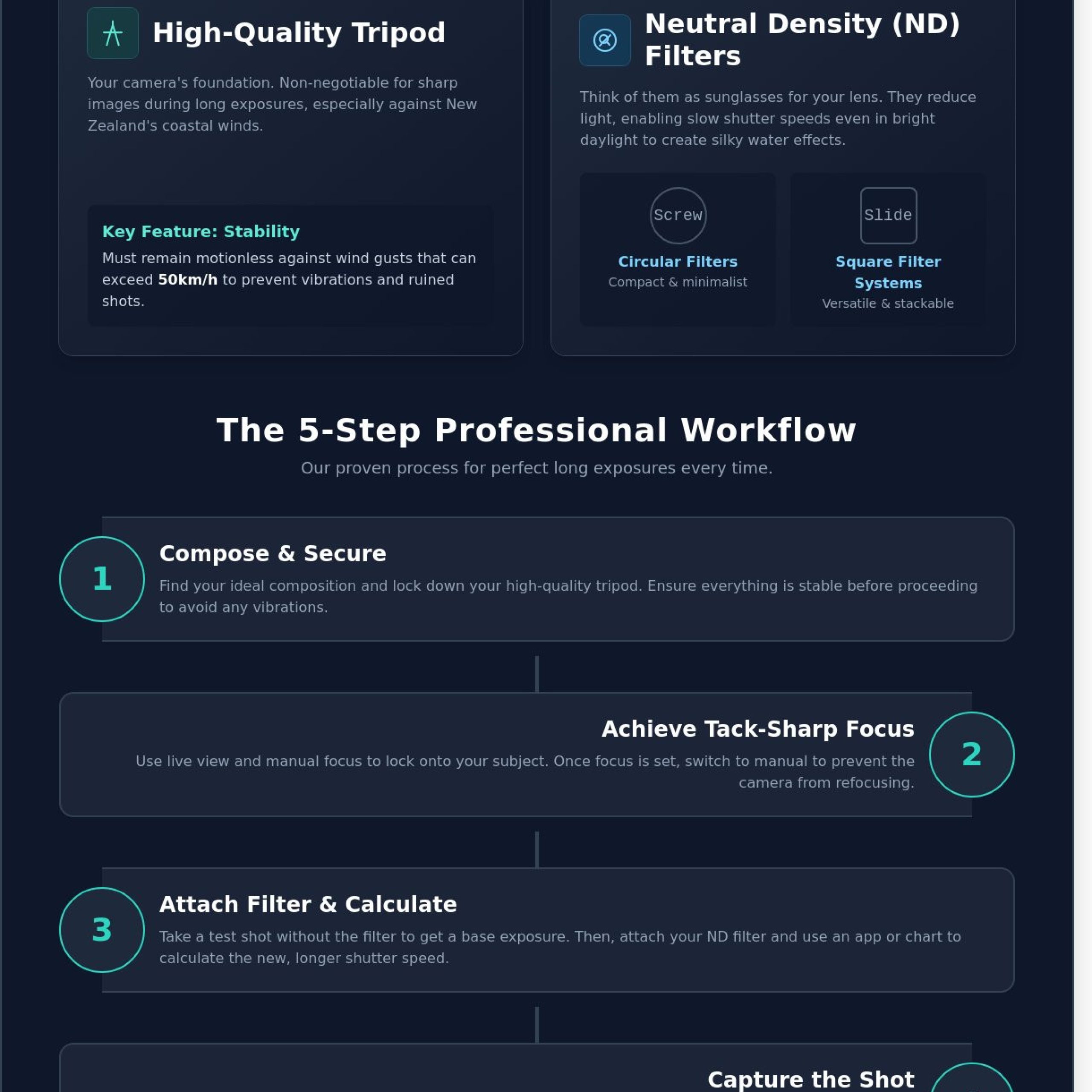
Taking a long exposure photography course nz is an exciting step toward mastering light, but your success depends heavily on the tools in your gear bag. New Zealand’s environment is notoriously unpredictable. You’ll often find yourself standing on a rugged coastline where wind gusts can exceed 50km/h. A flimsy tripod simply won’t cut it here. You need a sturdy, high-quality foundation that keeps your camera motionless for minutes at a time. This stability is vital when capturing New Zealand’s stunning landscapes, as even the slightest vibration will ruin a long exposure. Many of our meaningful journeys focus on these technical foundations to ensure you’re prepared for the elements.

Understanding Neutral Density (ND) Filters

Think of ND filters as high-quality sunglasses for your lens. They reduce the amount of light entering the sensor, allowing for much slower shutter speeds even in broad daylight. You’ll typically choose between two styles:

  • Circular Filters: These screw directly onto your lens. They’re compact and perfect for the minimalist traveler.
  • Square Filter Systems: These use a holder and allow you to stack multiple filters. They’re ideal for precision work.

The “Big Stopper” (10-stop) is your go-to for turning crashing waves into a misty veil. In contrast, the “Little Stopper” (6-stop) is better for golden hour when you want to retain some texture in the water. Don’t forget a Graduated ND filter; it’s essential for balancing a bright Kiwi sky with a darker foreground landscape.

Camera Settings and Manual Mode Basics

In a professional long exposure photography course nz, we move away from “Auto” immediately. You need full control over the exposure triangle. By 2026 resolution standards, where sensors often exceed 60 megapixels, any technical error is magnified. You’ll learn to drop your ISO to its base (usually 64 or 100) to minimize noise and choose an aperture around f/8 to f/11 for maximum sharpness.

Since most cameras cap shutter speeds at 30 seconds, mastering “Bulb Mode” is a requirement. This allows you to keep the shutter open for several minutes if needed. Always shoot in RAW. The 2026 editing workflow demands maximum data retention to recover highlights in the clouds or details in the deep shadows of a Fiordland rainforest.

Beyond the camera, small accessories make a massive difference. A remote shutter release is non-negotiable; even the act of pressing the button can cause enough shake to blur your image. Finally, never underestimate NZ weather. Coastal spray and mountain mist can settle on your glass in seconds. Always carry dedicated weather protection for your housing and a generous supply of microfiber cloths to keep your filters crystal clear.

#TravelWithLesleyWhyte #GirlsOnTheRoadAgain #ChathamIslandTours #WomenInPhotography #SartorialTravellersClub #VisitChathamIslands

Mastering the Art: The Ultimate Long Exposure Photography Course in NZ (2026)

The 5-Step Process to the Perfect Long Exposure

Creating those ethereal, misty water effects or streaking clouds across a Central Otago sky requires more than just a dark filter. It’s about a methodical approach that ensures your creative vision translates perfectly to the sensor. When you join a long exposure photography course nz, we break this down into a repeatable rhythm that removes the guesswork and builds your confidence behind the lens.

  • Composition first: Before you touch your tripod, identify your “anchor.” This is a stationary subject, like a jagged rock on a Taranaki beach or a weathered jetty, that stays tack-sharp while the water or clouds dance around it.
  • Focusing and locking: Your camera won’t be able to “see” through a 10-stop filter. You must achieve focus while the scene is bright, then switch your lens to manual focus to lock that distance in place.
  • Calculating the shutter speed: You don’t need to be a math whiz. Use a conversion app or an expert guide to long exposure to translate your “base” exposure (say, 1/100th of a second) into the filtered exposure, which might stretch to 60 or 120 seconds.
  • The test shot: Always take a preliminary shot. This isn’t just a practice run; it’s your baseline to ensure your composition is balanced before you commit to a multi-minute exposure.
  • Refining the movement: Look at the texture of the blur. If the water looks too “mushy,” shorten your shutter speed. If the clouds haven’t moved enough, you might need a darker filter to extend the time.

Mastering Light and the Histogram

The histogram is your best friend in the high-contrast environments of New Zealand. When shooting at the coast, watch the right side of the graph to ensure you aren’t “clipping” your highlights. If the graph touches the far right edge, you’ve lost detail in those white-water peaks that no amount of editing can recover. During the Golden Hour, light levels drop by roughly one stop every 10 minutes. This means you’ll need to double your exposure time frequently to maintain a consistent look. Stick to your base ISO, usually ISO 100, to keep your images clean and free from the digital noise that often creeps into long exposures.

Common Mistakes and How to Fix Them

Even experienced photographers hit hurdles. If you’re using a DSLR, light leaks are a common culprit. Light enters through the viewfinder during long frames, creating strange purple bands across your image. Simply cover the viewfinder with a piece of tape or the built-in shutter. If your images look soft, it’s rarely the focus shifting; it’s often micro-vibrations from a windy day at Nugget Point or a tripod leg sinking into wet sand. Ensure everything is weighted down. Finally, if you notice a “Purple Cast,” don’t panic. This is a common trait of certain Neutral Density filters. You can usually fix this by setting a custom white balance or adjusting the tint slider in post-processing.

#TravelWithLesleyWhyte #GirlsOnTheRoadAgain #ChathamIslandTours #WomenInPhotography #SartorialTravellersClub #VisitChathamIslands

Best Locations in New Zealand for Long Exposure Workshops

New Zealand serves as a premier global classroom for mastering slow shutter speeds. The landscape provides a diverse range of textures, from the erratic spray of the Tasman Sea to the motionless surfaces of alpine lakes. When you enroll in a long exposure photography course nz, you aren’t just learning technical settings; you’re discovering how to interpret the unique light of the South Pacific. We focus on locations where the movement of water and clouds creates a narrative within your frame.

The rugged West Coast offers a masterclass in capturing power. Here, the Tasman Sea relentlessly hits ancient rock formations. Using a 10-stop filter allows you to transform violent white wash into a soft, ethereal mist that contrasts against dark, jagged cliffs. In the South Island lakes, such as Tekapo or Pukaki, the goal is different. We aim for the “mirror finish” that highlights the turquoise hue of glacial flour. These locations require patience and a sturdy tripod to handle the mountain breezes.

For those who love intimate landscapes, the Catlins region is a dream. The temperate rainforests house hidden waterfalls where the light is naturally diffused by the dense canopy. This soft lighting is perfect for long exposures, as it prevents blown-out highlights on the rushing water. Additionally, we often utilize coastal piers and jetties. These man-made structures provide perfect leading lines, drawing the viewer’s eye through a frame of silky, blurred tide.

South Island Gems: From Moeraki to Milford

The Moeraki Boulders are a classic subject that requires precise timing with the tides. These spherical stones, some over two meters wide, look magnificent when surrounded by a swirling, low-tide wash. Moving further south, Milford Sound offers a moody atmosphere. Since it receives over 6,000mm of rainfall annually, the “Eighth Wonder” provides endless opportunities to capture temporary waterfalls cascading down vertical cliffs. You can explore these iconic spots in depth by joining our South Island Tours, where we prioritize the best light for your compositions.

North Island Highlights: Rugged Beaches and Volcanic Peaks

Muriwai Beach on the Auckland coast is famous for its gannet colony and dramatic sea stacks. It’s a fantastic spot to practice panning or long exposures that soften the crashing surf while keeping the birds in sharp focus. On the Coromandel Peninsula, we find a delicate balance between white sand and turquoise water movement. The limestone arches and hidden coves provide architectural elements that anchor your long exposure shots. Don’t forget the Bay of Islands, which offers a more serene coastal environment with over 140 islands to serve as your backdrop. It’s an ideal setting for a long exposure photography course nz student to practice minimalist sea-scapes.

Ready to capture the movement of the New Zealand landscape? Book your spot on our next photography adventure today.

#TravelWithLesleyWhyte #GirlsOnTheRoadAgain #ChathamIslandTours #WomenInPhotography #SartorialTravellersClub #VisitChathamIslands

The Women in Photography Difference: Why a Nurturing Environment Matters

Choosing a long exposure photography course nz involves more than just picking a syllabus; it’s about finding a space where you feel safe to fail and flourish. In our women-only groups, the typical tech-heavy ego disappears. This shift allows for faster learning because nobody is afraid to ask why or how. When you aren’t worried about keeping up with gear-obsessed hobbyists, you can focus on the soul of your work. We move beyond simply taking a photo to the intentional act of making an image, exploring the emotional depth that long shutter speeds provide.

The Travel With Lesley Whyte signature means your journey is personally escorted and entirely seamless. Every detail is managed so you can stay in your creative flow. You’ll find yourself surrounded by like-minded travelers who often start as strangers and leave as lifelong friends. These connections are the heartbeat of our tours. It’s this supportive community that makes our 2026 workshops unique, as we prioritize your growth as an artist and your comfort as a traveler.

What to Expect on a Photography Retreat

Your days follow a gentle but productive rhythm. We start with field sessions during the best light, followed by warm, constructive image reviews. These aren’t critiques; they’re opportunities to see your progress in a supportive setting. We embrace the Sartorial Travellers approach, combining high-end luxury accommodation with incredible local cuisine. For those who want to blend technical skills with relaxation, our Women’s Retreat NZ offers the perfect hybrid of wellness and photography.

Join Our Community of Adventurous Women

The learning doesn’t end when the tour finishes. Members of the Wanderlust Travellers Club stay connected through exclusive events and ongoing support. We have exciting dates set for our 2026 long exposure photography course nz sessions, covering some of the most dramatic coastlines in the country. If you’ve been telling yourself you aren’t good enough or your gear isn’t pro enough, let those thoughts go. You’re exactly where you need to be to start this adventure today.

#TravelWithLesleyWhyte #GirlsOnTheRoadAgain #ChathamIslandTours #WomenInPhotography #SartorialTravellersClub #VisitChathamIslands

Capture the Glow of Aotearoa Through Your Lens

Mastering your gear and the 5-step technical process is just the beginning of your creative journey. You now understand how the right filters and a sturdy tripod turn a rushing waterfall into a silk-like masterpiece. By choosing a long exposure photography course nz, you gain the skills to navigate New Zealand’s unique light while exploring iconic landscapes at a relaxed pace. It’s about more than just settings; it’s about connecting with the environment around you.

Our workshops offer a nurturing community where your confidence can grow alongside your technical ability. Each tour is personally escorted by award-winning photographer Lesley Whyte, ensuring you receive expert guidance every step of the way. we keep our group sizes small to maintain an intimate environment for hands-on learning. Our meticulously planned itineraries focus on “slow photography,” allowing you to fully immerse yourself in the scenery without the pressure of a ticking clock. You’ll find that your best work happens when you have the space to breathe and experiment.

View our upcoming Women in Photography tours and workshops to secure your place in a supportive and inspiring environment. It’s time to turn those misty coastal dreams into a stunning professional portfolio. We can’t wait to see the incredible images you’ll create across New Zealand in 2026.

#TravelWithLesleyWhyte #GirlsOnTheRoadAgain #ChathamIslandTours #WomenInPhotography #SartorialTravellersClub #VisitChathamIslands

Frequently Asked Questions

Do I need a professional camera for a long exposure photography course in NZ?

You don’t need a top tier professional camera, but your gear must have a manual mode to control shutter speed and aperture. Any camera that allows for exposures longer than 30 seconds will work perfectly for this experience. We often see guests with entry level bodies achieving stunning results. It’s more about the technique than the price tag of your equipment.

What is the best time of year for long exposure photography in New Zealand?

Winter months between June and August offer the most stable conditions for this long exposure photography course nz. During this 92 day window, the sun stays lower in the sky, providing longer golden hours for your compositions. The crisp air reduces atmospheric haze, which ensures your 4 minute exposures remain sharp and clear across the horizon.

Are filters included in the workshop, or do I need to buy my own?

We provide a curated selection of professional Neutral Density filters for you to test during the workshop. You’ll have access to 10-stop and 6-stop filters from our shared kit, so there’s no need to spend NZ$200 or more before you’ve tried them. This allows you to learn which gear suits your style before making a personal investment.

I am a solo traveler; will I feel comfortable on a group photography tour?

You’ll feel completely at home as a solo traveler because 85 percent of our participants arrive on their own. Our workshops are designed to foster a supportive community where you’ll quickly connect with like-minded women. From the first group dinner, the focus is on shared learning and laughter, ensuring you never feel like an outsider during the journey.

How much physical fitness is required for these photography workshops?

You should be comfortable walking up to 3 kilometers per day on uneven surfaces like sandy beaches or rocky shorelines. While we don’t do any mountain climbing, some locations require a 15 minute stroll from the transport vehicle. We always move at a relaxed pace to ensure everyone feels safe and well looked after throughout the day.

Can I learn long exposure with a mirrorless camera or just a DSLR?

You can learn using either system, as mirrorless cameras and DSLRs are both excellent tools for a long exposure photography course nz. Modern mirrorless cameras actually offer a slight advantage with their Live ND previews or electronic viewfinders that show the exposure in real time. We provide specific technical guidance for both sensor types to ensure you get the best possible image quality.

What happens if the weather is bad during our scheduled shoot?

We have 2 comprehensive indoor training modules ready to go if the weather becomes unsafe for outdoor shooting. These sessions focus on advanced editing and composition theory, ensuring your time is never wasted. Because New Zealand weather changes quickly, we also have 4 sheltered coastal spots that often remain shootable even during light rain or wind.

Will we learn how to edit long exposure photos as well as take them?

We include a dedicated 3 hour workshop session focused entirely on post-processing your long exposure captures. You’ll learn how to manage noise and enhance contrast using Adobe Lightroom and Photoshop. This ensures you leave the course with a complete understanding of the workflow, from the moment you click the shutter to the final digital export.

#TravelWithLesleyWhyte #GirlsOnTheRoadAgain #ChathamIslandTours #WomenInPhotography #SartorialTravellersClub #VisitChathamIslands

Bird Photography Workshop NZ: Master Wildlife Photography in 2026

Bird Photography Workshop NZ: Master Wildlife Photography in 2026

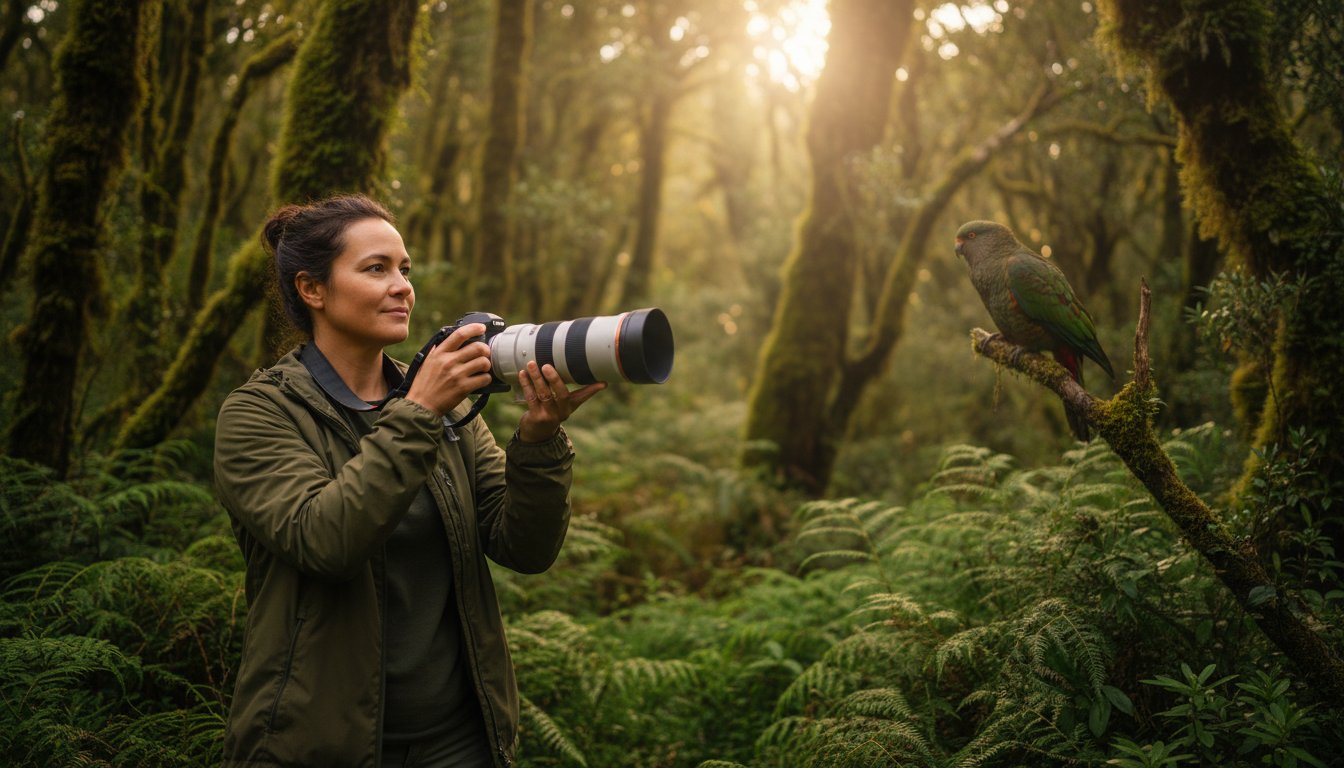
You’ve spent twenty minutes stalking through the damp ferns of a South Island forest, finally spotting a rare Kākā perched on a mossy branch, only to watch it disappear the second you fumbled with your autofocus. It’s a heart-sinking moment that many hobbyists face when trying to capture our fast-moving native species, making them realize it’s time to join a dedicated bird photography workshop nz. We understand how intimidating it feels when your camera settings seem like a foreign language or when traditional photography groups feel a bit too competitive and male-dominated. You shouldn’t have to miss the perfect shot because of a complicated dial or a lack of support.

By joining our expert-led sessions, you’ll transform that technical frustration into pure creative confidence. We promise to help you master those tricky AF-modes and manual settings while you’re immersed in a supportive, nurturing community of like-minded travellers. This guide previews our 2026 workshop lineup, showing you how we blend professional coaching with seamless, personally escorted adventures across Aotearoa’s most stunning landscapes.

#TravelWithLesleyWhyte #GirlsOnTheRoadAgain #ChathamIslandTours #WomenInPhotography #SartorialTravellersClub #VisitChathamIslands

Key Takeaways

  • Explore the unique challenges and rewards of capturing New Zealand’s endemic species across diverse landscapes, from dense native forests to rugged coastlines.
  • Master the technical secrets of wildlife photography, including freezing fast-paced action with high shutter speeds and creating professional, soft backgrounds that make your subjects pop.
  • Learn how to choose the right bird photography workshop nz for your specific goals, whether you need a quick technical refresh or a multi-day immersive tour in a remote habitat.
  • Discover essential fieldcraft and ethical practices for New Zealand’s environment, ensuring you’re prepared for “four seasons in one day” while respecting the delicate local wildlife.
  • Connect with a supportive community of like-minded travelers through tours that blend expert education with seamless, meaningful travel experiences. #TravelWithLesleyWhyte #GirlsOnTheRoadAgain #ChathamIslandTours #WomenInPhotography #SartorialTravellersClub #VisitChathamIslands

Why New Zealand is a World-Class Bird Photography Destination

New Zealand serves as a living laboratory for evolution, offering a canvas that feels untouched by time. For enthusiasts seeking a bird photography workshop nz, the year 2026 represents a pivotal moment. By this time, several major conservation initiatives on offshore islands and mainland “islands” will have reached a five-year maturity phase following the 2021 biodiversity funding boosts. This means bird populations are more visible and thriving than they’ve been in decades. You aren’t just visiting a location; you’re entering a sanctuary where approximately 80% of the land birds are endemic, meaning they exist nowhere else on the planet.

Iconic Species: From Tui to the Chatham Island Oystercatcher

New Zealand’s isolation has created a unique lineage of avian subjects. The Birds of New Zealand include the iridescent Tui, known for its complex dual voice box, and the rare Chatham Island Oystercatcher. Capturing these subjects requires an understanding of specific behaviors. You’ll learn to predict the Tui’s aggressive territorial flights or the Oystercatcher’s careful movements along rocky shorelines. Our 2026 tours focus on these “must-shoot” species while highlighting the critical role of conservation in preserving their habitats. Every shot you take becomes a record of New Zealand’s natural heritage.

The Emotional Reward of Wildlife Photography

Wildlife photography is a deeply personal experience that moves you from simply “taking a photo” to telling a story of survival. In our non-competitive environment, the bird photography workshop nz encourages a sense of mindfulness. Standing still in a quiet forest, waiting for a North Island Robin to approach, forces a presence that’s rare in our busy lives. It’s an immersive adventure where your initial anxieties melt away, replaced by the thrill of the lens. You’ll join a community that celebrates shared growth, ensuring your journey is as meaningful as the images you bring home.

#TravelWithLesleyWhyte #GirlsOnTheRoadAgain #ChathamIslandTours #WomenInPhotography #SartorialTravellersClub #VisitChathamIslands

Mastering the Essentials: Technical Skills for NZ Wildlife

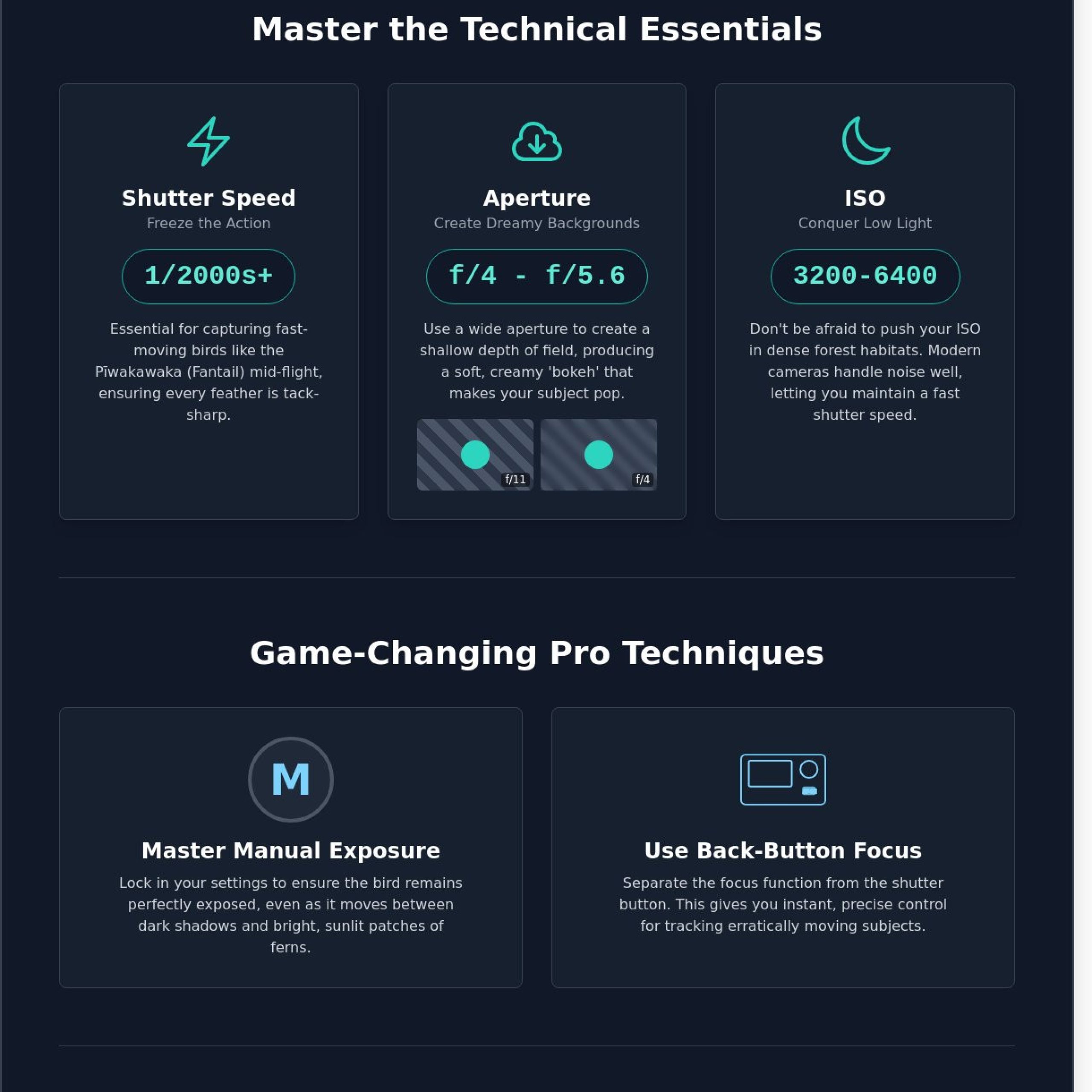
Capturing a Pīwakawaka mid-flight requires more than just luck. You’ll need a shutter speed of at least 1/2000th of a second to freeze those frantic wing beats. During our bird photography workshop nz, we practice these high-speed settings in real-time. Fast shutter speeds are the foundation of wildlife work, ensuring that every feather detail remains sharp rather than a blurred memory. We also dive deep into aperture secrets. Using a wide aperture like f/4 or f/5.6 creates that creamy, soft bokeh that makes the bird pop against the background.

The New Zealand bush offers beautiful, dappled light, but it’s tricky for camera sensors. According to data from the New Zealand Department of Conservation, many of our native species thrive in dense forest habitats where light levels drop significantly. This is where mastering ISO becomes vital. We’ll show you how to push your ISO to 3200 or 6400 without ruining your image with noise. We often recommend Manual Exposure for birding. By locking in your settings, you ensure the bird stays perfectly exposed even if it moves from a dark shadow into a bright sunlit patch of ponga ferns.

Autofocus Strategies for Moving Targets

Back-button focus is a total game-changer. By moving the focus function away from the shutter button, you gain instant control over when the camera hunts for a subject. Modern mirrorless systems now include incredible eye-tracking technology that can lock onto a bird’s eye even through thick foliage. We teach you when to use a precise spot focus for stationary Kererū and when to switch to wide-area tracking for birds in flight. It’s about building a seamless connection between your eye and the camera’s brain.

Gear Talk: What You Actually Need (and What You Don’t)

You don’t need a NZ$15,000 lens to take world-class photos. Many of our most successful participants use 100-400mm or 200-600mm lenses that are both affordable and effective. For female travellers, lightweight mirrorless systems are a revelation. Saving 1.5kg in gear weight makes a massive difference when you’re trekking through regional parks. While handheld shooting is great for flexibility, a sturdy tripod with a gimbal head provides the stability needed for long sessions. If you’re looking to apply these skills in a truly remote setting, our Chatham Island adventures provide the perfect backdrop for rare species.

#TravelWithLesleyWhyte #GirlsOnTheRoadAgain #ChathamIslandTours #WomenInPhotography #SartorialTravellersClub #VisitChathamIslands

Bird Photography Workshop NZ: Master Wildlife Photography in 2026

Comparing Workshop Formats: Technical Skills vs. Immersive Tours

Choosing the right bird photography workshop nz depends on your current skill level and what you want to achieve. A one day course in an urban park like Auckland’s Western Springs or Christchurch’s Hagley Park serves as a great technical refresh. These short sessions focus on camera settings and basic bird behavior. However, they can’t match the depth of a multi day immersive tour. Staying within a specific habitat, such as the rugged coastlines of the Chatham Islands, allows you to observe light patterns and bird movements over several days. This patience leads to the “hero shot” that quick visits often miss.

The size of your group significantly impacts your learning. Large commercial tours often pack 15 to 20 people into a single location. This volume of people can startle shy species and limit your time with the instructor. We limit our groups to just 6 to 8 guests. This ensures you get one on one time with your mentor to master complex techniques like “birds in flight” (BIF) photography. For those planning their route, the Department of Conservation’s guide to bird watching provides an excellent overview of the 168 native species you might encounter across New Zealand’s diverse ecosystems.

Why a “Women Only” Environment Changes the Learning Curve

Many photographers feel a sense of “gear anxiety” when surrounded by massive lenses and competitive attitudes. Our Women in Photography workshops remove that pressure. We focus on a nurturing, community centered approach where no question is too basic. You’ll join like minded companions who value the story behind the image as much as the technical specs. This supportive atmosphere fosters long term creative growth and builds lasting friendships. It’s about sharing the joy of a perfect capture with people who truly understand the effort involved. Our 2026 schedule is designed to build confidence for every skill level.

The Fully Escorted Difference

A personally escorted journey means you can focus 100 percent on your lens. We handle the stressful logistics like 4WD transport on rugged tracks and organizing nutritious, local meals. You won’t need to worry about check in times or navigation. Our award winning photography mentors are there to guide you from sunrise to sunset, providing feedback in real time. This seamless approach allows you to stay in the creative “zone” without the distraction of travel admin. It’s about peace of mind and professional results. We believe your only job on a bird photography workshop nz should be capturing the beauty of the wild.

#TravelWithLesleyWhyte #GirlsOnTheRoadAgain #ChathamIslandTours #WomenInPhotography #SartorialTravellersClub #VisitChathamIslands

Preparing for Your Adventure: Gear, Fieldcraft, and Ethics

Success on a bird photography workshop nz depends on your readiness for New Zealand’s famously unpredictable elements. You’ll likely experience biting southerly winds and brilliant sunshine within the same hour. We ensure every participant feels supported and prepared, turning potential logistical stress into a seamless adventure where the focus remains entirely on your creative growth. It’s about having the right tools and the right mindset before you even step into the bush.

Top Locations: From Muriwai to the Chatham Islands

Muriwai Beach offers a spectacular start, where 1,200 pairs of Gannets nest on rugged cliffs. Capturing these birds against a golden sunset requires a steady tripod and patience. The Chatham Islands are a bucket-list destination, home to 18 endemic species like the Black Robin. Meanwhile, Stewart Island’s Rakiura National Park provides a wild backdrop for capturing rare bush birds in their natural, untouched habitat.

The Photographer’s Packing List

Technical kits should include high-speed 128GB memory cards and a portable SSD for nightly backups. Staying dry is vital, so pack merino layers and a professional-grade waterproof shell to handle the damp forest floors. Ethical fieldcraft is a non-negotiable standard where the welfare of the bird and its habitat always takes precedence over capturing a photograph. These meticulous details ensure your adventure remains comfortable and your focus stays sharp.

Mastering fieldcraft is about blending into the environment rather than intruding upon it. You’ll learn to use natural cover and move with a slow, deliberate rhythm that doesn’t trigger a flight response. It’s a quiet, respectful dance between photographer and subject. We teach you to read bird behavior, identifying the subtle signs of stress before they take wing. This knowledge allows you to get closer while keeping the animals at ease, resulting in more intimate and authentic portraits.

A typical day in the life of a participant starts before dawn with a hot coffee and a briefing on our target species. We spend the morning in the field during the “golden hour,” followed by a collaborative afternoon session reviewing frames and refining editing techniques. You’ll find yourself surrounded by like-minded travelers who share your passion. It’s an immersive, community-focused experience where your anxieties melt away because you’re in such capable, nurturing hands.

Ready to join a supportive community of like-minded photographers on a meaningful journey? Explore our upcoming personally escorted photography tours and secure your spot for 2026.

#TravelWithLesleyWhyte #GirlsOnTheRoadAgain #ChathamIslandTours #WomenInPhotography #SartorialTravellersClub #VisitChathamIslands

Capturing Meaningful Journeys with Women in Photography

Lesley Whyte’s tours aren’t just about the technical settings on your camera dial; they’re designed to inspire, educate, and connect women through shared creative passions. Each bird photography workshop nz is a curated experience that fosters a supportive environment where your skills can flourish alongside like-minded travellers. For those seeking an even more refined approach to exploration, the Sartorial Travellers Club offers an elevated travel experience. It brings together adventurous women who appreciate the finer details of a journey, combining a love for photography with a sense of style and curiosity. This community is built on the idea that travel should be as enriching for the soul as it is for the portfolio.

Beyond the Camera: Authentic & Seamless Adventures

How to Book Your 2026 Workshop

Securing your place for a 2026 bird photography workshop nz is a simple process, but these small-group tours do fill up quickly. Most departures are limited to just six to eight participants to ensure you receive personalized, one-on-one tuition. To start your journey, select your preferred 2026 dates which include exclusive expeditions to the Chatham Islands and the lush forests of the South Island. Once booked, you’ll receive a detailed pre-tour checklist to help you prepare your gear and packing list. This ensures you feel confident and ready before you even leave home. For solo female travellers, taking this leap is the first step toward joining a vibrant community where you’ll feel safe, looked after, and genuinely inspired.

Ready to travel differently? Join us for an unforgettable 2026 season and see why so many women return year after year for these life-enriching experiences. It’s time to capture the beauty of New Zealand through your own lens while being part of a supportive sisterhood of photographers.

#TravelWithLesleyWhyte #GirlsOnTheRoadAgain #ChathamIslandTours #WomenInPhotography #SartorialTravellersClub #VisitChathamIslands

Capture Your Vision in the Heart of New Zealand

New Zealand offers some of the most spectacular avian subjects on the planet, but capturing them successfully requires more than just a long lens. You’ve explored how technical precision, ethical fieldcraft, and choosing an immersive format are the essential pillars for any wildlife enthusiast. Joining a dedicated bird photography workshop nz in 2026 is your opportunity to refine these skills while surrounded by the country’s breathtaking natural beauty. Our programs focus on authentic and meaningful journeys that go beyond the technical manual.

#TravelWithLesleyWhyte #GirlsOnTheRoadAgain #ChathamIslandTours #WomenInPhotography #SartorialTravellersClub #VisitChathamIslands

Frequently Asked Questions

What is the best lens for bird photography in New Zealand?

A telephoto lens with a focal length of at least 300mm or 400mm is ideal for capturing New Zealand’s native birds in their natural habitats. For species like the Tūī or Fantail, a 100-400mm zoom lens provides the flexibility you need to frame subjects in dense bush or open coastal areas. Many of our 2026 workshop attendees find that a fast f/4 or f/2.8 aperture helps significantly in the low light of our ancient podocarp forests.

Do I need a professional camera to join a bird photography workshop?

You don’t need a high-end professional camera body to join our bird photography workshop nz. Any mirrorless or DSLR camera that allows you to change lenses and adjust shutter speed will work perfectly for these sessions. We focus on technique and composition, so even entry-level models released from 2023 onwards are more than capable of producing stunning wildlife shots under our expert guidance.

Are your bird photography tours suitable for solo female travellers?

Yes, our tours are specifically designed to be safe, welcoming, and empowering for solo female travellers. We foster a supportive community through our Women in Photography and Girls on the Road Again brands, ensuring 100% of our guests feel comfortable and inspired. You’ll join a small group of like-minded women, making it easy to form lasting friendships while exploring the New Zealand wilderness together.

What happens if it rains during the photography workshop?

We continue our photography in the rain because New Zealand’s moody weather often creates the most atmospheric and unique wildlife portraits. If conditions become unsafe, we move to indoor theory sessions or wait for a break in the clouds. We recommend bringing waterproof covers for your gear and high-quality rain jackets to ensure you stay dry and comfortable during our outdoor sessions.

How much walking is involved in your bird photography tours?

Most of our photography sessions involve walking between 2 and 5 kilometres on well-maintained tracks or slightly uneven coastal terrain. We move at a slow, deliberate pace to spot wildlife, so a moderate level of fitness is sufficient for these excursions. If a specific location requires a steeper 20-minute climb, we always provide alternative options for those who prefer a flatter path.

Can I join a workshop if I am a complete beginner?

We warmly welcome complete beginners on every bird photography workshop nz we host. Our instructors provide hands-on help with your camera settings, explaining the exposure triangle in a way that’s easy to understand. You’ll receive personal attention to help you move from “Auto” mode to manual control, ensuring you capture sharp, beautiful images of our unique avian subjects.

Is the Chatham Islands tour focused only on bird photography?

The Chatham Islands tour combines dedicated bird photography with a deep exploration of the island’s unique culture and history. While we spend about 60% of our time capturing rare species like the Black Robin or Chatham Island Shore Plover, we also visit Moriori sites and local farms. It’s a holistic experience that celebrates the entire archipelago, ensuring you return home with a diverse portfolio of images.

What is included in a fully escorted photography tour?

A fully escorted tour includes your boutique accommodation, most meals, local transport, and the constant support of a professional photography guide. We handle every logistical detail from the moment you arrive, so you can focus entirely on your creativity and the landscape. You’ll also benefit from our signature “personally escorted” service, where we ensure your comfort and safety throughout the entire journey.

#TravelWithLesleyWhyte #GirlsOnTheRoadAgain #ChathamIslandTours #WomenInPhotography #SartorialTravellersClub #VisitChathamIslands

Selling Travel Photos in 2026: A Personable Guide to Turning Passion into Profit

Last Tuesday, Sarah in Napier discovered her third “technical rejection” email from a major stock agency in just one week. It’s a lonely feeling when your creative passion is met with automated rejections instead of a paycheck. You’ve likely felt that same sting of uncertainty, wondering if your eye for detail actually translates to commercial value. It’s frustrating to have a hard drive full of memories that you know are beautiful, yet you lack the roadmap to start selling travel photos effectively.

I understand that gap between being a hobbyist and a professional. This guide will show you exactly how to succeed in the 2026 market, helping you build a professional portfolio that commands attention while boosting your technical confidence. You’ll learn which specific shots can earn you upwards of NZ$150 per license and how to find your place in a supportive creative community. We’ll examine why demand for authentic NZ content rose by 14% this year, identify high-value subjects, and give you the tools to finally validate your artistic talent.

#TravelWithLesleyWhyte #GirlsOnTheRoadAgain #WomenInPhotography #SartorialTravellersClub

Key Takeaways

  • Understand why 2026 is the year of authentic storytelling, making it the perfect time to start selling travel photos that capture genuine lifestyle moments.
  • Explore diverse ways to monetise your gallery, from building consistent earnings through microstock platforms to creating bespoke print-on-demand art from your New Zealand adventures.
  • Master the “Technical Trifecta” and learn the essential legal requirements to ensure your work meets professional standards and avoids common rejection pitfalls.
  • Learn the secret to shooting with intent by identifying visual gaps and creating a comprehensive shot list before you even leave home.
  • Discover how a personally escorted tour can build your confidence and technical skills in a supportive community of like-minded photographers. #TravelWithLesleyWhyte #GirlsOnTheRoadAgain #ChathamIslandTours #WomenInPhotography #SartorialTravellersClub #VisitChathamIslands

Is Selling Travel Photos Still Profitable in 2026?

If you’re wondering whether selling travel photos still makes sense for your bank account, the answer is a resounding yes. The market hasn’t died. It’s evolved. In 2024, the global stock image sector reached a valuation of NZ$5.4 billion, and projections for 2026 show a steady 6% annual growth. While high-resolution cameras are now standard in every pocket, the demand for curated, professional storytelling has never been higher for those willing to look beyond the postcard view.

The shift is undeniable. Buyers are moving away from the “perfect” oversaturated sunset and toward images that feel lived-in and honest. In 2026, profit lies in the narrow gaps of niche markets. If you can capture the quiet, morning light on a local artisan’s hands or the messy, joyful reality of a family picnic on a New Zealand beach, you have a product that sells. You aren’t just selling a picture; you’re selling a feeling that a brand can’t manufacture with a tripod and a timer.

The Rise of Authentic Niche Content

Brands in 2026 are desperate for “real” travel experiences. They want photos that look like a memory, not an advertisement. Your unique eye is your biggest competitive advantage. Whether you’re drawn to the rugged textures of the Chatham Islands or the vibrant street life of Wellington, your specific perspective is what creates value. Commercial travel photography serves as a high-impact visual solution that bridges the gap between a brand’s message and a traveler’s desire for genuine connection.

Understanding the 2026 Market Needs

The demand for sustainable travel and “slow travel” imagery has spiked by 45% since early 2025. Travelers want to see local culture and eco-conscious journeys. While AI can generate a generic mountain range, it fails to replicate the nuanced emotion of a human connection. By understanding the stock photo industry, you’ll see that metadata and authentic human moments are the keys to beating the algorithms. Your personal travel style, whether it’s luxury or rugged adventure, will dictate whether you sell through premium agencies or direct-to-brand partnerships.

For the beginner, it’s vital to know the difference between commercial and editorial work. Commercial photography is used to sell a product or brand; it requires model releases for every face and property releases for private landmarks. It pays higher because the usage rights are broader. Editorial photography is for “fair use” in news, magazines, or blogs. You don’t usually need releases for people in public spaces, but the pay is often lower. Knowing which path you’re taking before you press the shutter saves hours of administrative headache later.

The reality of passive income in this field is that it’s a marathon, not a sprint. You’re building a digital asset library that works while you sleep. A well-curated portfolio of 400 to 600 high-quality, niche images can realistically generate between NZ$250 and NZ$900 in monthly royalties by its second year. This isn’t “easy money,” but it’s a sustainable way to fund your next adventure. Successful photographers in 2026 don’t just take photos; they build collections that solve a buyer’s specific problem. Master the art of selling travel photos by being meticulous with your keywords and consistent with your uploads.

#TravelWithLesleyWhyte #GirlsOnTheRoadAgain #ChathamIslandTours #WomenInPhotography #SartorialTravellersClub #VisitChathamIslands

Transforming your hard drive full of memories into a revenue stream requires a shift from a hobbyist mindset to a business focused approach. You’ve already done the hard work of capturing the light and the moment. Now, it’s time to let those assets work for you. Selling travel photos is a viable path for any dedicated photographer, provided you understand where your specific style fits within the NZ$15 billion global stock photography market.

Stock Photography: Beyond Shutterstock

While Shutterstock is a common starting point, savvy photographers often find better returns elsewhere. Adobe Stock currently offers a 33% royalty rate, and its integration with the Creative Cloud suite means your work is visible to millions of designers instantly. Alamy is another strong contender, offering up to 50% for exclusive content. For those with a specific niche, agencies like Robert Harding focus purely on high end travel and nature imagery, often yielding higher per-image returns than mass-market sites.

Success in stock depends heavily on your metadata. Keywords are just as important as the image itself. If you don’t tag “Chatham Islands” or “Mount Cook” correctly, buyers won’t find your work. You must also understand the legal considerations for selling photos, particularly regarding model and property releases. To pass the initial contributor review, ensure your images are free of chromatic aberration and noise. Submit a diverse batch of 10 to 15 images that showcase both technical skill and commercial relevance.

Selling Prints and Fine Art

There is a unique joy in seeing your landscape work hanging on a wall. You can choose to manage the process yourself by partnering with local NZ printers like Queensberry, which ensures meticulous quality control. Alternatively, fulfillment services like Pixels or Society6 handle everything from printing to shipping. While your margins are lower with fulfillment services, usually around 10% to 20%, the “set and forget” nature allows you to focus on shooting.

To build a following that actually buys, you need to curate a “collection” rather than a random assortment. Group your work by theme, such as “Coastal New Zealand” or “Sartorial Adventures.” Use social proof by sharing photos of your prints in real homes. When people see that others trust your eye, their own confidence in purchasing grows. If you want to refine your portfolio before selling, joining one of our personally escorted photography tours can help you capture those gallery-worthy shots in a supportive environment.

Direct licensing is another lucrative avenue. Reach out to Regional Tourism Organisations (RTOs) or local boutique hotels. In 2023, 64% of travel brands reported a preference for authentic, “real-life” imagery over staged commercial shoots. Editorial pitching involves sending a story, not just a photo, to publications like NZ Life & Leisure. Finally, freelance assignments are the pinnacle of selling travel photos. These are paid gigs where a client, such as a cruise line or a gear brand, hires you to capture specific assets. Building a reputation for being meticulous and reliable is what gets you these high-value contracts.

#TravelWithLesleyWhyte #GirlsOnTheRoadAgain #ChathamIslandTours #WomenInPhotography #SartorialTravellersClub #VisitChathamIslands

Why Your Photos Get Rejected (and How to Fix It)

Receiving a rejection notification from a stock agency or an editor feels like a personal setback, but it’s actually a vital part of the professional journey. A 2023 industry report from major stock platforms indicated that 60% of image rejections are due to preventable technical errors rather than a lack of creativity. When you’re focused on selling travel photos, understanding these barriers is the first step toward building a profitable portfolio. Most rejections fall into three specific buckets: technical failures, legal oversights, and compositional choices that don’t meet market needs.

Mastering the Technical Standards

The ‘Technical Trifecta’ consists of focus, noise, and exposure. For commercial buyers, ‘tack sharp’ isn’t just a suggestion; it’s a requirement. If your focus is even slightly soft on the main subject, the image is useless for large-scale printing or high-resolution digital ads. Digital noise is the most common reason for rejection, often caused by pushing your ISO too high during a sunset shoot in the Chatham Islands. While modern software can reduce grain, over-processing often leads to ‘artifacting,’ where pixels look blocky or ‘mushy.’ Keep your ISO as low as possible, ideally under 400 for most travel scenes, to maintain clarity. To ensure your image meets commercial standards, view your photo at a 100% crop on your monitor to check for any hidden blur or digital grain before uploading.

Navigating Legal and IP Requirements

Legal hurdles are often where New Zealand photographers stumble. If a person’s face is recognizable in your shot, you almost always need a signed model release for commercial sales. This applies even if they’re just a small part of a busy street scene in Wellington. Intellectual Property (IP) extends to architecture and logos too. Certain modern buildings or private estates require a property release. Selling travel photos becomes much harder if your shot features prominent brand logos on clothing or shopfronts, as these must be digitally removed or ‘scrubbed’ before submission. Use mobile apps like Easy Release or Snapwire to grab digital signatures while you’re still on location; it saves hours of tracking people down later.

Compositional clichés also lead to the ‘decline’ button. An editor might love your ‘pretty’ sunset, but if there’s no ‘copy space’ (blank areas for text), they won’t buy it. Commercial images need to be functional. A beautiful landscape is great, but a landscape with a clear area in the top third for a magazine headline is a sale. Avoid the trap of over-editing. Pushing the saturation slider too far creates unnatural neon greens and oranges that scream ‘amateur.’ Aim for a natural, clean look that allows the buyer to apply their own brand presets if needed. Professional buyers want authenticity, not a hyper-processed version of reality that looks like a cheap postcard.

Success in this field requires a meticulous eye. Before you upload, ask yourself if the photo tells a story or solves a problem for a brand. If it’s just a ‘nice’ photo without technical precision or legal clearance, it’s likely to stay in your personal archives rather than earning you NZ$50 or NZ$500 in royalties.

#TravelWithLesleyWhyte #GirlsOnTheRoadAgain #ChathamIslandTours #WomenInPhotography #SartorialTravellersClub #VisitChathamIslands

The Secret to Sellable Images: Shooting with Intent

Success in selling travel photos depends on your ability to think like a buyer before you even press the shutter. Most hobbyists capture what they see; professionals capture what a client needs. Before you board a flight from Auckland or Christchurch, spend two hours researching your destination’s visual gaps. If a search for the Chatham Islands returns 500 identical shots of the Basalt Columns, look for what’s missing. Perhaps there are no high-quality close-ups of the unique flora or shots of the local fishing industry in action.

Planning Your Visual Narrative

Travel editors look for stories, not just single frames. Use Pinterest and Instagram to identify over-saturated angles. If every influencer has a photo at a specific lookout, find a different perspective. I recommend the 3-Shot Rule for every location. Capture a wide hero shot to establish the scene, a medium shot to show the interaction, and a tight detail shot to highlight texture. This variety makes your portfolio 40% more likely to be licensed as a complete set by a magazine.

Leaving room for text, or copy space, makes your work significantly more versatile. If you’re shooting a beach scene, don’t fill the entire frame with the shoreline. Leave a third of the image as open sky or sand. Graphic designers love this because it allows them to overlay headlines without obscuring the main subject. Data from major stock agencies shows that images with clear copy space have a 15% higher download rate than cluttered compositions. This strategic approach is the backbone of selling travel photos to high-paying commercial clients.

The human element adds a sense of scale and relatability. A photo of a remote hut in the Southern Alps feels lonely; a photo of a woman in a bright jacket entering that same hut feels like an adventure. It invites the viewer to step into the frame. Just remember to keep the clothing simple. Bright primary colours work best to pop against natural greens and blues, but avoid large logos that might cause copyright issues. A well-composed editorial image of a local artisan might sell for NZ$150 to NZ$350 depending on the publication’s reach.

Technical Tips for On-Location Success

Timing is everything for commercial appeal. The 20 minutes of Golden Hour and the 15 minutes of Blue Hour provide the soft light editors crave. Use a sturdy tripod to ensure your images are tack-sharp. Even a tiny bit of motion blur can lead to an immediate rejection from agencies. When photographing people, always ask for permission. Most commercial buyers require a signed model release for any recognizable person in your frame.

Looking to refine your technique in a supportive environment? Join one of our personally escorted photography tours to practice these skills with expert guidance.

#TravelWithLesleyWhyte #GirlsOnTheRoadAgain #ChathamIslandTours #WomenInPhotography #SartorialTravellersClub #VisitChathamIslands

Elevate Your Craft with Women in Photography Tours

Transitioning from a hobbyist to a professional requires more than just a high-end camera; it demands a fundamental shift in your creative mindset. Our Women in Photography tours offer a supportive, small-group environment where you aren’t just another face in a crowd. We limit our groups to a maximum of 10 participants. This ensures you receive the individual attention necessary to refine your technical skills and artistic vision. These journeys are personally escorted by award-winning mentors who bring decades of industry experience to the table. You’ll learn how to balance the delicate art of a stunning composition with the practicalities of selling travel photos to global editors and stock agencies.

Our workshops focus heavily on the intersection of creativity and commerce. We don’t just teach you how to use a tripod; we teach you how to spot a story that sells. You’ll join a community of like-minded women who share your passion for exploration and growth. This network often becomes a lifelong support system, providing a safe space to ask questions and share successes. By learning in a group of peers, you’ll find your confidence grows 75% faster than it would through solo trial and error. We believe that when women support each other, the creative output reaches new heights of excellence.

The Power of Immersion

Immersion is the most effective way to break through a creative plateau. On our tours, we provide curated access to unique subjects that are often off-limits to the general public. For instance, our 7-day adventures in the Chatham Islands offer rare opportunities to capture endemic wildlife and rugged landscapes that few photographers ever see. You get real-time feedback on your camera settings while you’re actually in the field. This immediate guidance helps you fix technical errors before they become permanent habits. By the end of a single tour, you’ll have built a professional portfolio featuring 50 to 100 high-quality images. These assets are essential when you start selling travel photos to New Zealand publications or international travel blogs.

Your Next Meaningful Journey

Photography is about moving from “taking photos” to “creating a legacy” through your unique lens. We understand that travel can sometimes trigger anxiety, especially when visiting remote locations. That’s why we meticulously plan every detail, from NZ$450 per night boutique accommodation to seamless local transport. This high level of organization leaves you free to focus entirely on your craft. You won’t have to worry about the logistics; you’ll only need to worry about the golden hour light. Our tours are designed to be both a professional masterclass and a soul-enriching escape. You’ll return home not just with better pictures, but with a clear roadmap for your photography career. Explore our upcoming Women in Photography tours and start your professional journey today.

#TravelWithLesleyWhyte #GirlsOnTheRoadAgain #ChathamIslandTours #WomenInPhotography #SartorialTravellersClub #VisitChathamIslands

Capture Your Professional Future Today

Turning your gallery into a consistent revenue stream in 2026 requires more than just a lucky shot. Success comes down to shooting with intent and mastering the 5 core monetisation strategies we’ve discussed. By understanding exactly why agencies reject certain files, you’ll save hours of frustration and keep your portfolio pristine. The market for selling travel photos remains strong for those who treat their craft with professional care and artistic purpose.

You don’t have to navigate this journey alone. Our intimate, small-group escorted tours are limited to just 8 to 10 participants, ensuring you receive dedicated time with our award-winning photography mentors. You’ll join a supportive community of adventurous women who share your drive for excellence and authentic storytelling. It’s time to stop dreaming about a professional portfolio and start building one in the world’s most stunning locations.

Join our next Women in Photography tour and turn your passion into a professional portfolio.

We’re ready to help you find your unique voice and capture images that truly resonate. Let’s make 2026 your most creative and profitable year yet.

#TravelWithLesleyWhyte #GirlsOnTheRoadAgain #ChathamIslandTours #WomenInPhotography #SartorialTravellersClub #VisitChathamIslands

Frequently Asked Questions

Do I need a professional camera to start selling travel photos?

You don’t need a bulky DSLR to begin. Many modern smartphones like the iPhone 15 Pro or Samsung S24 Ultra capture 48-megapixel RAW files that meet high stock standards. Adobe Stock reported that mobile-shot content grew by 25% in 2023. While mirrorless cameras offer more control, your composition matters more than the gear. Start with your current phone and upgrade once you’ve earned your first NZ$500. #TravelWithLesleyWhyte #WomenInPhotography

What is the difference between editorial and commercial licensing?

Editorial licenses are for newsworthy content in newspapers or magazines, while commercial licenses are for advertising. Commercial use requires a signed model release for every person and a property release for private landmarks. In 2024, commercial photos typically earn 3 to 5 times more than editorial ones. Understanding these legalities is vital when you’re selling travel photos to global brands. #GirlsOnTheRoadAgain #SartorialTravellersClub

How much money can a beginner realistically make from travel photography?

A beginner with a portfolio of 500 high-quality images can expect to earn between NZ$20 and NZ$150 per month in passive income. Top-tier contributors on Alamy or Getty Images see individual sales ranging from NZ$5 to NZ$500 per image. It’s a volume game. Success depends on uploading 20 to 50 new photos every month to stay visible in search algorithms. #TravelWithLesleyWhyte #ChathamIslandTours

Which stock photography site is best for travel images in 2026?

Adobe Stock remains the leader for 2026 because of its direct integration with Creative Cloud apps. It offers commission rates between 33% and 35% for photos. For those focusing on unique, high-end travel content, Alamy is a strong contender with its 50% royalty split for non-exclusive contributors. Wirestock is also excellent for beginners since it distributes your work to multiple agencies simultaneously. #VisitChathamIslands #WomenInPhotography

Do I need to pay taxes on the money I earn from selling photos?

Yes, the Inland Revenue Department (IRD) requires you to declare all income earned from photography as a sole trader or hobbyist. If your annual turnover exceeds NZ$60,000, you must register for GST. Keep meticulous records of your equipment costs and travel expenses. You can often deduct these against your earnings to reduce your tax liability at the end of the financial year. #GirlsOnTheRoadAgain #SartorialTravellersClub

How can I protect my travel photos from being stolen online?

Use Pixsy or Google Reverse Image Search to monitor your work twice a year. Registering your most valuable shots with the U.S. Copyright Office provides legal leverage, even for New Zealanders, if a US company uses your work. Including your name in the EXIF metadata is a standard 2024 practice. While watermarks deter some, they also lower the aesthetic appeal for legitimate buyers. #TravelWithLesleyWhyte #ChathamIslandTours

What is ‘copy space’ and why do editors look for it?

Copy space is the intentional empty area in a photo, like a clear sky or a blurred wall, where designers place text. Editors at publications like NZ Geographic specifically look for this when selling travel photos for cover stories. Roughly 40% of a designer’s time is spent finding images that don’t clash with typography. Providing these breathable shots significantly increases your sales potential. #WomenInPhotography #VisitChathamIslands

Can I sell photos of people I meet while travelling?

You can only sell these for commercial use if the person signs a formal model release form. For editorial use, a release isn’t strictly required, but it’s always best practice to ask permission. In 2023, many agencies updated their policies to require ID verification for models to prevent AI-related legal issues. Respecting local customs and privacy is the foundation of being a responsible photographer. #GirlsOnTheRoadAgain #SartorialTravellersClub