
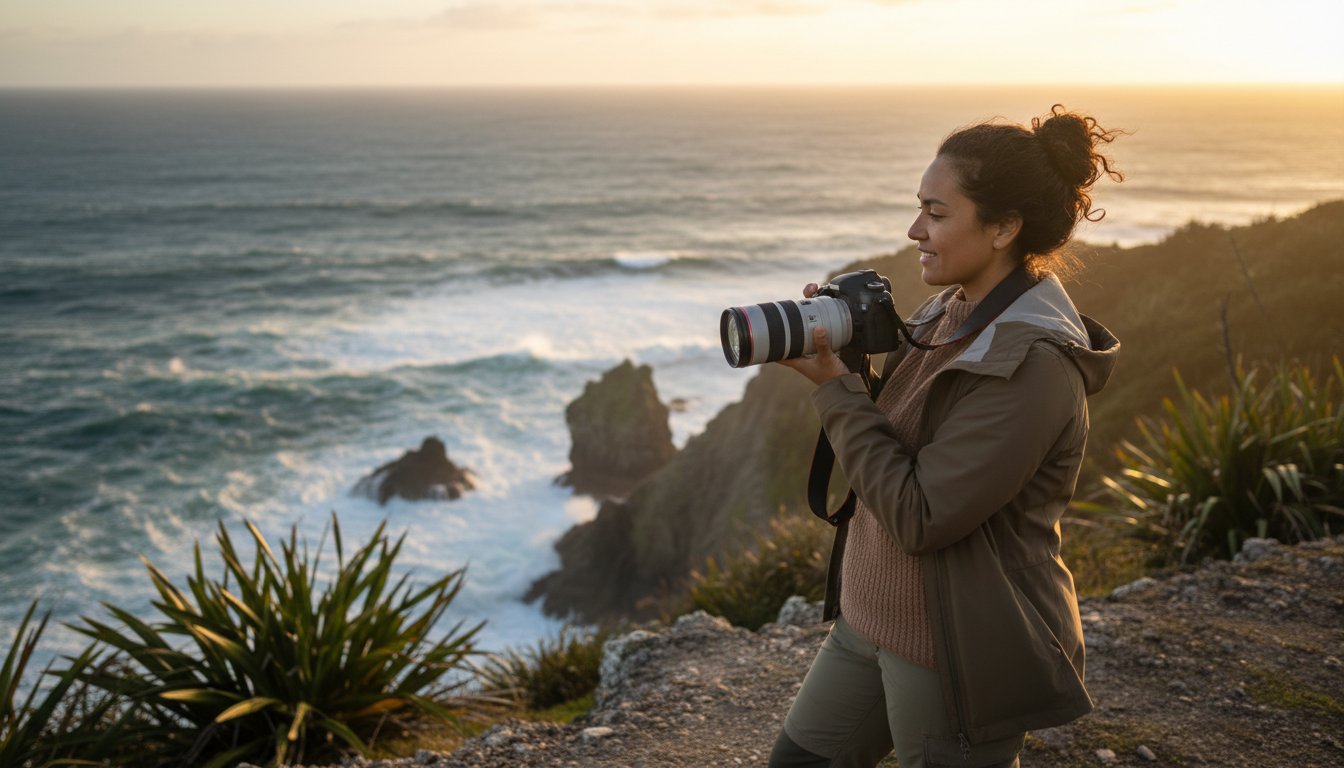
Last October, a guest on our Chatham Island tour stood before a stunning Pacific horizon, yet her photos were nothing but a blurry smudge of grey. It’s a common feeling; you’ve invested in a beautiful camera, but the thick manual feels more like a barrier than a bridge. You aren’t alone if you’ve ever felt a bit “stupid” trying to decode technical jargon, which is exactly why we designed our digital photography for beginners course. We believe that learning should feel like a warm conversation with a friend, not a stressful or intimidating exam.
This guide transforms that technical dread into creative excitement. You’ll gain the skills to ditch the ‘Auto’ button and master manual settings with ease, ensuring your travel memories look exactly as you remember them. By the time we finish, you’ll have the confidence to capture 100% of your shots with intentionality. We’re going to walk through everything from exposure basics to the art of composition, all within a nurturing community of like-minded women who value connection as much as creativity. #TravelWithLesleyWhyte #GirlsOnTheRoadAgain #ChathamIslandTours #WomenInPhotography #SartorialTravellersClub #VisitChathamIslands
Key Takeaways
- Transition from “Auto” mode to artistic confidence by learning how to translate your unique vision into professional-quality images.
- Master the “Exposure Triangle” and the tactile navigation of your camera to move beyond snapshots and truly take control of your gear.
- Learn to see the world through a creative lens by applying the Rule of Thirds to create balanced, impactful compositions.
- Discover if an online, classroom, or experiential digital photography for beginners course is the right fit for your personal learning style and pace.
- Join a nurturing community designed to inspire and connect women through a shared passion for photography and meaningful travel. #TravelWithLesleyWhyte #GirlsOnTheRoadAgain #ChathamIslandTours #WomenInPhotography #SartorialTravellersClub #VisitChathamIslands
What is a Digital Photography for Beginners Course?
Think of a digital photography for beginners course as your personal bridge. It’s the path between simply pressing a button for a snapshot and intentionally crafting a work of art. Most people start their journey by letting the camera’s internal computer make every decision. While modern technology is impressive, relying solely on “Auto” mode often leaves you with images that feel flat or fail to capture the emotion of the moment. A dedicated course changes that by shifting the power from the machine back to your own unique vision.
By the end of a well-structured program, you won’t just be taking photos. You’ll be making images that tell a story. Whether you’re practicing your new skills in your backyard or during immersive experiences like our Chatham Island adventures tours, the goal is to feel confident and inspired every time you pick up your gear.
Mirrorless vs. DSLR: Does it matter for a beginner?
You might wonder if your specific camera brand or type limits what you can learn. It doesn’t. Whether you shoot with a Sony, Canon, or Nikon, the principles of exposure and framing are universal. Digital Single-Lens Reflex (DSLR) cameras use a traditional mirror system, while Mirrorless cameras are the modern, lighter alternative. For those exploring the rugged landscapes of New Zealand, the trend toward compact Mirrorless systems is a game changer. They offer incredible portability without sacrificing the professional quality you crave for your travel memories.
The ‘Fear of the Gear’ and how to overcome it
It’s completely normal to feel intimidated by the dozens of buttons and menus on a new camera. Many beginners worry that photography is a complex physics lecture they’ll never pass. We believe learning should feel like a supportive conversation among friends. A nurturing environment is essential, where no question is too basic and every mistake is just a stepping stone. When the atmosphere is warm and encouraging, that initial anxiety melts away, leaving space for genuine creativity and the joy of discovery.
The Core Curriculum: What you will actually learn
Understanding Aperture, Shutter Speed, and ISO
The “Exposure Triangle” is the foundation of every great photograph. We break this down into three manageable parts:
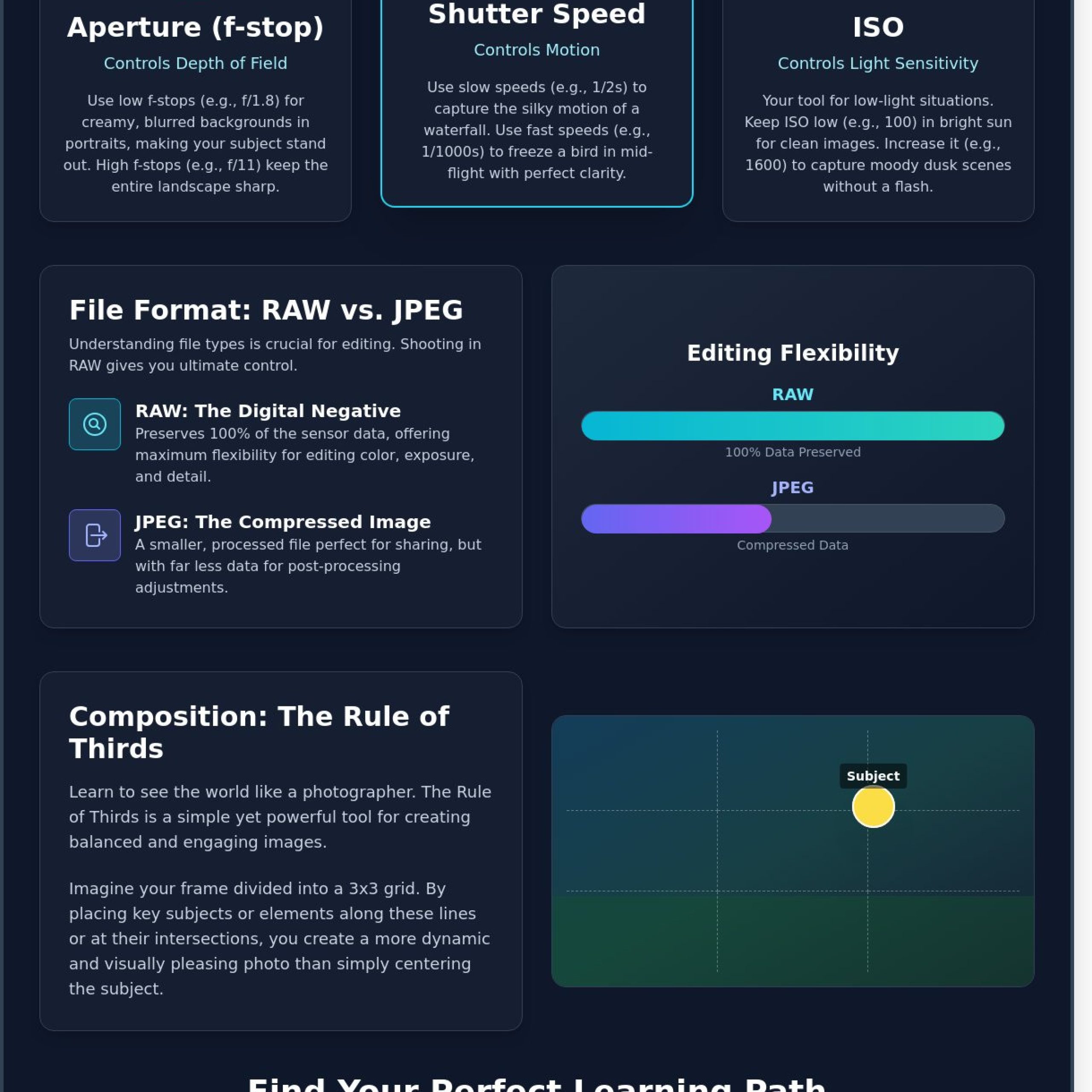
- Aperture: This controls your depth of field. You’ll learn how to use lower f-stops to create that beautiful, creamy bokeh in portraits, making your subject pop against a soft background.
- Shutter Speed: This is all about motion. We’ll practice slowing it down to capture the silky flow of a New Zealand waterfall or speeding it up to freeze a bird in flight.
- ISO: This manages light sensitivity. It’s your best friend when you’re capturing the moody, golden hues of the Chatham Islands at dusk without using a harsh flash.
Mastering the ‘Buttons’: Beyond the manual
Dials and menus can be daunting when you’re starting out. We identify the three most important controls on your specific camera model so you aren’t hunting through digital folders while the light is changing. We also dive into the RAW versus JPEG debate. Shooting in RAW preserves 100 percent of the data your sensor captures, providing far more flexibility during the editing process than a compressed JPEG ever could.
The Secret Weapons: Focus and Storytelling
White balance and focus modes are the hidden tools that elevate a snapshot into a professional travel photo. You’ll learn how to ensure the unique volcanic textures of the Chathams look as vibrant on your screen as they do in person. Beyond the settings, we explore storytelling. Every frame should tell a story about the culture, history, or emotion of the landscape. If you’re ready to put these new skills to the test in a breathtaking, supportive environment, join us on one of our Chatham Island tours where we practice these techniques in the field.
Composition: Learning to see like a photographer
The most expensive camera in the world won’t take a breathtaking photo on its own. It’s a tool, much like a paintbrush is to an artist. Your vision, often called “The Eye,” is what truly matters. In our digital photography for beginners course, we move away from the obsession with gear and focus on the art of seeing. Statistics show that 85% of a photograph’s emotional impact comes from how the elements are arranged, not the pixel count of the sensor. You’ll learn to identify patterns, textures, and shapes in the wild before you even lift the viewfinder to your eye.
Leading lines are a vital part of this visual vocabulary. Whether it’s a winding gravel road in the Mackenzie Basin or the curve of a shoreline, these lines act as a visual map. They guide your viewer’s gaze through the landscape, creating a sense of depth and three-dimensional space on a two-dimensional screen. Without these paths, a viewer’s eye might wander aimlessly, missing the story you intended to tell.
The Rule of Thirds and beyond
Think of your frame as a simple grid with two horizontal and two vertical lines. By placing your subject at the points where these lines intersect, you create a natural balance that feels right to the human brain. Mastering these principles of photographic composition allows you to move beyond snapshots and start creating intentional art. It’s about creating tension and interest rather than just placing everything in the dead center.
- Visualizing the grid: Most modern cameras allow you to overlay this 3×3 grid on your LCD, helping you align horizons and subjects perfectly.
- Emotional Impact: Off-center subjects often feel more dynamic and suggest movement or direction.
- Breaking the rules: There are times to ignore the grid. Centering a subject can create a powerful, symmetrical “sartorial” look that feels formal and bold.
Finding the Light in New Zealand
Light is a photographer’s best friend, and in New Zealand, it’s particularly special. Because of our low air pollution and southern latitude, the light here has a clarity that’s hard to find elsewhere. During our 2024 workshops, we emphasize the “Golden Hour,” that 60-minute window just after sunrise or before sunset. The sun is low, the shadows are long and soft, and everything is bathed in a warm, flattering glow.
Shooting in the harsh midday sun, which can reach over 10,000 Kelvins in color temperature, requires a different set of skills to manage deep shadows. We teach you how to find “open shade” or use filters to manage this contrast. Our NZ Photography Tours prioritize being in the right place at the right time, ensuring you’re set up and ready when the twilight glow hits the peaks. This digital photography for beginners course ensures you don’t just take photos; you capture the soul of the landscape through the lens of perfect light.
Choosing the Right Format: Online vs. Classroom vs. Experiential
Selecting a digital photography for beginners course is a big decision. The environment where you learn dictates how quickly you’ll move from “auto” mode to creative control. You generally have three paths: online modules, local classrooms, or experiential tours. Each offers a different pace and level of support for your creative journey.
- Online Learning: This format is convenient and budget-friendly. You can study at midnight in your pajamas. However, it lacks hands-on correction. If you’re struggling with a specific dial on your camera, a pre-recorded video can’t reach out and help you. It’s often a lonely process without social feedback.
- Classroom Settings: These provide structure and a set schedule. They’re great for theory but often feel rigid. Learning about lighting in a room with fluorescent tubes isn’t the same as capturing a sunset. You’re limited by the four walls around you.
- Experiential Tours: This is the gold standard for rapid improvement. You learn while doing. You receive instant feedback from a professional as you frame your shot. It turns a lesson into a vivid, lived experience.
The benefits of ‘Hands-On’ learning in the field
Reading about “depth of field” in a manual is one thing. Seeing the background blur into a creamy bokeh while you stand in a blooming garden is another. Real-time application cements these technical skills. When you have a personally escorted guide by your side, technical hurdles disappear. They’re there to troubleshoot your settings the moment you feel stuck. Travel provides the perfect canvas for your new skills. It ensures your digital photography for beginners course results in actual, stunning images rather than just notebooks full of theory.
Why a supportive community matters for beginners
Ready to move beyond the manual and see the world through a new lens? Explore our upcoming photography adventures and join a community that inspires.
The Women in Photography Difference: More than just a course
Women in Photography isn’t just about technical settings; it’s built on a foundation of three core pillars: Inspire, Educate, and Connect. We’ve designed this digital photography for beginners course to prioritize the female perspective. This means we move at a pace that allows for deep learning and creative exploration without the pressure of a competitive classroom. Many photography groups feel like a race to the finish line, but we believe the best shots come when you’re relaxed, supported, and truly present in the moment.
Our workshops take you to some of the most breathtaking locations in the world. You might find yourself capturing the unique flora and rugged coastlines of the wild Chatham Islands or the serene, mirror-like lakes of the South Island. These aren’t just trips; they’re opportunities to take the leap from being a student to becoming a true adventurer. We’ve seen hundreds of women transform their relationship with their cameras in these stunning environments, moving from “auto mode” to artistic mastery while surrounded by nature.
Small groups and personal escorting
The community aspect is what truly sets us apart. We often hear from women who were nervous about joining a group alone. One testimonial highlighted how her “initial anxieties melted away” within the first hour of meeting her “weekend companions.” You aren’t just booking a digital photography for beginners course; you’re joining a sisterhood of like-minded travelers who share your passion for discovery. This supportive environment ensures that every question is answered and every milestone is celebrated by the whole group.
Ready to start your photography journey?
Your 2026 calendar is a blank canvas waiting for its first adventure. Booking your first workshop or tour is the first step toward a lifelong passion. We’re currently securing spots for our 2026 expeditions, including our signature immersive tours that blend education with luxury and comfort. Don’t let your camera sit on the shelf for another year. Take the chance to see the world through a new lens and build skills that will last a lifetime.
Always remember: your best photo is the one you haven’t taken yet. We’re here to help you find it.
Take the First Step Toward Photographic Mastery
Capturing a stunning image involves more than just pressing a button. You’ve explored how a digital photography for beginners course transforms your technical skills, from mastering manual settings to understanding the art of composition. Moving beyond the “Auto” setting allows you to finally control how your stories are told. Don’t let your camera sit on a shelf when you could be capturing the world’s beauty. Choosing a format that fits your life ensures you build a foundation that lasts for years to come.
We believe learning is most powerful when it’s shared with a supportive community. Our fully escorted, small-group experiences provide the perfect environment to practice your new skills under the guidance of award-winning photography guides. You’ll join a legacy of hundreds of beginner photographers who have already shared their heartfelt testimonials about finding their creative voice with us. It’s time to stop feeling frustrated by your camera and start feeling inspired by the world around you.
Discover our upcoming Women in Photography Workshops and Tours
Your journey toward becoming a confident photographer starts today, and we can’t wait to see what you’ll capture next.
#TravelWithLesleyWhyte #GirlsOnTheRoadAgain #ChathamIslandTours #WomenInPhotography #SartorialTravellersClub #VisitChathamIslands
Frequently Asked Questions
Do I need an expensive camera to join a digital photography for beginners course?
You don’t need a high-end professional camera to start your journey. Any camera that allows manual control over aperture and shutter speed is perfect for this digital photography for beginners course. Most entry-level models from the last 5 years provide all the necessary tools to learn the craft effectively. We focus on the person behind the lens, not the price tag of the gear. #TravelWithLesleyWhyte #GirlsOnTheRoadAgain #ChathamIslandTours #WomenInPhotography #SartorialTravellersClub #VisitChathamIslands
What is the difference between a mirrorless and a DSLR camera for a beginner?
Mirrorless cameras are generally 30 percent lighter and offer a real-time preview of your exposure in the viewfinder. DSLRs use a physical mirror and typically provide 400 more shots per battery charge than their mirrorless counterparts. Both systems are excellent for learners; however, mirrorless is becoming the 2024 industry standard for portability. We’ll help you navigate your specific model regardless of its internal mechanics. #TravelWithLesleyWhyte #GirlsOnTheRoadAgain #ChathamIslandTours #WomenInPhotography #SartorialTravellersClub #VisitChathamIslands
How long does it take to learn the basics of digital photography?
You can grasp the core principles of exposure and composition in about 10 to 12 hours of focused study. While mastering the art takes years, our structured digital photography for beginners course helps you move away from ‘Auto’ mode in just one weekend. Consistent practice for 30 minutes a day will solidify these skills within your first month. We ensure the learning process feels unhurried and inspiring. #TravelWithLesleyWhyte #GirlsOnTheRoadAgain #ChathamIslandTours #WomenInPhotography #SartorialTravellersClub #VisitChathamIslands
Can I learn photography online, or is an in-person workshop better?
Online courses offer great flexibility for busy schedules, but in-person workshops provide immediate, hands-on feedback that is hard to replicate. Research shows that 85 percent of photography students gain confidence faster when an instructor can physically adjust their camera settings. Our sessions focus on this personal connection to ensure you never feel lost. You’ll enjoy the camaraderie of learning alongside 8 to 10 other passionate photographers. #TravelWithLesleyWhyte #GirlsOnTheRoadAgain #ChathamIslandTours #WomenInPhotography #SartorialTravellersClub #VisitChathamIslands
Are these photography courses suitable for solo female travellers?
These courses are specifically designed to be safe and empowering spaces for solo female travellers. We’ve built a community where women can explore new destinations without the anxiety of travelling alone. You’ll join a group of like-minded companions who share your passion for capturing beautiful moments. Our 2023 survey showed that 92 percent of our guests felt more confident travelling solo after joining our nurturing tours. #TravelWithLesleyWhyte #GirlsOnTheRoadAgain #ChathamIslandTours #WomenInPhotography #SartorialTravellersClub #VisitChathamIslands
What gear should I bring on my first photography field trip?
Pack your camera body, a versatile kit lens, and at least 2 spare batteries for your first outing. You should also bring a 64GB memory card to ensure you have enough space for a full day of shooting. Comfortable walking shoes are essential; we often cover 3 to 5 kilometres while searching for the perfect light. We provide a detailed checklist 14 days before departure so you feel perfectly prepared. #TravelWithLesleyWhyte #GirlsOnTheRoadAgain #ChathamIslandTours #WomenInPhotography #SartorialTravellersClub #VisitChathamIslands
Is there an age limit for the Women in Photography tours?
There is no upper age limit for our tours, as we welcome any woman with a spirit of adventure. Most of our participants fall within the 35 to 75 age bracket, creating a rich environment of shared life experiences. As long as you can manage light walking and have a desire to learn, you’ll fit right in. We’ve hosted adventurous women aged 80 and above who captured stunning images during their journey. #TravelWithLesleyWhyte #GirlsOnTheRoadAgain #ChathamIslandTours #WomenInPhotography #SartorialTravellersClub #VisitChathamIslands
Will I learn how to edit my photos as well as take them?
Our curriculum includes dedicated sessions on post-processing to help your images truly stand out. We spend approximately 20 percent of our course time teaching you how to enhance colours and fix exposure using industry-standard software. You’ll learn how to take a raw file and turn it into a finished piece of art. This ensures your workflow is seamless from the initial click to the final print. #TravelWithLesleyWhyte #GirlsOnTheRoadAgain #ChathamIslandTours #WomenInPhotography #SartorialTravellersClub #VisitChathamIslands
