There was a time when river cruising was viewed simply as a relaxing way to travel between destinations. Today, however, a new style of cruising is capturing the imagination of travellers seeking something far more meaningful: women-only river cruises.
Across Europe, women are increasingly choosing journeys that combine culture, friendship, comfort and discovery with the confidence of travelling alongside like-minded travellers. From solo adventurers to lifelong friends travelling together, women-only departures are creating a travel experience that feels welcoming, enriching and genuinely enjoyable.
At Travel With Lesley Whyte, we’ve witnessed first-hand the growing demand for women-only travel experiences. More women are seeking opportunities to explore the world without compromise, enjoy authentic cultural encounters, and form lasting friendships while discovering remarkable destinations.
One of the most exciting examples of this trend is our upcoming Barcelona and Rhône River Cruise through Spain and France.
What if your next New Zealand adventure didn’t involve being “just a number” on a 50-seat coach or squinting at a map in a lonely rental car? In 2026, many travellers over 60 find that while the desire for discovery remains strong, the logistical hurdles of planning all-inclusive tours for seniors nz can feel overwhelming. You likely want to see the rugged beauty of the Chatham Islands or the hidden corners of the South Island, yet the fear of hidden costs and the anxiety of solo travel often keep those dreams grounded. It’s a common worry, but your holiday should be about inspiration, not administration. You deserve a journey that feels like a personal invitation rather than a transaction.
This guide explores how you can reclaim that sense of wonder through a seamless, worry-free holiday. We promise to show you how to access New Zealand’s most remote destinations with the safety and camaraderie of a small, personally escorted group of just 8 to 12 people. You’ll learn how expert guidance adds genuine depth to the scenery, ensuring every moment is meaningful rather than just a photo opportunity. We’ll preview the best ways to secure a journey where every detail is meticulously planned, from the first flight to the final farewell dinner. This is your chance to focus on building lasting connections with like-minded companions while we handle the rest.
Learn how to transition from exhausting logistics to deep immersion by eliminating the decision fatigue of modern travel planning.
Identify the essential inclusions of premium all-inclusive tours for seniors nz to ensure your 2026 budget covers everything from regional flights to daily comforts.
Discover why small-group intimacy is the key to accessing New Zealand’s most remote “bucket list” destinations that large coaches simply cannot reach.
Explore the top 2026 destinations for senior adventurers, featuring the rugged Chatham Islands and the hidden corners of the South Island.
Understand the “personally escorted” difference, where meticulous planning and a supportive community create a seamless, worry-free journey. #TravelWithLesleyWhyte #GirlsOnTheRoadAgain #ChathamIslandTours #WomenInPhotography #SartorialTravellersClub #VisitChathamIslands
Why All-Inclusive Travel is the Gold Standard for Seniors in New Zealand
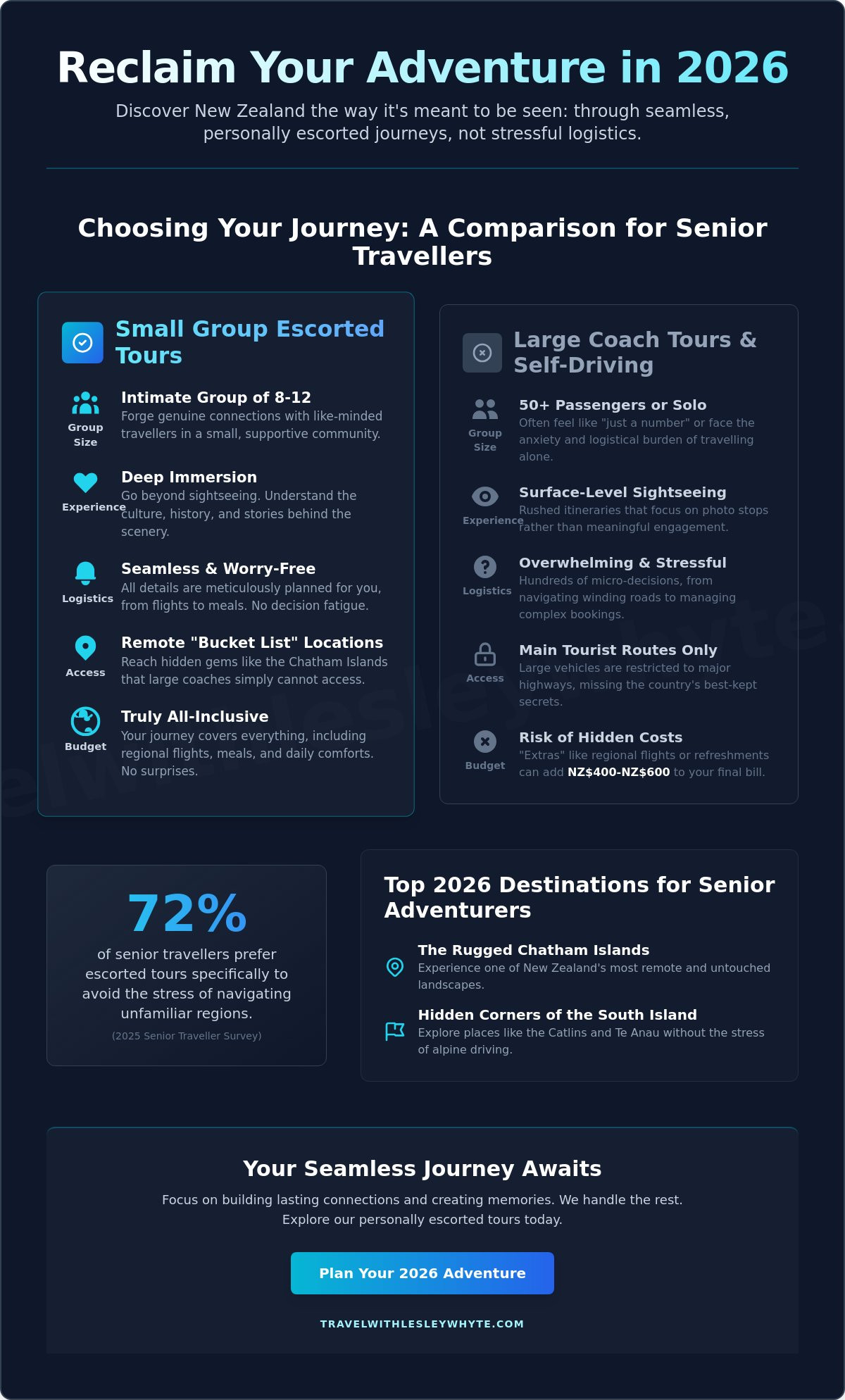
By 2026, the way we explore Aotearoa has shifted from simple sightseeing to deep, meaningful immersion. Many travellers in the 50+ demographic are moving away from rushed itineraries that only scratch the surface. They want to feel the pulse of a place, understand its history, and connect with locals on a personal level. Opting for all-inclusive tours for seniors nz ensures that every moment is spent experiencing the beauty of the country rather than squinting at a GPS or managing complex bookings. A 2025 survey of senior travellers showed that 72% prefer escorted tours specifically to avoid the stress of navigating unfamiliar regions.
Planning a trip across both islands involves hundreds of micro-decisions. From selecting the right accommodation in Te Anau to finding a reliable shuttle in the Catlins, the logistics can be exhausting. New Zealand’s tourism industry is vast and complex; trying to manage it alone often leads to decision fatigue. A fully escorted tour removes this weight entirely. You get to enjoy a seamless journey where the only choice you need to make is which local wine to pair with your dinner. Having a personal escort is vital in remote regions. These experts don’t just point out landmarks; they manage the small details that make a big difference, like knowing which cafes have the best accessibility or where to find the quietest viewpoints.
The Reality of Driving in New Zealand for Seniors
Driving yourself might seem like freedom, but the reality on the ground is often different. New Zealand’s roads are frequently narrow, winding, and prone to sudden weather shifts. In 2024, road safety reports highlighted that fatigue is a major factor for long-distance travellers on the South Island’s alpine passes. When you sit back in a comfortable coach, you actually see the Southern Alps instead of focusing on the white line. Professional drivers handle the unpredictable slips or road closures that can happen in places like the Haast Pass, ensuring you arrive safely and relaxed. This level of care is why all-inclusive tours for seniors nz have become the preferred choice for those who value both adventure and comfort.
Finding Community on the Road
Solo travel can feel daunting as we get older, but it shouldn’t be a barrier to adventure. Group tours provide a built-in safety net and a community of like-minded companions. It’s about more than just transport; it’s about sharing a laugh over a flat white in a hidden coastal cafe. Whether you’re interested in Chatham Island adventures tours or a photography workshop, you’ll find people who share your specific passions. These tours often feel like a family by the second day, creating a supportive environment where initial anxieties melt away. This social element is a core part of the brand’s identity, fostering lifelong friendships among those who are ready to travel differently.
What Does ‘All-Inclusive’ Actually Mean for NZ Senior Tours?
For 2026, an all-inclusive package isn’t just a booking; it’s a promise of complete peace of mind. It means your transport, premium accommodation, the majority of your meals, and all planned excursions are pre-paid and managed before you even leave home. This structure allows you to focus on the landscape rather than your wallet. When booking all-inclusive tours for seniors nz, you’re investing in a seamless adventure where the logistical heavy lifting is done for you.
Watch out for the “hidden cost” trap that often catches travelers off guard. Some operators exclude regional NZ domestic flights or small essentials like morning teas and afternoon refreshments, which can easily add NZ$400 to NZ$600 to your total spend. Always verify if these specific items are covered. For those visiting from overseas, checking safety and security information helps ensure your logistics and health requirements align with current local standards.
There’s a clear divide between standard and premium all-inclusive tours for seniors nz. Standard tours often utilize buffet-style dining and 3-star chain hotels. Premium experiences, such as our Chatham Island Adventures, focus on 4-star plus boutique stays and high-quality local cuisine that caters to your specific dietary needs. It’s about the quality of the pillow and the freshness of the Blue Cod on your plate, not just having a room and a meal provided.
The All-Inclusive Checklist for 2026
Accommodation: Stays should be central, accessible, and high-quality. We ensure no “budget” surprises, focusing on properties with lift access and walk-in showers for those who need them.
Meals: 2026 tours prioritize farm-to-table NZ cuisine. Whether it’s fresh seafood or Canterbury lamb, every meal should feel like a meaningful event rather than a cafeteria stop.
Activities: All entrance fees must be pre-booked. This avoids 30-minute queues at popular sites like Te Papa or Milford Sound, ensuring you spend your time exploring, not waiting.
The Value of a Personal Escort
An escort goes far beyond a standard tour guide. They manage group dynamics and anticipate individual needs before they even arise. They handle the “behind-the-scenes” logistics, from luggage transfers to checking room accessibility, so you don’t have to worry about a single detail. This level of care creates a supportive community where initial anxieties melt away, replaced by the joy of shared discovery. Fully Escorted is a 24/7 commitment to guest comfort where every detail is managed to ensure a seamless and supportive experience.
Small Group Intimacy vs. Large Coach Tours: Which is Right for You?
Choosing how you move through Aotearoa changes your entire experience. Big bus tours often appeal to those seeking a lower price point. These 50-seater coaches move with industrial efficiency, following a strict timetable that leaves little room for a lingering sunset or an extra cup of tea. While you’ll see the main sights, you’re often one of 45 people, making it easy to feel like just another number in the crowd. The anonymity of a large coach can feel isolating, especially if you’re looking for a deeper connection with the land.
Opting for all-inclusive tours for seniors nz that prioritize small groups offers a different world entirely. Small vans or luxury mini-coaches can navigate the winding gravel roads of the Coromandel or pull into a tiny coastal lookout that a large bus would have to bypass. This isn’t just about convenience; it’s about the quality of your adventure. You aren’t just looking at the view through a tinted window; you’re standing in it.
When the group is small, the schedule breathes. If the light is hitting a mountain range perfectly, we stop for photos. If a local cafe looks too inviting to pass, we take a longer break. For seniors with specific mobility needs, this personalized attention ensures no one feels rushed. Your escort is right there to help with a steady hand or to adjust the day’s plan if you’d prefer a quiet afternoon by the lake instead of another walk.
Accessing the ‘Real’ New Zealand
Large groups often stick to “tourist hubs” because of parking constraints and facility requirements. Small groups have the freedom to visit boutique vineyards in Central Otago or private farms in the Chatham Islands. This approach is significantly more sustainable for New Zealand’s fragile ecosystems. According to Tourism New Zealand’s 2023 sustainability framework, reducing the physical footprint of visitors is vital for long-term conservation. Smaller groups naturally integrate into local communities, making you feel like a welcomed guest rather than part of a tourist invasion.
The Social Dynamics of Small Groups
It’s much easier to form genuine bonds when you’re traveling with only 8 to 12 people. In a large group, cliques often form quickly, which can be daunting for solo travelers. Small groups foster a supportive community where everyone’s name is known by the first evening. The escort can tailor the daily rhythm to the group’s energy levels, ensuring the pace remains enjoyable for everyone. This is the heart of all-inclusive tours for seniors nz; it’s about shared stories, new friendships, and a seamless, unhurried journey through our beautiful backyard.
Top New Zealand Destinations for All-Inclusive Senior Travel in 2026
2026 is shaping up to be a landmark year for domestic exploration. New Zealand seniors are increasingly looking for more than just a standard bus tour; they want depth, connection, and a touch of the extraordinary. Choosing the right all-inclusive tours for seniors nz means finding destinations that offer a mix of luxury comfort and raw discovery. It’s about visiting those “bucket list” spots while someone else handles the luggage, the bookings, and the local permits.
Chatham Island Adventures
The Chatham Islands sit 800km east of the mainland and represent the ultimate frontier for kiwi travellers. Planning a trip here requires expert precision because the islands have fewer than 200 visitor beds and limited flight schedules. It’s a place where you’ll step back in time, enjoying world-class seafood like blue cod and crayfish while exploring the ancient Moriori dendroglyphs. Because logistics are so unique, a personally escorted tour is the only way to ensure you don’t miss the hidden gems. You can learn more in our Chatham Islands: The Ultimate Guide to an Unforgettable NZ Adventure.
Specialised Tours for Women
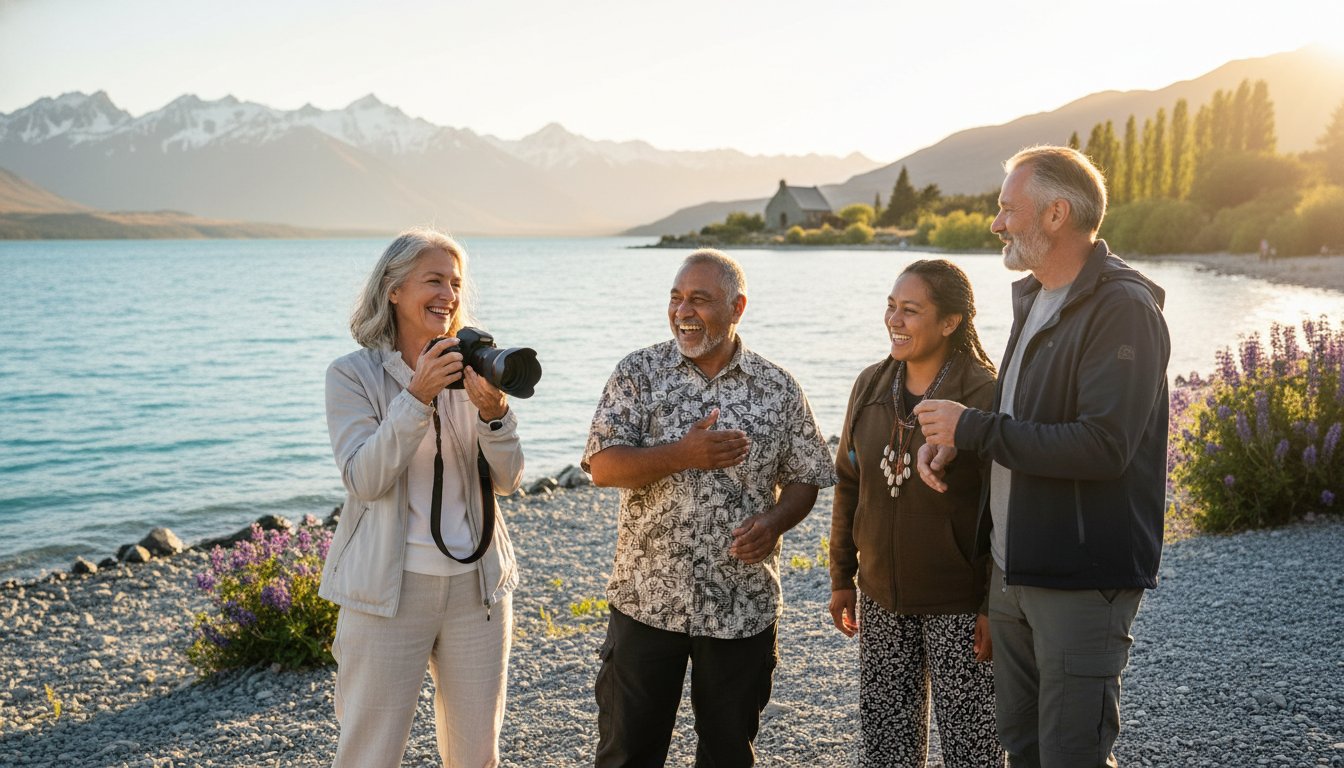
Travel is often more meaningful when shared with like-minded companions. Our Girls on the Road Again tours create a safe, supportive space for adventurous women to explore together without the pressure of a mixed group. For those with a creative spark, the Women in Photography tours combine travel with hands-on skill-building. You’ll visit New Zealand’s most photogenic spots, like the Moeraki Boulders or the lupins of Lake Tekapo, with a professional guide who ensures you get the perfect shot. If you’re looking for a shorter, more focused getaway, check out our Women’s Retreat NZ: The Ultimate Guide to Finding Your Perfect Escape.
Beyond the typical tourist hubs, 2026 will see a surge in interest for the South Island’s hidden corners. The Catlins offers a rugged, prehistoric beauty with its waterfalls and petrified forests, while Stewart Island provides a rare chance to see kiwi in their natural habitat. To make the most of these locations, seasonal timing is everything. The “sweet spots” for 2026 are autumn (March to May) and spring (September to November). These months avoid the 30-degree summer heat and the heavy winter frosts, offering stable weather that’s perfect for light walking and outdoor photography.
Autumn 2026: Best for the golden hues of Central Otago and calm weather in the Chathams.
Spring 2026: Ideal for seeing newborn wildlife and vibrant floral displays in Christchurch gardens.
Niche Focus: Look for tours that offer specific themes, such as heritage trails or coastal photography, to add value to your journey.
Ready to start your next chapter of discovery? Book your next seamless journey with us at Travel with Lesley Whyte today.
The Lesley Whyte Difference: Personally Escorted Journeys
Lesley Whyte doesn’t just sell trips; she stakes her reputation on every itinerary she creates. When you choose her all-inclusive tours for seniors nz, you’re opting for a level of personal accountability that large travel corporations simply can’t match. Every hotel is vetted for comfort and accessibility. Every restaurant is chosen for its local flavour and consistent quality. This meticulous approach ensures your 2026 adventure isn’t left to chance, but is instead a carefully crafted masterpiece.
The feedback from past travellers highlights a recurring theme of feeling “nurtured” throughout the entire process. One guest from a 2023 Chatham Islands tour noted that her initial anxieties about solo travel melted away within hours of meeting Lesley. Another guest praised the “seamless” nature of the logistics, stating they wanted for nothing because every need was anticipated before they even thought to ask. It’s this high-touch service that defines the brand’s reputation across New Zealand.
Meet Your Escort: More Than Just a Guide
Lesley’s philosophy focuses on creating meaningful journeys that celebrate local culture and nature. It isn’t just about ticking boxes on a map; it’s about deep, authentic connection with the land and its people. By joining a tour, you’re invited into the Wanderlust Travellers Club. This is a community of like-minded explorers who often return year after year, forming friendships that last long after the suitcases are unpacked. The club has seen a 25% increase in membership over the last two years, reflecting a growing desire for community-centric travel.
A seamless adventure is a curated experience where every detail is managed so you can focus entirely on the beauty around you. This brand promise is the foundation of every trip, from the rugged coastlines to the quietest rural retreats. For 2026, these small-group journeys are expected to fill quickly. Most tours are strictly limited to 10 or 12 participants to ensure the intimate service Lesley is known for. Registering early isn’t just a suggestion; it’s a necessity for those wanting to secure a spot on popular routes like the Chatham Islands or the South Island photography circuits.
Ready to Travel Differently?
You’ve worked hard to reach a stage where travel should be about pleasure, not logistics. By choosing these all-inclusive tours for seniors nz, you’re investing in comfort, community, and curated excellence. You won’t find generic, cookie-cutter stops here. Instead, you’ll find a hand-selected collection of New Zealand’s best-kept secrets, shared with people who value the same things you do. It’s time to stop worrying about the “how” and start enjoying the “where.”
View the upcoming 2026 tour calendar today to find your next great escape. Spaces are limited, and the community is waiting to welcome you.
You’ve earned the right to explore New Zealand without the burden of complex logistics or heavy suitcases. Choosing all-inclusive tours for seniors nz allows you to trade travel stress for pure discovery. By joining a small group of just 8 to 12 guests, you’ll enjoy an intimate atmosphere that large coach tours simply can’t match. Every detail is meticulously planned to ensure you want for nothing while exploring remote gems like the Chatham Islands. Each journey is personally escorted by Lesley Whyte, providing the professional expertise and warm encouragement you need to feel completely looked after. It’s time to step off the beaten track and into a meaningful journey where everything is taken care of for you. We can’t wait to welcome you into our community of like-minded explorers.
Are all-inclusive tours for seniors in NZ worth the extra cost?
Yes, all-inclusive tours for seniors nz offer exceptional value by removing the stress of hidden costs and complex logistics. You’ll find that these packages bundle accommodation, gourmet meals, and transport into one transparent upfront price. This allows you to relax and enjoy a seamless adventure, knowing every detail is managed by a professional guide who prioritizes your comfort and safety.
What is the average group size for a Travel With Lesley Whyte tour?
We keep our groups intimate to ensure a personalized and meaningful journey for every guest. Typically, a tour consists of 8 to 12 like-minded travellers, which is small enough to access boutique locations that larger coaches simply can’t reach. This small size fosters a supportive community atmosphere where your host can provide the personally escorted service we’re known for.
Can solo travellers join these senior tours without a ‘single supplement’?
Solo travellers are a core part of our community and make up about 60 percent of our tour groups. While most of our guests prefer the privacy of their own room, which usually involves a single supplement, we do our best to accommodate everyone’s needs. Our tours are designed to be inclusive and welcoming, so you’ll feel like you’re travelling with a group of friends from the very first day.
How much walking is involved in your New Zealand senior tours?
Most of our itineraries require a moderate level of fitness, involving between 2 and 5 kilometres of walking daily. We prioritize accessible paths and flat terrain, but some locations may have uneven surfaces. It’s important to choose a tour that matches your physical comfort, and we provide detailed activity descriptions for each trip to help you make the right choice for your 2026 adventure.
Are flights to the Chatham Islands included in the tour price?
Yes, return flights from mainland New Zealand to the Chatham Islands are included in our specialized tour packages. We handle all the bookings with Air Chathams to ensure your transition from the mainland is completely handled. This is a key part of our all-inclusive tours for seniors nz, ensuring you don’t have to worry about coordinating remote flight schedules yourself.
What happens if I have specific dietary requirements or medical needs?
We cater to all specific dietary requirements and medical needs with meticulous care and advance planning. During the booking process, we collect detailed information about your health and food preferences to ensure our local partners are fully prepared. Your safety is our top priority, and we personally check that every meal and venue meets our high standards for your well-being.
Is travel insurance required for all-inclusive tours in New Zealand?
We strongly recommend comprehensive travel insurance for every participant on our New Zealand journeys. While the ACC system covers many accident-related costs in NZ, insurance is vital for unexpected cancellations, lost property, or medical events not caused by an accident. Having a policy in place ensures your 2026 trip remains a stress-free experience regardless of what happens.
How far in advance should I book my 2026 NZ senior tour?
You should aim to book your 2026 tour at least 10 to 12 months before the departure date. Because we limit our group sizes to just 12 guests, our most popular itineraries often sell out a year in advance. Securing your spot early is the best way to ensure you don’t miss out on these bespoke, personally escorted adventures across New Zealand.
What if your next New Zealand adventure felt less like a rigid bus schedule and more like a long, laughter-filled lunch with old friends? You’ve likely seen those massive 50-seater coaches unloading crowds at busy viewpoints and felt a pang of hesitation. It’s completely natural to worry about being treated as just another seat number or feeling rushed through a physical pace that doesn’t respect your needs. You deserve a journey that honors both your independence and your desire for meaningful connection with like-minded companions.
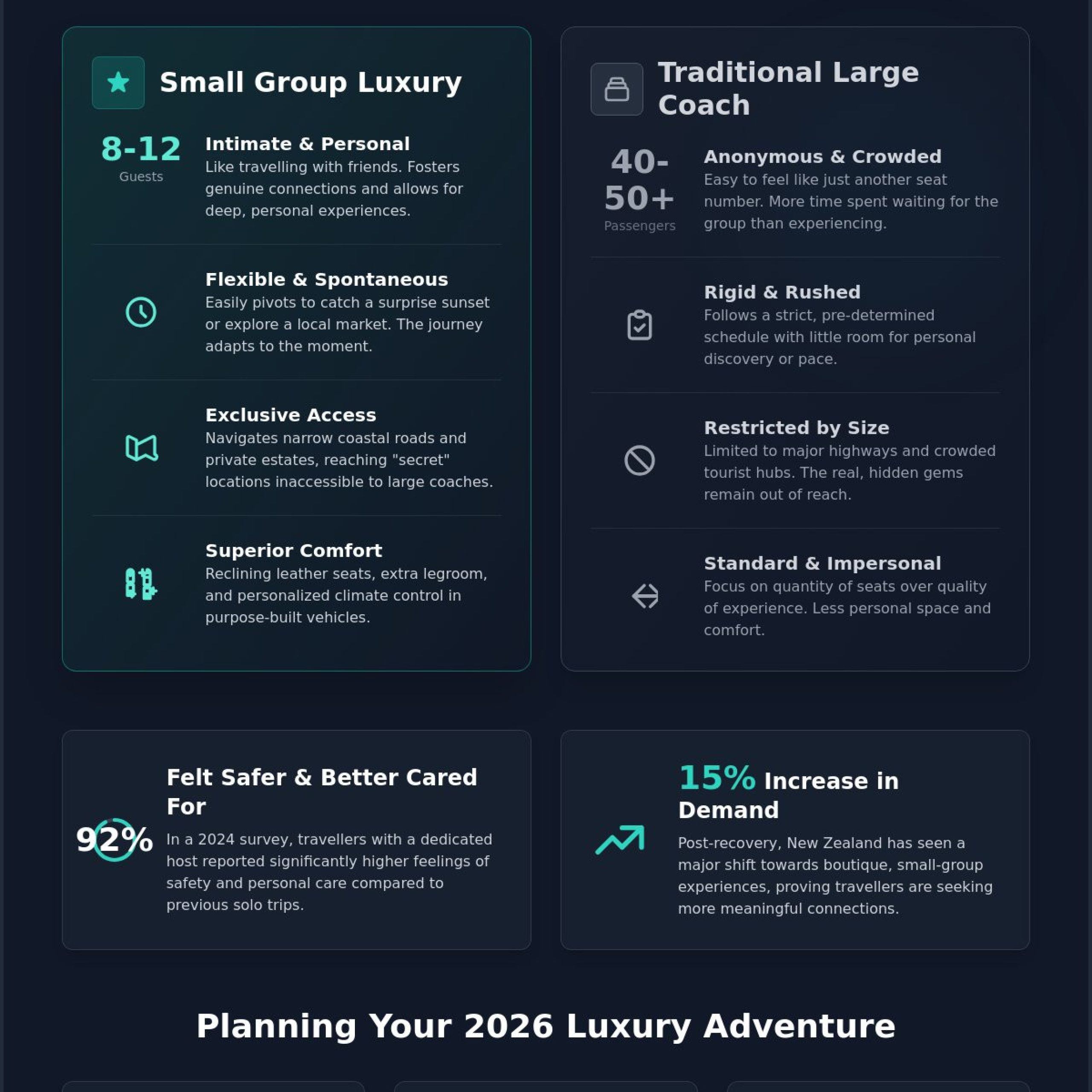
This guide promises to show you how luxury coach tours nz for seniors have been reimagined for 2026. You’ll discover the joy of intimate, personally escorted travel where every detail is handled with meticulous care. In a 2024 survey of our regular travellers, 92% stated that having a dedicated host made them feel safer and better looked after than on any previous solo trip. We’re going to explore how small-group journeys unlock “secret” New Zealand locations that big buses simply can’t access; providing you with total peace of mind and a seamless experience from start to finish.
Learn how 2026 luxury travel prioritizes a “refined pace,” giving you the time to breathe, connect with local stories, and truly immerse yourself in the landscape.
Discover why an intimate group of 8–12 like-minded travelers creates a more meaningful and flexible journey than traditional large-scale coach tours.
Understand the unique value of luxury coach tours nz for seniors that are personally escorted, ensuring you feel nurtured and well-cared for at every turn.
Explore why the South Island and the remote Chatham Islands are the ultimate destinations for seniors seeking a blend of natural beauty and deep history.
Get practical advice on securing your 2026 adventure 12–18 months in advance and packing “luxury layers” for New Zealand’s changing weather. #TravelWithLesleyWhyte #GirlsOnTheRoadAgain #ChathamIslandTours #WomenInPhotography #SartorialTravellersClub #VisitChathamIslands
What Defines ‘Luxury’ Coach Tours for Seniors in New Zealand?
Luxury in 2026 has moved past the era of gold-plated buses and rigid schedules. For the discerning traveler, luxury coach tours nz for seniors now center on curated, meaningful journeys that prioritize the quality of the experience over the quantity of stops. It is a shift from the superficial to the substantial. Guests expect a refined pace that allows ample time for photography, sharing local stories, and genuine relaxation without the pressure of a ticking clock. This evolution reflects a broader trend in how we explore the world, where the focus is on creating a deep connection with the destination.
Since the recovery of the travel sector, Tourism in New Zealand has seen a 15 percent increase in demand for boutique, small-group experiences. These tours transform the participant from a tourist into a guest. High-end accommodation isn’t just about a five-star rating; it’s about staying in locations that tell a story, like a historic homestead or a secluded eco-lodge. For those seeking truly unique destinations, Chatham Island adventures offer a perfect example of this transition, where the remote landscape meets personalized hospitality. Dining becomes an event in itself, featuring regional delicacies and wines that reflect the terroir of the landscape you’ve just traversed.
The Shift Toward Immersive Senior Travel
Modern seniors are looking for authentic experiences that resonate on a personal level. They want to engage with New Zealand’s history and nature through the eyes of experts rather than through a scripted microphone. Luxury is the freedom to be present while every detail is managed for you. When the logistics are invisible, you can fully immerse yourself in the moment. Whether you are capturing the light on a Southern Alps peak or listening to a Kaumatua share ancestral legends, the focus remains on the connection. This community-oriented approach ensures you are traveling with like-minded companions who share your passions.
Accessibility and Comfort Standards
True luxury ensures that every guest feels confident and capable throughout their journey. Itineraries are meticulously planned to be manageable for varying levels of mobility, ensuring adventure is accessible to everyone. The “seamless” promise is the backbone of this service. It includes door-to-door transfers, pre-booked entries to private estates, and professional luggage handling that removes the physical burden of travel. Small-group vehicles provide a significant advantage over large coaches. They offer:
Superior Access: The ability to navigate narrow coastal roads and reach secluded scenic lookouts where large 50-seater buses are prohibited.
Ergonomic Design: Reclining leather seats with extra legroom and individual climate control for personalized comfort.
Frequent Stops: Well-planned breaks at high-quality local cafes rather than crowded highway rest areas.
By limiting group sizes to 12 or 15 guests, the travel experience remains intimate and flexible. This allows for spontaneous detours when a pod of dolphins is spotted or a local market catches the group’s eye. It’s this level of attention that defines the new standard for luxury coach tours nz for seniors in the New Zealand landscape.
Small Group vs. Large Coach: The True Luxury Choice
The ‘Big Bus’ myth suggests that a 45-seater coach offers the pinnacle of comfort. In reality, large groups often mean less time experiencing the sights you’ve travelled so far to see. When you’re part of a group of 40 people, simple tasks like disembarking for a photo or ordering a flat white can take 30 minutes or more. In 2026, the true definition of luxury coach tours nz for seniors has shifted toward intimacy and agility.
Travelling with just 8 to 12 like-minded people transforms the journey. It’s the difference between being a number on a manifest and a guest at a dinner party. This smaller scale allows for a nimble itinerary. If the West Coast mist clears unexpectedly, a small group can pivot to catch a sunset view that a large tour would miss due to rigid scheduling. It’s about having the freedom to linger over a second glass of Central Otago Pinot Noir because the group isn’t tied to a stopwatch. Genuine friendships form naturally in these community-oriented environments, where conversations flow easily across a shared dinner table.
Accessing New Zealand’s Hidden Gems
Large coaches are physically restricted to main highways and high-volume tourist hubs. Small groups explore New Zealand’s ‘back garden’ instead. You’ll find yourself on the rugged, wind-swept coastlines of the Chatham Islands or visiting remote South Island high-country stations that haven’t seen a 50-seater bus in decades. Staying in boutique lodges is a key highlight. These properties often feature only 10 to 12 rooms, offering a level of personal service and local charm that’s impossible for large groups to access.
The Community Factor for Solo Travellers
For solo seniors, the anxieties of safety and companionship can be a barrier to adventure. While it’s wise to consult the NZ Government travel advice for seniors regarding health and insurance, the social safety net of a small group is equally vital. We foster a ‘family’ atmosphere where no one is left behind. Brands like ‘Girls on the Road Again’ provide a particularly supportive space for women, ensuring every experience is shared and every traveller feels seen. You might join as a solo explorer, but you’ll finish the tour with a new circle of friends. If you’re ready to see the country differently, you can browse our curated small-group itineraries to find your next meaningful journey.
Many standard luxury coach tours nz for seniors rely on a single driver to manage everything from navigating tight mountain passes to handling hotel check-ins. We believe that true luxury requires a more robust support system. This is why we utilize a two-tier model where a professional driver handles the road while a dedicated host manages your experience. This separation of roles ensures that your needs are never secondary to the logistics of the vehicle.
The host acts as the calm in the centre of your journey. If a sudden weather shift occurs in the Southern Alps or a guest requires unexpected medical attention, the host manages the situation discreetly and efficiently. You won’t find yourself worrying about rescheduled bookings or changing itineraries. Instead, you can focus on the landscape while your host works behind the scenes to keep the journey seamless and stress-free.
Meticulous Planning Behind the Scenes
Our philosophy is built on the idea that guests should want for nothing. This starts months before departure, as we coordinate with hand-selected experts and local guides who provide depth to every stop. Whether it’s a private vineyard tour or a historical walk through a remote settlement, these connections offer insights you won’t find in a brochure. The escort serves as the essential bridge between the traveller and the destination, ensuring every interaction feels personal and authentic. We anticipate needs before they’re even voiced, from ensuring the right seating at dinner to having extra batteries ready for your camera.
Confidence and Empowerment for Seniors
It’s common for travellers to feel a flicker of anxiety before a big trip, especially when visiting remote locations like the Chatham Islands. We’ve seen these anxieties melt away within the first few hours of a tour. The presence of a nurturing host gives guests the safety net they need to try new things. You might find yourself finally mastering wildlife photography or joining a group for a coastal walk you would have skipped if travelling alone.
The magic often happens through the bond of like-minded companions. Travelling with others who share your interests and life stage builds a unique kind of confidence. Our small groups foster a community where everyone feels included and supported. This environment turns a simple holiday into a meaningful journey, defined by the signature personal touches that Lesley Whyte is known for. It’s about more than just seeing New Zealand; it’s about experiencing it with total peace of mind.
Top New Zealand Destinations for Refined Senior Tours
New Zealand offers landscapes that demand more than a quick glance through a window. For those seeking luxury coach tours nz for seniors, the focus shifts from ticking boxes to deep immersion. The South Island remains a powerhouse of scenery, but the most discerning travelers are now looking toward the edges of the map for something truly rare. These tours aren’t just about transport; they’re about curated access to places that feel untouched by time.
The Chatham Islands: A World Apart
Roughly 800 kilometers east of Christchurch lies an archipelago that feels like another era. The Chatham Islands: The Ultimate Guide to an Unforgettable NZ Adventure showcases why this is the ultimate bespoke choice. It’s a place where you can explore unique Moriori culture and see endemic birdlife found nowhere else on earth. For the traveler who has already seen the “main” islands, the Chathams offer a sense of discovery that’s increasingly hard to find. It’s a step back in time where the hospitality is as rugged and genuine as the coastline.
South Island Spectacles at a Slower Pace
The best South Island Tours prioritize your comfort over constant transit. We utilize a “hub and spoke” touring model. This means you might stay three or four nights in a single luxury location, like a lodge overlooking the Marlborough Sounds or a premium hotel near Aoraki Mount Cook. You don’t have to pack your suitcase every morning. Instead, you enjoy day trips to Milford Sound or the glaciers, returning to the same plush pillow each night. This approach allows for a much deeper connection with the landscape and the local community.
Rakiura / Stewart Island: The Wild Frontier
New Zealand’s third island is a sanctuary for those who value silence and natural beauty. Our Stewart Island / Rakiura guide highlights why this is a must-visit for nature lovers. It’s one of the few places where you can reliably see the Stewart Island brown kiwi in its natural habitat. With very few cars and a tiny local population, the island offers an incredible opportunity for star-gazing under some of the world’s darkest skies. It’s the perfect destination for seniors who want to experience the “edge of the world” without sacrificing the comforts of a professionally escorted tour.
Many of these routes are specifically designed for photography enthusiasts. You’ll travel with expert guides who know exactly when the light hits the Southern Alps or how to capture the moody mists of the Fiordland bush. You don’t need to be a professional; you just need a desire to see Aotearoa through a more focused lens. We ensure there’s always enough time at each stop for you to get the perfect shot without feeling rushed by a rigid schedule.
Ready to explore these iconic landscapes with a group of like-minded travelers? View our upcoming 2026 tour dates and start planning your next meaningful journey.
Planning Your 2026 Luxury Adventure: Practical Tips
Booking your spot on one of the premier luxury coach tours nz for seniors isn’t something you should leave until the last minute. Because these curated small-group experiences often limit guest numbers to just 10 or 12 people, the most popular 2026 dates will likely sell out 12 to 18 months in advance. Planning early ensures you secure your preferred cabin on a fjord cruise or that specific boutique hotel room with a majestic view of Lake Tekapo. Early birds also get the pick of the best flight connections before prices climb.
Packing requires a strategic approach. New Zealand is famous for experiencing four seasons in a single day. You’ll want a ‘luxury layers’ wardrobe. Think high-quality NZ merino wool base layers, a breathable waterproof jacket, and comfortable walking shoes with excellent grip. This setup keeps you warm during a crisp morning in the Southern Alps and cool during a sunny afternoon in a Northland vineyard. Don’t forget a slightly dressier outfit for those special lodge dinners, though the vibe in New Zealand remains elegantly casual.
Travel insurance is absolutely non-negotiable for 2026 travel. Look for comprehensive policies that specifically cover pre-existing conditions and provide generous medical evacuation limits. Seniors should prioritize ‘cancel for any reason’ clauses. This protects your investment against unexpected life events or health changes. It’s about peace of mind; you want to know that if things change, your hard-earned savings are protected.
Choosing the Right Tour Operator
Don’t be afraid to ask direct questions before you pay a deposit. Ask exactly how many people will be on the coach. A true luxury experience shouldn’t feel crowded. Inquire about who your escort is; you want a seasoned professional who knows the local history, not just a driver. Watch out for hidden costs like ‘optional’ excursions that should be part of the package. Choosing a local, NZ-owned company ensures your money stays in the community. You’ll gain authentic insights and access to private locations that international chains often miss.
Final Steps to a Seamless Journey
If your itinerary includes a flight to the Chatham Islands or the ferry to Stewart Island, prepare for smaller scales. These journeys are part of the adventure but require light packing and a flexible mindset. Most high-end tours now include a pre-tour ‘meet and greet’ or a digital briefing. These sessions are vital. They help settle nerves, introduce you to your fellow companions, and ensure everyone is on the same page before the first day. You’ll feel like you’re traveling with friends from the very start. Ready to explore? Join the Wanderlust Travellers Club to start your journey today.
Choosing the right way to see Aotearoa makes all the difference in your travel experience. You’ve seen how small group travel prioritizes your comfort and allows for those spontaneous, off-the-beaten-path moments that big buses simply can’t reach. By opting for luxury coach tours nz for seniors, you’re choosing a seamless adventure where every detail is thoughtfully planned by a 100% NZ owned and operated team. Our 2026 itineraries focus on authentic connections, whether you’re joining our specialized women-only brands like Girls on the Road Again or learning from award-winning photography guides. These personally escorted journeys ensure you’re never just a number; you’re part of a supportive community of like-minded travelers who value depth over distance. It’s time to trade the stress of planning for the joy of discovery. Your next meaningful journey is waiting to be uncovered across the stunning landscapes of the North and South Islands.
We can’t wait to welcome you on the road for an experience that feels like traveling with a group of dear friends. Let’s make your 2026 travel dreams a reality together.
What is the average group size for a luxury coach tour with Lesley Whyte?
Our luxury coach tours nz for seniors maintain an intimate group size of 8 to 12 travellers. This small-group approach ensures you receive personal attention and can access boutique locations that larger coaches simply can’t reach. It fosters a genuine community atmosphere where you’ll quickly feel like you’re travelling with friends rather than strangers. We believe these smaller numbers create a far more meaningful and authentic journey for everyone involved.
Are these tours suitable for solo female travellers over 60?
Absolutely, our tours are specifically designed with the solo female traveller in mind. Approximately 70% of our guests join us solo, and we provide a safe, supportive environment through our Girls on the Road Again brand. You’ll have the choice of your own room for complete privacy or the option to share with a like-minded companion. Our community is built on connection, so you’ll never feel alone unless you choose to be.
How much walking is involved in your senior-focused itineraries?
We design our itineraries with a relaxed pace philosophy, typically involving 1 to 2 kilometres of walking per day on flat or well-maintained surfaces. We always provide alternative options if a particular walk feels too strenuous for your comfort. Our goal is to ensure you experience the scenery comfortably without feeling rushed or physically overextended. We carefully select paths that allow you to enjoy New Zealand’s nature at your own speed.
Do your tours include flights to destinations like the Chatham Islands?
Yes, our Chatham Island Adventures tours include return flights from Auckland, Wellington, or Christchurch. We handle all the logistics of your Air Chathams booking so your experience is seamless from the moment you arrive at the airport. This all-inclusive approach means you don’t have to worry about coordinating complex regional flight schedules yourself. We ensure your transition from the mainland to the islands is handled with meticulous care and professional attention.
Is travel insurance required for seniors on New Zealand tours?
We require all guests to hold comprehensive travel insurance for the duration of their tour. This policy must cover medical emergencies and trip cancellations to protect your financial investment. Since 2022, we’ve seen an increase in unexpected travel disruptions, so having robust cover ensures you have total peace of mind while exploring. It’s a vital step in our planning process to ensure every traveller is protected against any unforeseen circumstances during their journey.
What makes a ‘personally escorted’ tour different from a standard guided tour?
A personally escorted tour means Lesley Whyte or a dedicated host travels with you from start to finish. Unlike standard tours where a driver might also act as a guide, we provide a separate host to manage every small detail and personal request. This 24/7 presence ensures a high level of care and a truly bespoke travel experience. You can relax knowing a professional is always on hand to ensure everything runs smoothly and comfortably.
Can you accommodate specific dietary requirements on these luxury tours?
We cater to all specific dietary requirements, including gluten-free, dairy-free, and vegan needs. Please inform us of your requirements at least 30 days before departure so we can coordinate with our hand-selected local restaurants and lodges. We take pride in ensuring every meal is a highlight of your luxury coach tours nz for seniors. Our team works closely with chefs across New Zealand to ensure your dining experiences are both safe and delicious.
What is the best time of year for seniors to tour New Zealand?
The shoulder seasons of March to May and September to November offer the most comfortable conditions for senior travellers. During these months, temperatures typically range between 15 and 22 degrees Celsius, which is ideal for active sightseeing. You’ll also encounter fewer crowds at iconic locations compared to the peak summer period of December and January. It’s the perfect time to enjoy the crisp air and vibrant colours of the New Zealand landscape.
Last March, Margaret stood on the shores of Lake Tekapo and realized she hadn’t touched a suitcase or checked a map in seven days. She was experiencing one of the premier fully guided tours nz for seniors, where the focus is on the moment rather than the schedule. You likely agree that travel should feel like a reward, not a logistical puzzle. It’s natural to feel anxious about being just a number on a large coach or worrying if the physical pace will leave you exhausted. You deserve a journey where your comfort and connection to the land come first.
This guide helps you identify the best small-group adventures for the 2026 season. We promise to show you how to choose a seamless, personally escorted adventure that prioritizes intimacy and authentic local encounters so you’ll want for nothing. You’ll learn what to look for in an itinerary to ensure you’re well looked after from the moment you arrive. We’ll preview the top immersive experiences that turn strangers into lifelong companions while exploring New Zealand’s most breathtaking corners. #TravelWithLesleyWhyte #GirlsOnTheRoadAgain #ChathamIslandTours #WomenInPhotography #SartorialTravellersClub #VisitChathamIslands
Key Takeaways
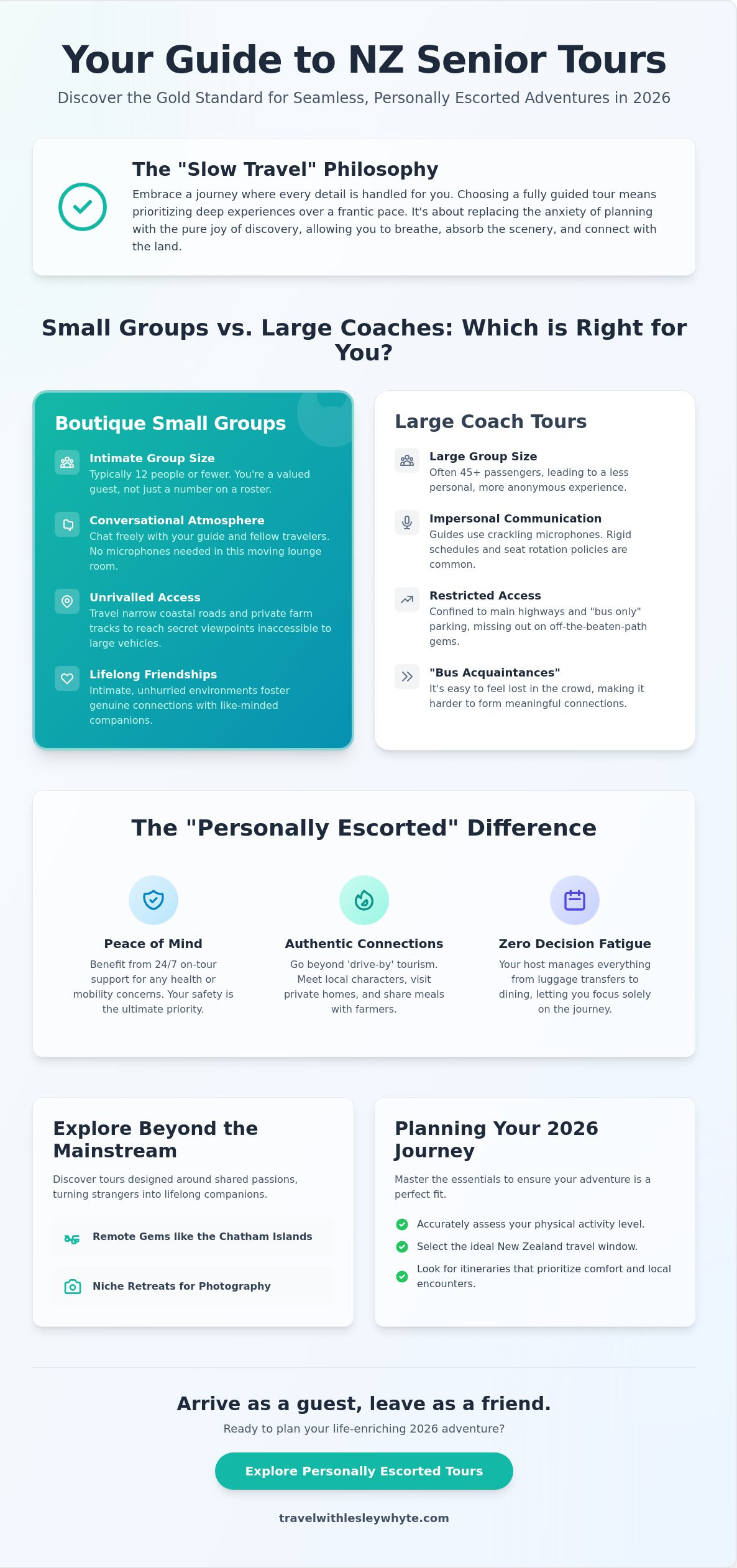
Discover why “slow travel” and seamless, end-to-end service define the gold standard for fully guided tours nz for seniors in 2026.
Learn the logistical advantages of boutique small groups over large coaches, prioritizing intimate connections and flexible, conversational seating.
Explore the allure of remote gems like the Chatham Islands and the rise of niche retreats designed around photography and shared passions.
Master the essentials of planning your journey, from accurately assessing your physical activity level to selecting the ideal New Zealand travel window.
Experience the “Personally Escorted” difference that ensures you arrive as a guest and leave as a friend. #TravelWithLesleyWhyte #GirlsOnTheRoadAgain #ChathamIslandTours #WomenInPhotography #SartorialTravellersClub #VisitChathamIslands
Why Fully Guided Tours are the Gold Standard for Seniors in NZ
Choosing fully guided tours nz for seniors means choosing a seamless, end-to-end experience where every logistical detail is handled by a professional host. In 2026, the travel market has shifted significantly toward ‘slow travel.’ This movement prioritizes the depth of an experience over the frantic pace of ticking off every landmark in a single week. For the senior traveler, this transition offers a chance to actually breathe and absorb the scenery without the stress of constant movement.
A fully guided experience removes decision fatigue entirely. You won’t spend hours debating which restaurant is open or how to navigate winding rural roads in a rental car. Instead, your host manages everything from luggage transfers to dining reservations. This allows you to focus solely on the journey. Having a personally escorted expert who understands the local terrain and culture ensures that your itinerary is both efficient and enriching. It’s about replacing the anxiety of planning with the joy of discovery.
The Peace of Mind Factor: Safety and Support
Safety is a primary concern for many travelers, especially when exploring the rugged landscapes of the South Island or the remote reaches of the North. Fully guided tours provide 24/7 on-tour support to handle any health or mobility concerns that may arise. You can expect seamless transitions between transport, accommodation, and activities, ensuring you’re never left waiting on a cold platform or searching for a lost booking. Personally escorted travel serves as the ultimate safety net for solo senior travelers, providing a constant point of contact and a community of peers.
Authentic Connection Over Sightseeing
There’s a vast difference between ‘drive-by’ tourism and immersive travel. While many large bus tours only offer a brief glimpse of a mountain through a window, small group adventures focus on meeting local characters and visiting private homes. As the landscape of Tourism in New Zealand continues to evolve, the demand for high-quality, guided experiences has reached new heights. A guide acts as a cultural bridge, offering deep insights into New Zealand’s history and Māori heritage that you simply won’t find in a guidebook.
The Travel With Lesley Whyte philosophy centers on ‘meaningful journeys’ that go beyond the surface. These tours are designed to foster genuine connections between travelers and the places they visit. Whether you’re sharing a meal with a local farmer or learning the stories behind a sacred site, the focus remains on authenticity. This approach ensures that your 2026 adventure isn’t just a holiday, but a life-enriching experience shared with like-minded individuals.
Small Groups vs. Large Coaches: Which NZ Tour Is Right for You?
Choosing between a 45-seater coach and a 12-person micro-group changes the entire DNA of your New Zealand holiday. Large tours rely on rigid schedules and “seat rotation” policies to ensure everyone gets a turn at the front window. In contrast, boutique small groups offer a conversational atmosphere where you can swap seats freely and chat with your guide without the need for a crackling microphone. You aren’t just another passenger; you’re a guest in a moving lounge room.
Large coaches are often restricted to main highways and designated “bus only” parking zones. This means they miss the narrow coastal roads of the Catlins or the private farm tracks that lead to secret viewpoints. When you choose fully guided tours nz for seniors that prioritize small vehicles, you gain access to places the official tourism board highlights as “off-the-beaten-path” gems. It’s the difference between seeing a landscape through a window and actually standing in it.
The social dynamic shifts significantly in a smaller setting. On a large bus, you might meet “bus acquaintances” you barely recognize by day ten. In a micro-group, you’re traveling with like-minded companions who share your interests. These journeys often lead to genuine, lifelong friendships because the environment is intimate, supportive, and unhurried.
The Flexibility of the Micro-Group
Micro-groups can pivot instantly. If a sudden West Coast downpour hits, a small group can duck into a local craft gallery or extend a long lunch at a boutique vineyard. You won’t spend your holiday waiting in line. On a large tour, 40 people checking into a hotel or using a bathroom break can take 45 minutes of your precious day. Small groups bypass this “dead time.” You also get to stay in unique Chatham Islands accommodation or rural lodges that simply don’t have the capacity for a massive coach load.
Cost vs. Value: Evaluating the Investment
Small group fully guided tours nz for seniors usually carry a higher price tag than mass-market options. However, the value lies in the 1:10 guide-to-guest ratio compared to the 1:45 industry standard. This ensures personal attention and a “personally escorted” feeling throughout the trip. True value means an all-inclusive price with no “optional” extra fees hidden in the fine print. You’re investing in a seamless, stress-free experience where every detail is meticulously handled. If you’re ready to see the country differently, our Chatham Island adventures offer the perfect entry point into intimate travel.
Remote Gems and Niche Interests: Beyond the Mainstream
Seniors in 2026 aren’t just looking for a seat on a bus; they want to stand where few others have stood. While the traditional tourist route has its charms, there’s a growing desire for the “deep New Zealand” experience. This shift has placed the Chatham Islands at the top of the bucket list for adventurous retirees. Located about 800 kilometres east of the mainland, these islands offer a step back in time. However, the lack of traditional tourist infrastructure means that fully guided tours nz for seniors are the only practical way to manage the complex logistics of island life.
Remote travel requires a different level of care. When you’re visiting places with limited medical facilities or unpredictable weather, having an expert guide isn’t just a luxury; it’s a safety requirement. These specialized journeys focus on quality over quantity, ensuring that every lodge, meal, and transport link is vetted for comfort and reliability.
The Chatham Islands: A Frontier Experience
The allure of the Chathams lies in its raw, 40-million-year-old geology and the unique history of the Moriori people. It’s a place where you can taste blue cod and crayfish fresh from the boat while listening to stories from locals who have lived there for generations. Flying with Air Chathams is a breeze when every transfer and lodge booking is handled for you by a host with deep local connections. Without these personal ties, many of the islands’ best spots, which sit on private land, remain inaccessible to the public. A host ensures you don’t just see the islands; you’re welcomed into the community.
Specialized Tours: Photography and Women’s Journeys
Interest-based travel is booming as seniors look to reconnect with long-lost hobbies or find new passions. “Women in Photography” tours are a perfect example, blending skill-building with a supportive social environment. These trips remove the intimidation factor often found in tech-heavy workshops. Instead, they focus on creative expression in stunning landscapes. Similarly, the rise of women’s retreats in NZ provides a space for empowerment and relaxation. The “Girls on the Road Again” brand has become a staple for women who want to travel safely without the stress of planning. These fully guided tours nz for seniors provide more than just a itinerary; they offer a community of like-minded companions.
For those who love flora and fauna, Rakiura/Stewart Island is another essential stop. With 85% of the island designated as a National Park, it’s a haven for the tokoeka (Southern Brown Kiwi). Government initiatives launched in 2024 have introduced new tools for finding accessible nature trails, ensuring that even the most remote forests are reachable for those with varying mobility levels. Whether you’re capturing the perfect shot of a rare orchid or sharing a laugh over a glass of wine at a boutique retreat, these niche adventures prove that New Zealand’s greatest treasures are often found off the beaten path.
Planning Your 2026 NZ Tour: Logistics and Preparation
Securing your spot for 2026 requires a proactive approach. High demand for intimate, small group experiences means that fully guided tours nz for seniors often reach capacity 12 to 18 months before the departure date. Early planning doesn’t just guarantee your seat; it provides the peace of mind needed to enjoy the anticipation of your journey. Start by assessing your physical “fit” honestly. While some tours focus on gentle walks and cultural stops, others include more active components. Knowing whether you prefer a relaxed pace or a light daily hike helps us tailor the experience to your comfort level.
Choosing the right season is your next vital step. New Zealand’s temperate climate is famous for “four seasons in one day,” so timing is everything. While the peak summer months of December through February offer the warmest weather, the shoulder seasons of March and April provide stunning autumn colors and fewer crowds. Packing requires a layering strategy. Focus on high-quality merino wool, a waterproof outer shell, and sturdy walking shoes that are already broken in. You’ll also need comprehensive travel insurance. For senior travelers, ensure your policy specifically covers pre-existing conditions and includes medical evacuation, as some of New Zealand’s most beautiful spots are in remote locations.
Managing Mobility and Health
Your wellbeing is our priority, and that starts with clear communication. Before booking, use this checklist to discuss your needs with your tour operator:
Can you comfortably manage three to four flights of stairs?
What is your maximum walking distance on uneven gravel or forest tracks?
Do you require specific assistance with heavy luggage at boutique lodges?
Are there dietary requirements or medication storage needs, such as refrigeration?
Bespoke private tours offer the ultimate flexibility for those with specific health requirements. These unhurried itineraries allow for frequent breaks and a schedule that breathes, ensuring you never feel rushed or overexerted during your adventure.
Navigating New Zealand’s Geography
New Zealand’s two main islands offer vastly different experiences. The North Island is a hub for Maori culture and geothermal activity, while the South Island’s dramatic landscapes feature soaring alps and deep fjords. Opting for fully guided tours nz for seniors is significantly safer and more relaxing than self-driving. Our local roads are often narrow, winding, and subject to rapid weather changes. A professional guide handles the logistics of North-to-South transitions, including ferry crossings and domestic flights, so you can focus entirely on the scenery.
The Lesley Whyte Difference: Personally Escorted for You
At the heart of every journey is a simple belief; you arrive as a guest and leave as a friend. This philosophy defines how we approach fully guided tours nz for seniors. We don’t just provide a driver and a schedule. We offer a “personally escorted” promise. This means Lesley or her team of hand-selected experts are with you every step of the way. They don’t just lead the group; they become part of your travel family, ensuring your comfort and safety from start to finish.
The difference is found in the meticulous attention to detail. We understand that the small things make the biggest impact on your holiday. Our team manages seamless luggage handling, so you never have to worry about hauling heavy bags to your room. We’ve vetted every stop, from hand-picked restaurants that celebrate local New Zealand flavors to the most accessible scenic viewpoints. This level of care allows you to relax completely, knowing that every logistical hurdle has been cleared before you even arrive.
Traveling in a small group fosters a supportive community of like-minded travelers. You’ll be surrounded by people who share your curiosity for the world and your preference for a refined, unhurried pace. These connections often turn into lifelong friendships. It’s a space where you can feel confident and empowered to explore, backed by the expertise of a guide who truly cares about your experience.
A Portfolio of Brands for Every Interest
We’ve developed a range of specialized brands to cater to the diverse interests of our guests. ‘Women in Photography’ is designed for those who want to see the world through a lens, offering expert tuition in New Zealand’s most photogenic spots. For women seeking social and fun-filled escapes, ‘Girls on the Road Again’ provides a welcoming environment for shared adventures. If you’re looking for something truly off the beaten path, Chatham Island Adventures offers an immersive look at one of the country’s most remote and fascinating regions. To stay connected between trips, the Wanderlust Travellers Club provides an ongoing community for those who aren’t finished exploring.
Your Next Steps to Adventure
Your 2026 journey is closer than you think. We encourage you to view our 2026 tour calendar to see which upcoming adventures spark your interest. Whether you’re ready to join an established small group or you’d prefer to discuss a bespoke itinerary tailored to your specific needs, the path forward is simple. We know that booking fully guided tours nz for seniors involves many questions, and our team is ready to provide the reassurance you need. Don’t let uncertainty hold you back; we’re here to ensure your next trip is seamless, enriching, and entirely unforgettable.
Your 2026 New Zealand journey shouldn’t be about navigating maps or managing heavy luggage. It’s about the quiet magic of the Chatham Islands and the camaraderie of like-minded travelers. By choosing small groups over large coaches, you gain exclusive access to remote locations that remain hidden from the mainstream tourist path. These fully guided tours nz for seniors ensure every detail is handled with meticulous care. You’ll benefit from the award-winning photography and tour expertise of Lesley Whyte, with each itinerary personally escorted by Lesley or our hand-selected experts. We’ve designed these adventures to be seamless, so your only job is to soak in the scenery and connect with your companions. Whether you’re capturing the perfect sunrise or exploring a niche interest, you’re in safe, professional hands. It’s time to trade the stress of planning for a bespoke experience that feels like traveling with a trusted friend. We can’t wait to show you the hidden corners of Aotearoa that we love so much.
What is the average age of travelers on your fully guided NZ tours?
Most of our guests are between 55 and 75 years of age, though we welcome any adult with a spirit for discovery. These fully guided tours nz for seniors attract like-minded individuals who value comfort, connection, and meaningful experiences. You’ll find yourself among a community of peers who share your curiosity for New Zealand’s hidden gems and rich cultural history.
Do I need to be highly fit to join a small group tour in New Zealand?
You don’t need to be an elite athlete to enjoy our journeys, but a moderate level of mobility is helpful. We often spend 60 to 90 minutes walking on garden paths or gentle coastal tracks. Our itineraries focus on immersive experiences rather than strenuous hiking, and we always ensure the pace remains relaxed and inclusive for everyone in the group.
What happens if I am traveling solo? Do I have to pay a single supplement?
Approximately 40 percent of our guests join us as solo travelers, so you’ll be in excellent company. While we can sometimes pair you with a same-gender roommate, most guests prefer the privacy of their own room. A single supplement is applied to cover the cost of your private accommodation, ensuring you have a quiet sanctuary to recharge at the end of each day.
Are all meals and activities included in the ‘fully guided’ price?
Our fully guided tours nz for seniors are designed to be seamless, with the tour price covering almost every aspect of your journey. This includes your boutique accommodation, most meals from breakfast to dinner, and all scheduled excursions or entrance fees. You’ll only need to budget for personal items, alcoholic beverages, or the occasional independent lunch during your scheduled free time.
Can you accommodate specific dietary requirements or medical needs?
We happily accommodate specific dietary requirements, including gluten-free, vegan, or dairy-free needs, if you inform us at least 30 days before departure. For medical concerns, we ask that you share relevant details during the booking process. This allows us to coordinate with our local partners and ensure your safety and comfort are meticulously managed throughout the 2026 season.
How many people are typically in a ‘small group’ tour with Lesley Whyte?
We keep our groups intimate, typically hosting between 8 and 12 travelers on each journey. This small scale allows us to access unique locations and private homes that large coaches simply can’t reach. It also ensures you receive personal attention and professional guidance, fostering a warm community atmosphere where every guest feels well looked after and valued.
What is your cancellation policy for 2026 tours?
For our 2026 tours, a non-refundable deposit is required at the time of booking to secure your place. If you need to cancel more than 90 days before your departure date, we can often transfer your funds to a different scheduled trip. We use a tiered refund structure for cancellations made closer to the departure date, which is detailed in our full terms and conditions.
Do you help with booking domestic flights or pre-tour accommodation?
We provide full support for booking your domestic Air New Zealand flights and any pre-tour or post-tour accommodation you might need. Whether you want to arrive in Auckland a few days early or stay longer in Christchurch, we’ll handle the logistics for you. Our goal is to make your entire travel experience feel effortless and organized from the moment you start planning.
Last November, a guest on our Chatham Islands adventure stood before a colony of Royal Albatross, only to find her camera battery was flat and her spares were sitting on the charger in her room. It’s a heartbreaking moment every creative traveler fears. We know you want to capture every fleeting light change without the nagging anxiety of forgetting a crucial piece of kit or struggling with a bag that feels like a lead weight. Figuring out what to pack for a photography tour doesn’t have to be a guessing game that leaves you exhausted before the first shutter click.
You deserve a seamless experience where your gear feels like an extension of your vision, not a burden. This guide provides a meticulous 2026 checklist to help you master your packing list, ensuring you have the right lenses for 100 percent of the shots you want while staying within those tight 7kg or 15kg domestic airline weight limits. We’ll walk through the essential weather-ready layers for the New Zealand elements, the best lightweight tripod options, and the small comforts that make a long day in the field feel like a breeze.
Curate the ideal 2026 camera kit by balancing high-end mirrorless technology with essential backup systems to ensure a seamless creative adventure.
Learn how to select lightweight carbon-fiber support and calculate power needs for long, productive days in remote New Zealand climates.
Master a professional layering philosophy designed to keep you comfortable and protected during the unique weather conditions of the Chatham Islands.
Discover exactly what to pack for a photography tour to safeguard your gear against coastal elements while implementing a foolproof “Double-Backup” digital workflow.
Experience the peace of mind that comes with a personally escorted tour, where meticulous logistics allow you to focus entirely on your photographic craft. #TravelWithLesleyWhyte #GirlsOnTheRoadAgain #ChathamIslandTours #WomenInPhotography #SartorialTravellersClub #VisitChathamIslands
Selecting the Right Camera Bodies and Lenses for Your Journey
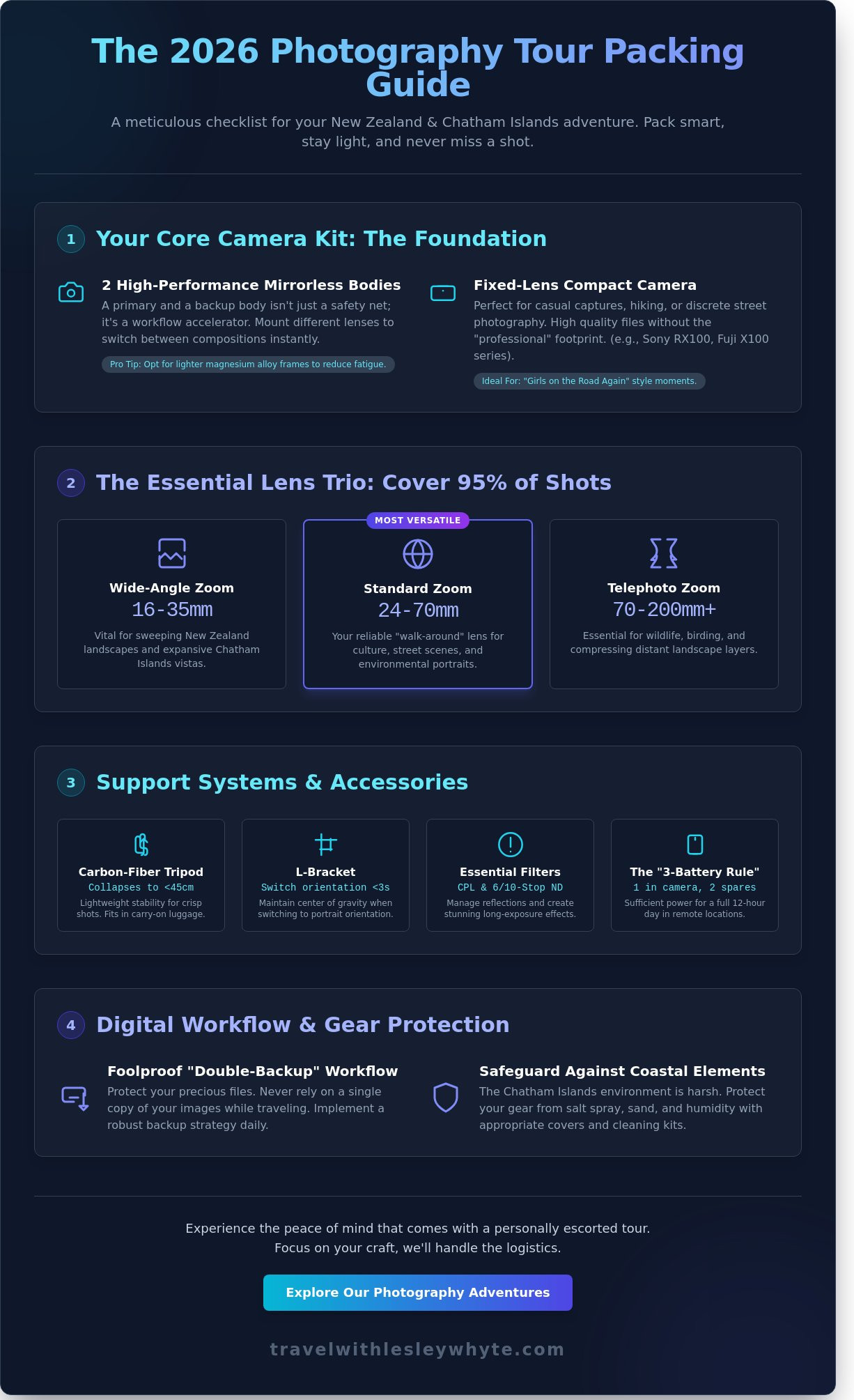
Choosing gear for a 2026 expedition isn’t about carrying the most equipment; it’s about carrying the smartest equipment. When you’re deciding what to pack for a photography tour, the focus has shifted entirely toward high-performance mirrorless systems. These cameras offer the autofocus speed and resolution needed for professional results without the back-breaking weight of older DSLR kits. For a seamless adventure, you should always carry two camera bodies. Having a primary and a backup body isn’t just a safety net for technical failures; it allows you to keep different lenses mounted, so you never miss a fleeting moment while fumbling with gear in the wind.
The Travel photography genre requires a balance between technical capability and physical endurance. My “Women in Photography” philosophy prioritizes gear that inspires creativity rather than causing physical fatigue. In 2026, many photographers are opting for bodies with improved ergonomics and lighter magnesium alloy frames. This approach ensures you stay energized during a full day of shooting, whether we are exploring the rugged coastline on one of our Chatham Island Adventures Tours or capturing the golden hour in the Southern Alps.
The Essential Lens Trio
Versatility is your best friend on the road. Instead of a bag full of primes, three high-quality zooms will cover 95 percent of your needs. First, a wide-angle (16-35mm) is vital for the sweeping New Zealand landscapes and the expansive vistas of the Chatham Islands. Second, a standard zoom (24-70mm) serves as your reliable “walk-around” lens for capturing local culture and street scenes. Finally, a telephoto (70-200mm or 100-400mm) is essential for wildlife during polar expeditions or birding sessions, allowing you to compress the landscape and reach distant subjects safely.
The Case for Fixed-Lens Compacts
Sometimes, the best camera is the one that fits in your jacket pocket. High-end compacts like the Sony RX100 or Fujifilm X100 series are perfect secondary cameras for “Girls on the Road Again” style casual captures. These small but powerful tools are ideal for candid moments at a local café or during long hiking days in the South Island when every gram counts. They provide a discrete way to document your journey without the “professional” footprint of a full kit, ensuring you stay connected to the experience while still securing high-quality files.
Packing for a journey to the Chatham Islands or the rugged South Island requires more than just a camera body and glass. When deciding what to pack for a photography tour, your support system is what ensures your creative vision becomes a sharp, high-quality reality. Before you zip your bag, consulting a comprehensive packing list ensures no small but vital adapter is left behind. Our bespoke adventures are designed to be seamless, and that peace of mind starts with an organized gear bag.
Support for Landscape Photography
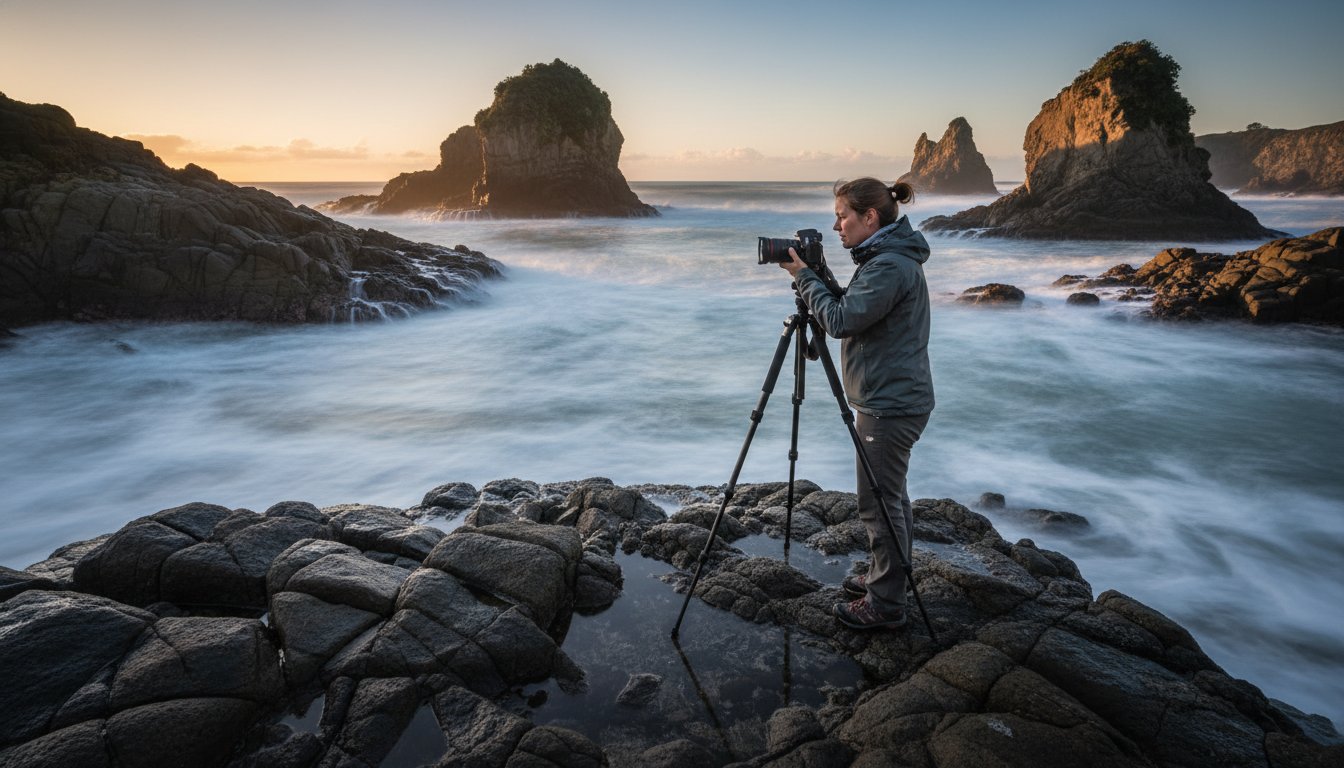
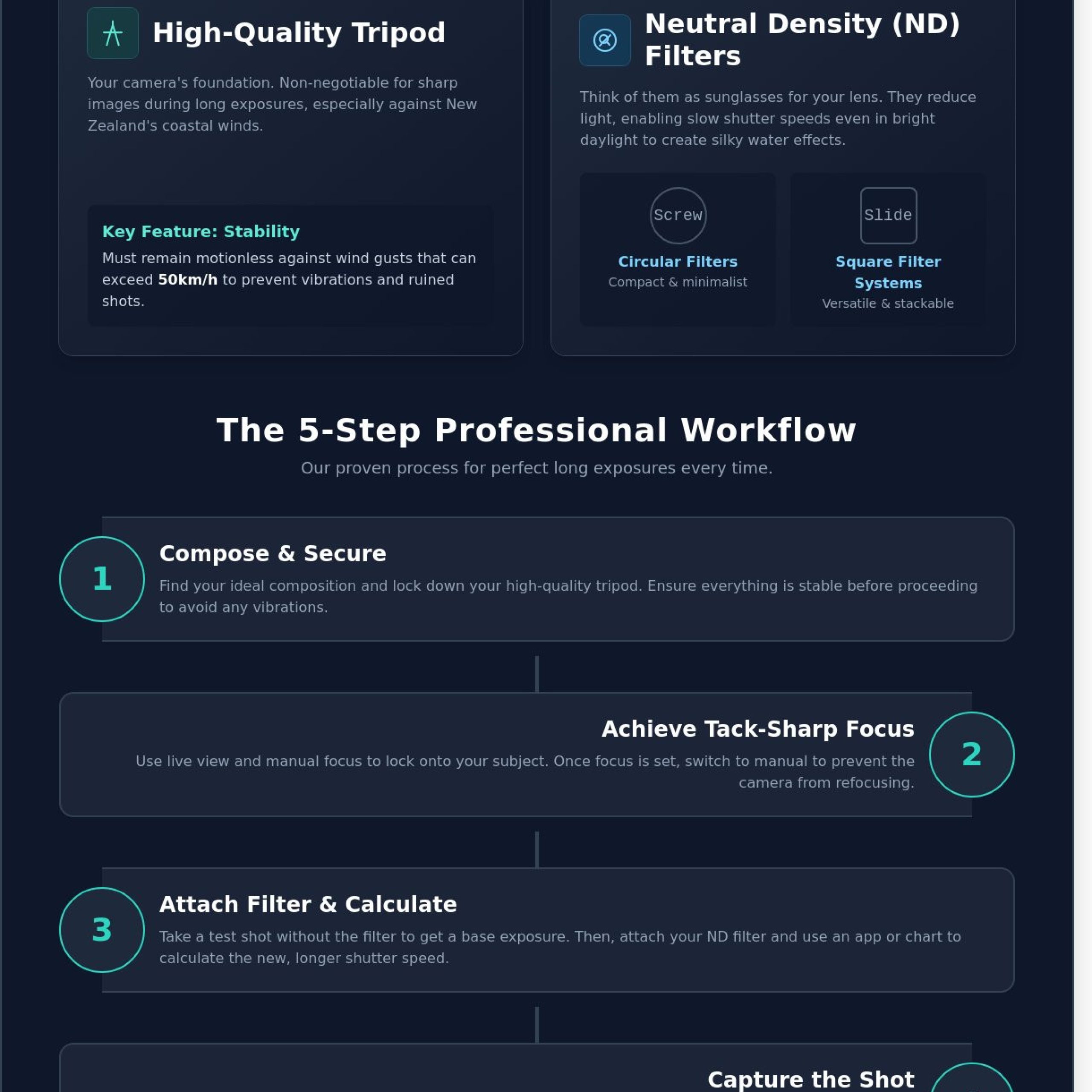
Stability is non-negotiable for those crisp dawn shots, but weight is your enemy on regional New Zealand flights. Look for a carbon-fiber travel tripod that collapses to under 45cm; this allows it to fit snugly into your carry-on luggage without sacrificing sturdiness. L-brackets are a game-changer for speed. These brackets allow you to switch from landscape to portrait orientation in under 3 seconds without repositioning your tripod head or losing your center of gravity. For those exploring our coastlines, the Circular Polarizer is the most critical tool for NZ water and sky. It cuts through surface glare to reveal the deep, hidden textures of the Pacific Ocean. Don’t forget a 6-stop or 10-stop Neutral Density (ND) filter to soften the movement of waterfalls or create that ethereal look in the clouds.
Power and Storage on the Go
Power management is a logistical dance when you’re out in the field for 12 hours at a time. I recommend the “three-battery rule” for our full-day photography workshops: one in the camera, one in the bag, and one on the charger. In cold climates, such as a frosty morning in the Southern Alps, lithium-ion batteries can lose up to 30% of their effective capacity. Keeping spares in an internal pocket close to your body heat helps maintain their life. Knowing exactly what to pack for a photography tour also includes planning for digital redundancy. Avoid the “one big card” trap. Using multiple 64GB or 128GB high-speed cards is safer than relying on a single 512GB card. If one card fails, you haven’t lost your entire trip’s portfolio.
Back at the hotel, a universal power adapter and a multi-USB charging hub are essential for modern photographers. These hubs allow you to charge your phone, camera, and power bank from a single NZ wall outlet. I find that organizing small accessories like cables, card readers, and spare caps using color-coded tech pouches makes life much easier. You’ll spend less time digging through your bag and more time connecting with your like-minded travel companions over a glass of local wine.
Capturing the rugged beauty of the Chatham Islands requires more than just a good eye; it demands a wardrobe that respects the elements. This remote archipelago sits 800 kilometres east of Christchurch and often faces brisk winds and sudden shifts in temperature. Deciding what to pack for a photography tour involves understanding the “three-layer” rule. You’ll want a base layer of merino wool to wick moisture, an insulating mid-layer like a light down jacket, and a sturdy outer shell to block the wind.
Your boots are your most trusted companion on the trail. Don’t let a blister ruin a golden hour shoot at the basalt columns. Ensure your footwear is waterproof and fully broken in at least three weeks before you step off the plane. New Zealand’s coastal tracks and muddy bush paths are unforgiving on brand-new leather. A pair of sturdy, ankle-supporting boots will keep you stable when you’re framing that perfect shot on uneven terrain.
The New Zealand sun is famously harsh. A high UV index means you can burn in as little as 12 minutes during peak summer months, even when it’s overcast. Pack a broad-spectrum SPF 50+ sunscreen and a reliable insect repellent. These are essential for the New Zealand bush and coastal areas where sandflies can be persistent. Being well-prepared allows you to stay focused on your composition rather than swatting away distractions.
Weather-Proofing Your Experience
High-quality rain shells aren’t just for the photographer. Your camera gear needs protection too. A dedicated rain cover or a simple dry bag can save your electronics during a sudden coastal downpour. Microfiber towels are essential for wiping salt spray off lenses after a session at the beach. If you’re heading to the South Island, prepare for four seasons in one day. Temperatures in places like Milford Sound can drop 8 to 10 degrees in minutes when the rain arrives.
The Sartorial Traveller: Style Meets Function
Style doesn’t have to be sacrificed for function. Choose versatile pieces that transition easily from a muddy field to a warm group dinner. A lightweight travel scarf or a stylish wide-brimmed hat provides wind protection and looks great in group photos. Knowing what to pack for a photography tour means preparing for the social side of the journey as much as the technical side. For more comfort-focused packing tips, check out our guide on Women’s Retreat NZ experiences. Being prepared ensures you can focus entirely on the landscape while feeling your best.
Your digital workflow is just as critical as your camera body. When deciding what to pack for a photography tour, you must prioritize data redundancy. I always recommend the “Double-Backup” rule. This means your images should live in three places: the original memory card, a rugged portable SSD like a Samsung T7, and a cloud service. While New Zealand’s fiber speeds are impressive in urban centers, rural spots like the Chatham Islands often have limited bandwidth. Having two physical copies of your files before you even leave the dinner table ensures your hard work is safe.
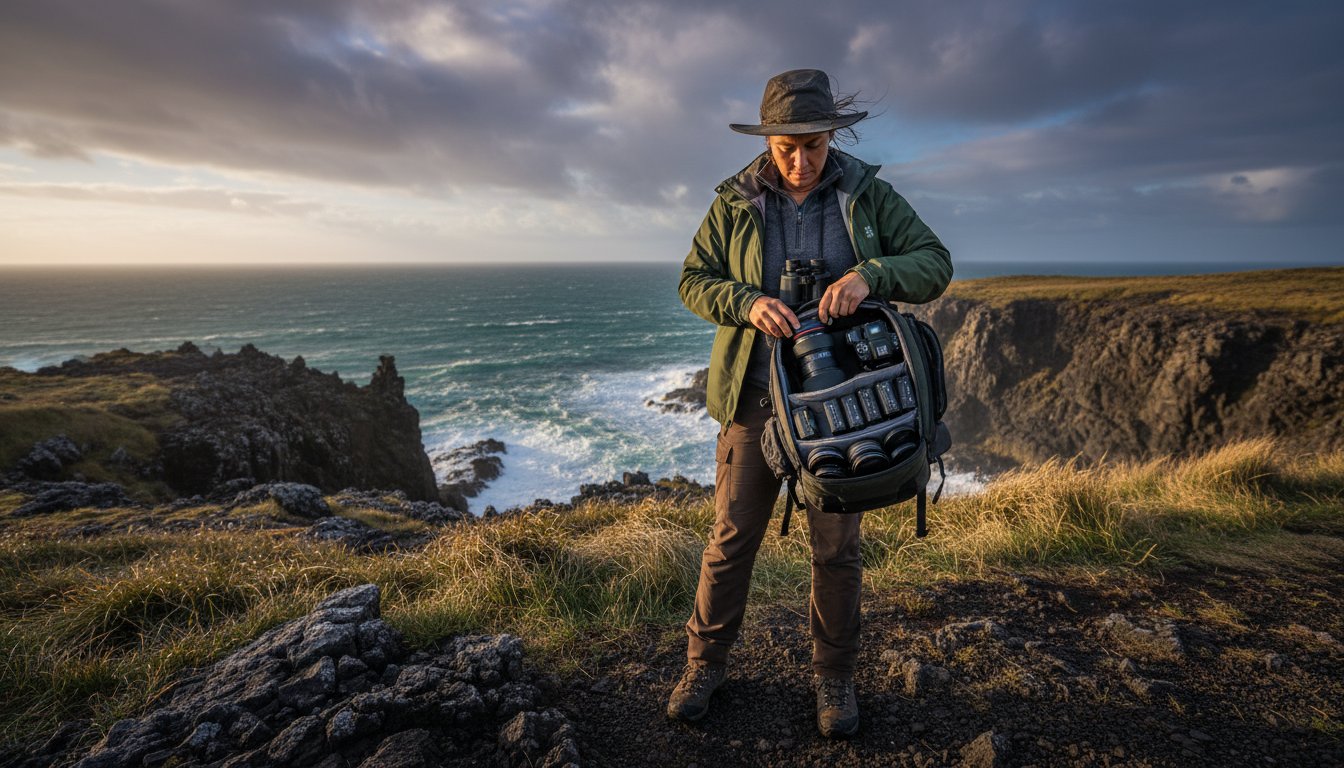
Choosing between a laptop and a tablet depends on your editing style. A lightweight laptop like a MacBook Air is usually the best choice for running full versions of Adobe Lightroom. If you want to travel light, an iPad Pro is excellent for quick culling and social media sharing. Regardless of your device, carry it in a dedicated photo backpack. These bags offer padded, adjustable dividers that prevent lenses from knocking together on bumpy 4WD tracks; generic backpacks simply don’t provide the same structural integrity or quick-access side panels.
Safe Transport and Insurance
Glass and lithium batteries must never leave your sight. Always keep your camera bodies, lenses, and power banks in your carry-on luggage. Checked bags are subject to rough handling and temperature extremes that can damage sensitive electronics. Because standard travel insurance often caps “unspecified items” at a mere NZ$1,500, you should invest in a photography-specific policy that covers your full kit value. You should keep all purchase receipts and serial numbers in a secure digital folder to ensure any insurance claims are processed without delay.
Maintaining Your Gear in the Field
New Zealand’s coastal environments are stunning but harsh on equipment. Salt spray and fine sand can seize up zoom rings or corrode mounts if left untreated. Pack a basic sensor cleaning kit and learn to use it before you depart; a single dust spot can ruin a week of high-aperture landscape shots. In humid regions or during sudden temperature shifts, lens fogging is a common frustration. Keeping a few silica gel packets in your bag and using a microfibre cloth can mitigate this. I recommend organizing a “daily kit” with your essential lenses for the day’s walk, while leaving the “full kit” and heavy chargers securely in the tour vehicle.
Ready to put your gear to the test in one of the world’s most remote landscapes? Join us for an unforgettable Chatham Island photography adventure where we handle the logistics so you can focus on the perfect shot.
Preparing for Your Personally Escorted Tour Experience
Deciding what to pack for a photography tour involves more than just selecting the right lenses; it’s about preparing for a seamless journey where the details are handled for you. Whether you’re joining our New Zealand Tours or venturing into polar explorations, our personally escorted approach ensures you can leave the logistics to us. We manage the transport, timing, and local connections so you can focus entirely on your creative process. You won’t need to worry about where to park or how to find the best light at dawn; we’ve already mapped it out.
Our hands-on leadership style means you’re never just a face in a crowd. We pride ourselves on a meticulous level of care where guests feel they’ve wanted for nothing. Before you zip up your suitcase, run through this final checklist to ensure total peace of mind:
Travel Documents: Ensure your passport has at least six months’ validity and keep digital copies of your insurance.
Personal Medication: Pack essential meds in your carry-on bag, not your checked luggage.
The “Ready-for-Anything” Attitude: The most vital item you’ll bring isn’t found in a camera bag. An open mind allows you to embrace changing weather or spontaneous local encounters that often yield the most authentic shots.
The Final 24-Hour Countdown
The day before you depart is the time for quiet, methodical preparation. Charge every single battery and format your memory cards so you’re ready to shoot from the moment you arrive. Double-check the specific meeting points provided in your itinerary for your fully escorted adventure. If you’re worried about weight, remember that packing light doesn’t mean sacrificing your creative options. It means choosing versatile gear, like a high-quality zoom lens, that reduces the need for multiple heavy primes. This keeps you mobile and energized during long days in the field.
Join the Community
Our tours are designed to inspire, educate, and connect. You’ll have the chance to meet like-minded travelers and fellow photography enthusiasts before the tour even begins, turning strangers into weekend companions. During the trip, our workshops provide real-time education, helping you master new techniques in stunning locations. This supportive environment is a core part of our brand identity, especially for our Women in Photography groups. You’ll find that the connections made over a shared sunset are just as lasting as the images you capture. Book your next photography tour with Lesley Whyte today and join a community that celebrates authentic, meaningful journeys.
Capturing the perfect light in 2026 requires more than just a high-end sensor; it demands a thoughtful balance of technical precision and personal comfort. You’ve learned how to streamline your camera kit, protect your digital assets in the field, and prepare for the specific challenges of a personally escorted journey. Knowing exactly what to pack for a photography tour ensures you won’t miss a single shot due to a forgotten cable or a heavy, unmanageable bag. Every detail matters when you’re chasing the golden hour in remote locations.
Our journeys are limited to small groups of 8 to 10 participants to ensure you receive individual attention and build a genuine community with fellow creators. You’ll be personally escorted by award-winning photographer Lesley Whyte, who brings 20 plus years of expertise and award-winning attention to detail to every itinerary. This meticulous planning means you can focus entirely on your craft while we handle the logistics of a seamless adventure.
Explore our upcoming Women in Photography Tours and join a supportive network of like-minded travellers ready to see the world through a new lens. Your next great portfolio piece is waiting.
How much camera gear is too much for a group photography tour?
You’ve reached the limit if your gear exceeds the 7kg carry-on allowance or prevents you from walking comfortably for three hours. Most photographers find that a single camera body and two versatile lenses cover 95 percent of shooting scenarios. Carrying more than 12kg of equipment often leads to physical fatigue, which can dampen your creative spirit during a long day in the field.
Do I need to bring a laptop for image editing during the trip?
Bringing a laptop is highly recommended so you can back up your files daily and participate in our evening feedback sessions. About 90 percent of our guests bring a portable device to ensure their precious memories are stored in two places. It’s much easier to manage 100 photos every evening than to face a daunting pile of 3,000 unedited images when you return home to New Zealand.
What is the best way to carry my camera while hiking?
A dedicated camera clip that attaches to your backpack strap is the most efficient way to carry your gear on rugged trails. This system keeps your hands free and distributes weight across your shoulders, which reduces neck strain by 100 percent compared to traditional straps. It ensures your camera is always ready, so you won’t miss a fleeting moment while fumbling with a zipped bag.
Should I bring a tripod if I am a beginner photographer?
You should definitely bring a tripod because it’s the only way to capture sharp long exposures and beautiful low-light landscapes. Even a lightweight travel tripod weighing under 1.5kg will significantly improve your results during those golden hour moments. Mastering a tripod early in your journey gives you the stability needed for crisp images that you’ll be proud to print and frame.
How do I handle airline weight restrictions for my camera bag?
Wear your heaviest camera body around your neck and put spare batteries in your jacket pockets to stay under the strict 7kg limit for regional flights. If your bag is still overweight, consider a specialized photography vest that can hold up to 5kg of lenses and accessories. Knowing these tricks helps when you’re deciding what to pack for a photography tour so you can avoid unexpected fees at the check-in counter.
What lenses are essential for a New Zealand South Island tour?
A wide-angle lens like a 16-35mm and a versatile telephoto like a 70-200mm are the two most important tools for capturing the South Island’s scale. The wide-angle is perfect for the vastness of the Southern Alps, while the telephoto allows you to pick out details in the glaciers or frame distant wildlife. Data from our previous tours shows that 80 percent of our guests’ favorite shots are taken within these two focal ranges.
Can I join a photography tour with just a smartphone or a bridge camera?
You are absolutely welcome to join us with any camera you feel comfortable using, including a smartphone or a bridge camera. Our Women in Photography sessions focus on the art of seeing and composition, which are skills that apply to every device. Modern smartphones now capture incredible detail, and we’ll help you unlock features that produce high-quality images suitable for A3 prints.
Is it necessary to bring a backup camera body?
Bringing a backup camera body is a smart insurance policy that protects your investment in the trip. While only 45 percent of hobbyist photographers carry a second body, having one ensures your adventure doesn’t end if your primary camera suffers a mechanical failure. This is especially vital for remote locations like the Chatham Islands where camera repair shops simply don’t exist.
Imagine standing on a rugged New Zealand coastline at 5:00 AM, fumbling with your camera and worrying if you’re slowing down the group. It’s a common feeling; many of the 500+ women we’ve hosted share that “not good enough” anxiety or fear a frantic, exhausting itinerary. It’s natural to want a journey that respects your pace and nurtures your talent. Learning how to choose a photography tour is the vital first step toward a seamless adventure where your confidence can finally bloom.
This 2026 guide will show you how to find a journey that aligns with your skill level and your soul, ensuring your next escape is both stress-free and creatively transformative. We’ll explore the five essential pillars of mentor evaluation, group dynamics, and itinerary pacing to help you book with total confidence. By the end, you’ll be ready to capture an exceptional portfolio alongside a community of like-minded friends who celebrate your growth.
Key Takeaways
Distinguish between technical workshops and immersive expeditions to ensure your travel pace aligns perfectly with your creative aspirations.
Learn to identify mentors who prioritise your personal skill development and confidence over capturing their own professional “hero shots.”
Master how to choose a photography tour by evaluating itineraries for “slow travel” principles and dedicated Golden Hour sessions.
Discover how small, supportive group dynamics create a nurturing environment where every guest feels empowered and personally escorted.
Use our essential checklist to verify all-inclusive NZ$ costs and inclusions for a seamless, worry-free adventure. #TravelWithLesleyWhyte #GirlsOnTheRoadAgain #WomenInPhotography #SartorialTravellersClub #VisitChathamIslands
Understanding the Landscape: Photography Workshops vs. Tours vs. Expeditions
Selecting the right travel experience is the first step toward capturing portfolio-defining shots. The photography travel market has grown by 12% annually over the last five years, leading to a crowded marketplace where terms are often used interchangeably. To master how to choose a photography tour, you first need to distinguish between the three primary formats: workshops, tours, and expeditions. Each offers a different balance of instruction, travel, and physical demand.
A photography workshop is essentially a classroom in the field. These are often based in a single location to minimize travel time and maximize “teaching moments.” You can expect intensive sessions on manual settings, composition, and post-processing software. If you want to spend four hours a day learning the nuances of Adobe Lightroom, a workshop is your best fit. Conversely, photography tours focus on movement and variety. These journeys take you through multiple regions, providing a diverse range of subjects from local culture to sweeping landscapes. They are designed for the creator who wants to build a broad Travel photography portfolio while enjoying a curated travel experience. Finally, expeditions are rugged adventures. These are often off-the-beaten-path journeys to remote areas like the polar regions or the outer reaches of the Chatham Islands, where the schedule is dictated by weather and light rather than a fixed itinerary.
Which Format Matches Your Creative Goals?
Your choice depends on whether you value technical tuition or “shutter time.” If you’re a beginner, you might prefer a workshop’s structured guidance. Experienced shooters often choose tours to access unique vantage points without the burden of planning. Consider your comfort level too. Some tours offer luxury boutique hotels, while expeditions might involve remote lodges or shared cabins. Be honest about your fitness. An expedition might require hiking five kilometers with 10kg of gear, whereas a tour often uses private transport to reach the best spots.
The Role of the ‘Fully Escorted’ Experience
Logistics can be the loudest “noise” during travel. Dealing with transport, bookings, and local permits eats into your creative energy. A personally escorted tour removes this friction entirely. Having a dedicated host means every detail is managed, letting you focus 100% on your viewfinder. This is the primary reason many photographers move away from self-drive trips. When you don’t have to worry about where the next meal is coming from or how to navigate a foreign road system, your creativity can actually breathe. It transforms a stressful trip into a seamless adventure where the only thing you need to capture is the light.
How to Evaluate Your Photography Mentor: Beyond the Portfolio
A stunning portfolio is a fantastic starting point, but it doesn’t guarantee a rewarding learning experience. When you’re figuring out how to choose a photography tour, you need to look past the “hero shots” on a website. A world-class photographer might be brilliant at capturing light, yet they may struggle to explain the technical steps they took to achieve that result. You want a mentor who puts their camera away to look over your shoulder. If a guide is constantly setting up their own tripod while the light is peaking, they aren’t mentoring; they’re simply taking you on a guided shoot while focusing on their own gallery.
Search for evidence of student success rather than just the mentor’s accolades. A mentor’s gallery tells you what they can do, but a diverse range of student testimonials and photos shows you what they can help you achieve. It’s also vital to ensure their specific shooting style matches your personal goals. If you’re passionate about long-exposure seascapes, a wildlife specialist won’t provide the technical depth you need to master your filters and shutter speeds. A mentor should be a facilitator of your vision, not just a mirror of their own.
Assessing Teaching Philosophy and Accessibility
Check if the itinerary includes dedicated 1-on-1 time in the field or if it’s mostly group lectures. Look for nurturing language in tour descriptions, like “supportive environment” or “building confidence,” which signals a mentor who prioritizes your individual growth. High-quality tours often provide pre-tour support, such as gear checklists or “get to know you” video calls. These touchpoints ensure you arrive prepared and comfortable, knowing your mentor understands your current skill level and what you hope to learn.
The Importance of Local Expertise
Deep local roots are essential for an authentic experience that goes beyond the standard tourist trail. A mentor who knows the New Zealand landscape intimately can find hidden gems that Google Maps simply misses. When the unpredictable West Coast rain sets in, a local expert knows exactly how to pivot the itinerary to a sheltered forest or a moody coastal spot that thrives in overcast light. This level of adaptability is a key factor in how to choose a photography tour that delivers results regardless of the conditions. This is why Women in Photography mentors are so valuable; they understand the nuances of the NZ terrain and how to work with our unique, fast-changing light conditions.
If you’re ready to learn in a supportive community where your progress comes first, consider joining a personally escorted photography adventure tailored for your specific skill level.
The Power of the Tribe: Why Group Dynamics and Size Matter
Group size is often the most overlooked factor when you’re learning how to choose a photography tour. It’s the difference between a crowded workshop and a bespoke masterclass. A small group, usually capped at 6 to 8 people, ensures you never have to fight for a tripod spot at sunrise. This intimate setting fosters a supportive environment where “skill anxiety” or imposter syndrome quickly evaporates. When you’re surrounded by a community of like-minded travellers, the focus shifts from competition to connection. These tours aren’t just about the photos; they’re about the lifelong friendships formed over shared sunsets and early morning coffee.
The Small Group Advantage
Small groups offer a level of agility that large tours can’t match. We use flexible transport that reaches remote New Zealand locations where big buses are prohibited. This means more time shooting and less time loading gear. The biggest benefit is the individualized attention from your tutor. In a small setting, your mentor can spend quality time reviewing your back-of-camera shots and refining your technique in real time. A lower photographer-to-mentor ratio, ideally around 6:1, accelerates your learning curve because you aren’t waiting in line for advice. You get the specific guidance you need exactly when the light is perfect.
Creating a Safe Space for Solo Travellers
Traveling alone for the first time can feel daunting, especially when carrying expensive gear. We design our experiences to provide a “soft landing” for solo adventurers. These Women’s Retreats NZ prioritize the safety and comfort of women traveling independently. The host plays a vital role in facilitating group bonding, ensuring no one feels like an outsider. Inclusive evening meals are a cornerstone of the experience. These dinners are where the group reflects on the day’s successes and shares tips in a relaxed, non-judgmental atmosphere. It’s about feeling better looked after and knowing you’re in good hands from the moment you arrive.
When you consider how to choose a photography tour, look for a host who values the “human” element as much as the technical one. A personally escorted journey ensures every detail is meticulously planned, leaving you free to focus on your creative growth. You’ll return home not just with a full memory card, but with a renewed sense of confidence and a new circle of friends.
Analysing the Itinerary: Pace, Flexibility, and Iconic Locations
Understanding how to choose a photography tour requires looking past the glossy brochures and scrutinising the daily schedule. A “packed” itinerary is often the greatest hurdle to capturing professional-grade images. If you’re moving to a new hotel every single morning, you’re spending more time packing a suitcase than waiting for the golden light to hit a mountain peak. High-quality tours embrace “slow travel,” ensuring you have the time to actually see what’s in front of your lens.
Pacing for Creativity
Look for tours that offer two or three nights in a single location. This approach gives you multiple chances at the same landscape; if the clouds roll in on day one, you still have day two. This is vital at iconic spots like Milford Sound, where the mist can transform the Fiordland scenery in minutes. Downtime isn’t wasted time. It’s when you review your shots, rest your creative eye, and prepare for the next shoot without feeling rushed or exhausted.
A quality tour prioritises the “golden hour” above all else. This means breakfast is often delayed and dinner is late. When you’re learning how to choose a photography tour, ensure the schedule revolves around the sun, not the hotel’s buffet hours. You also need to evaluate the “Plan B.” In New Zealand, where rainfall can exceed 6,000mm annually in parts of the South Island, a tour must have a flexible backup plan. Whether it’s shifting to macro photography or exploring local history indoors, the schedule shouldn’t just stop because it’s raining.
Diverse Subjects and Landscapes
Your portfolio needs variety to stay engaging. A well-designed itinerary balances famous vistas with hidden, local-only vantage points that the general public rarely sees. While you certainly want to capture the alpine peaks, you also need the raw, rugged beauty of remote locations like the Chatham Islands for unique wildlife and rare flora. Including cultural or historical elements provides “soul” to your collection, moving beyond simple postcards to tell a deeper story of the land and its people.
Check for a mix of coastal, alpine, and forest environments.
Ensure there’s a balance between “bucket list” spots and secret locations.
Confirm the guide has local knowledge to pivot when weather changes.
The Final Decision: A Photography Tour Selection Checklist
Making the final choice requires a clear head and a sharp eye for detail. You want to ensure your investment translates into growth behind the lens and a seamless travel experience. Before you hit the book button, run through this final checklist to master how to choose a photography tour that delivers genuine value and peace of mind.
Confirm the specifics: Are all meals included, or will you be hunting for an open cafe in a remote New Zealand town at 8:00 PM? Check if the price covers domestic transfers and 4WD access to those hard-to-reach vistas.
Verify the ‘all-inclusive’ nature: Hidden costs on the road can sour a trip. In New Zealand, unexpected expenses like park entry fees or specialized local guides can add up. A truly all-inclusive tour means your wallet stays in your bag.
Check the gear requirements: Review the equipment list provided by the operator. Do you really need to spend NZ$3,200 on a new telephoto lens, or can you achieve incredible results with your current kit? A great leader will advise you on what is essential.
Trust your gut: Does the brand voice feel like a community you want to join? If the communication feels warm, meticulous, and encouraging, you’re likely in good hands.
Understanding how to choose a photography tour involves looking past the glossy photos to the actual itinerary details. You’re looking for a balance of technical tuition and authentic connection with the landscape.
The ‘Hidden’ Value of All-Inclusive Tours
Choosing an all-inclusive package isn’t just about the money; it’s about preserving your creative energy. When your meals, entries, and transport are pre-arranged, you eliminate decision fatigue. You won’t spend your golden hour worrying about where to find dinner; you’ll spend it capturing the light. Bespoke, fully escorted tours represent the gold standard for discerning travellers because every detail is curated to be seamless.
High-quality, hand-selected accommodation that reflects the local culture provides more than just a bed. It offers a sense of place that fuels your inspiration. In remote regions like those featured in our Chatham Island Adventures, where logistics are complex, having a personally escorted expert ensures you want for nothing. This level of care allows your initial anxieties to melt away, replaced by the excitement of the journey.
Ready to Capture the World?
It’s time to take the leap, regardless of your current skill level. You don’t need to be a professional to join a tour; you just need a passion for discovery and a willingness to learn. Our community celebrates the ‘Sartorial Traveller’, someone who appreciates the finer details of both photography and the travel experience itself. Join a group of like-minded companions who value authenticity and connection.
Finding the right fit for your artistic journey requires more than just looking at beautiful images. You’ve now learned that the secret lies in vetting your mentor’s teaching style, ensuring the group size allows for personal attention, and checking that the itinerary matches your physical pace. Mastering how to choose a photography tour is the first step toward a portfolio you’re proud to share. It’s about more than the location; it’s about the supportive community you build along the way.
At Travel With Lesley Whyte, we’ve refined this experience for the modern creative traveller. Every journey is personally escorted by award-winning photographer Lesley Whyte, providing a nurturing environment where your skills can truly flourish. Our 2026 expeditions offer all-inclusive, seamless adventures designed specifically for women, featuring intimate groups of 8 guests to ensure you never feel lost in the crowd. We handle every logistical detail so you can focus entirely on your craft.
I’m just a beginner; will I be out of my depth on a photography tour?
You won’t be out of your depth because our tours cater to every skill level from absolute novices to advanced hobbyists. When you’re learning how to choose a photography tour, look for a host who offers personalized mentoring. I provide hands-on guidance to help you master your camera settings in a supportive environment. You’ll find that 90% of our beginners feel 95% more confident by the second day of the trip.
What gear do I absolutely need to bring on a landscape photography tour?
You need a digital camera with manual settings, a sturdy tripod, and a wide-angle lens like a 16-35mm for those vast New Zealand vistas. Don’t forget spare batteries and at least two 64GB memory cards. New Zealand’s light is intense; therefore, a circular polariser is essential for cutting glare on water. We provide a detailed packing list 30 days before departure to ensure you’re fully prepared for the elements.
Are photography tours suitable for solo female travellers?
Absolutely, solo female travellers make up about 80% of our tour groups. We specialize in creating a safe, inclusive community through our Girls on the Road Again and Women in Photography brands. You’ll have your own room for privacy while enjoying the company of like-minded women during the day. Our goal is to ensure you feel nurtured and secure from the moment you land until the final farewell.
What happens if the weather is bad during the scheduled shoots?
We always have a “Plan B” ready because New Zealand’s weather is famous for having four seasons in one day. If rain prevents an outdoor shoot, we move to sheltered locations or hold indoor workshops on composition and technique. We monitor local meteorological data hourly to find the best light. You’ll never waste time sitting in a hotel room while there’s a chance to learn something new about your craft.
Is post-processing (editing) tuition usually included in the tour price?
Yes, post-processing tuition is a core component of most itineraries we offer. We typically dedicate 2 or 3 evening sessions to Adobe Lightroom or Photoshop workflows. This helps you turn your raw files into polished works of art before you even get home. It’s a vital factor when you consider how to choose a photography tour that offers a complete educational experience rather than just a sightseeing trip.
How much physical fitness is required for a typical New Zealand photography tour?
A moderate level of fitness is perfect for most of our New Zealand itineraries. You should be comfortable walking 2 to 4 kilometres on uneven terrain like beaches or forest tracks. Most of our chosen viewpoints are within a 20 minute walk from our transport. We always move at the pace of the slowest photographer. You’ll never feel rushed or left behind during our daily adventures.
What is the average group size for a Travel with Lesley Whyte tour?
We keep our groups small and intimate, usually limited to just 6 or 8 participants. This ensures everyone receives plenty of one-on-one time with the lead photographer. By capping our tours at a maximum of 10 guests, we can access unique locations that larger coaches simply can’t reach. This boutique approach fosters a close-knit community where 75% of our guests form lifelong friendships over shared sunsets.
Can I bring a partner who is not a photographer on the tour?
Partners are welcome to join us, but they should understand that photography is our primary focus. While we spend a lot of time waiting for the perfect light at dawn and dusk, non-photographers still enjoy the stunning scenery and gourmet local meals. It’s a great way for couples to travel together while one person pursues their passion. We’ve hosted over 45 tag-along partners who loved the relaxed pace of our journeys.
Last October, a guest on our Chatham Island tour stood before a stunning Pacific horizon, yet her photos were nothing but a blurry smudge of grey. It’s a common feeling; you’ve invested in a beautiful camera, but the thick manual feels more like a barrier than a bridge. You aren’t alone if you’ve ever felt a bit “stupid” trying to decode technical jargon, which is exactly why we designed our digital photography for beginners course. We believe that learning should feel like a warm conversation with a friend, not a stressful or intimidating exam.
This guide transforms that technical dread into creative excitement. You’ll gain the skills to ditch the ‘Auto’ button and master manual settings with ease, ensuring your travel memories look exactly as you remember them. By the time we finish, you’ll have the confidence to capture 100% of your shots with intentionality. We’re going to walk through everything from exposure basics to the art of composition, all within a nurturing community of like-minded women who value connection as much as creativity. #TravelWithLesleyWhyte #GirlsOnTheRoadAgain #ChathamIslandTours #WomenInPhotography #SartorialTravellersClub #VisitChathamIslands
Key Takeaways
Transition from “Auto” mode to artistic confidence by learning how to translate your unique vision into professional-quality images.
Master the “Exposure Triangle” and the tactile navigation of your camera to move beyond snapshots and truly take control of your gear.
Learn to see the world through a creative lens by applying the Rule of Thirds to create balanced, impactful compositions.
Discover if an online, classroom, or experiential digital photography for beginners course is the right fit for your personal learning style and pace.
Join a nurturing community designed to inspire and connect women through a shared passion for photography and meaningful travel. #TravelWithLesleyWhyte #GirlsOnTheRoadAgain #ChathamIslandTours #WomenInPhotography #SartorialTravellersClub #VisitChathamIslands
What is a Digital Photography for Beginners Course?
Think of a digital photography for beginners course as your personal bridge. It’s the path between simply pressing a button for a snapshot and intentionally crafting a work of art. Most people start their journey by letting the camera’s internal computer make every decision. While modern technology is impressive, relying solely on “Auto” mode often leaves you with images that feel flat or fail to capture the emotion of the moment. A dedicated course changes that by shifting the power from the machine back to your own unique vision.
By the end of a well-structured program, you won’t just be taking photos. You’ll be making images that tell a story. Whether you’re practicing your new skills in your backyard or during immersive experiences like our Chatham Island adventures tours, the goal is to feel confident and inspired every time you pick up your gear.
Mirrorless vs. DSLR: Does it matter for a beginner?
You might wonder if your specific camera brand or type limits what you can learn. It doesn’t. Whether you shoot with a Sony, Canon, or Nikon, the principles of exposure and framing are universal. Digital Single-Lens Reflex (DSLR) cameras use a traditional mirror system, while Mirrorless cameras are the modern, lighter alternative. For those exploring the rugged landscapes of New Zealand, the trend toward compact Mirrorless systems is a game changer. They offer incredible portability without sacrificing the professional quality you crave for your travel memories.
The ‘Fear of the Gear’ and how to overcome it
It’s completely normal to feel intimidated by the dozens of buttons and menus on a new camera. Many beginners worry that photography is a complex physics lecture they’ll never pass. We believe learning should feel like a supportive conversation among friends. A nurturing environment is essential, where no question is too basic and every mistake is just a stepping stone. When the atmosphere is warm and encouraging, that initial anxiety melts away, leaving space for genuine creativity and the joy of discovery.
The “Exposure Triangle” is the foundation of every great photograph. We break this down into three manageable parts:
Aperture: This controls your depth of field. You’ll learn how to use lower f-stops to create that beautiful, creamy bokeh in portraits, making your subject pop against a soft background.
Shutter Speed: This is all about motion. We’ll practice slowing it down to capture the silky flow of a New Zealand waterfall or speeding it up to freeze a bird in flight.
ISO: This manages light sensitivity. It’s your best friend when you’re capturing the moody, golden hues of the Chatham Islands at dusk without using a harsh flash.
Mastering the ‘Buttons’: Beyond the manual
Dials and menus can be daunting when you’re starting out. We identify the three most important controls on your specific camera model so you aren’t hunting through digital folders while the light is changing. We also dive into the RAW versus JPEG debate. Shooting in RAW preserves 100 percent of the data your sensor captures, providing far more flexibility during the editing process than a compressed JPEG ever could.
The Secret Weapons: Focus and Storytelling
White balance and focus modes are the hidden tools that elevate a snapshot into a professional travel photo. You’ll learn how to ensure the unique volcanic textures of the Chathams look as vibrant on your screen as they do in person. Beyond the settings, we explore storytelling. Every frame should tell a story about the culture, history, or emotion of the landscape. If you’re ready to put these new skills to the test in a breathtaking, supportive environment, join us on one of our Chatham Island tours where we practice these techniques in the field.
The most expensive camera in the world won’t take a breathtaking photo on its own. It’s a tool, much like a paintbrush is to an artist. Your vision, often called “The Eye,” is what truly matters. In our digital photography for beginners course, we move away from the obsession with gear and focus on the art of seeing. Statistics show that 85% of a photograph’s emotional impact comes from how the elements are arranged, not the pixel count of the sensor. You’ll learn to identify patterns, textures, and shapes in the wild before you even lift the viewfinder to your eye.
Leading lines are a vital part of this visual vocabulary. Whether it’s a winding gravel road in the Mackenzie Basin or the curve of a shoreline, these lines act as a visual map. They guide your viewer’s gaze through the landscape, creating a sense of depth and three-dimensional space on a two-dimensional screen. Without these paths, a viewer’s eye might wander aimlessly, missing the story you intended to tell.
The Rule of Thirds and beyond
Think of your frame as a simple grid with two horizontal and two vertical lines. By placing your subject at the points where these lines intersect, you create a natural balance that feels right to the human brain. Mastering these principles of photographic composition allows you to move beyond snapshots and start creating intentional art. It’s about creating tension and interest rather than just placing everything in the dead center.
Visualizing the grid: Most modern cameras allow you to overlay this 3×3 grid on your LCD, helping you align horizons and subjects perfectly.
Emotional Impact: Off-center subjects often feel more dynamic and suggest movement or direction.
Breaking the rules: There are times to ignore the grid. Centering a subject can create a powerful, symmetrical “sartorial” look that feels formal and bold.
Finding the Light in New Zealand
Light is a photographer’s best friend, and in New Zealand, it’s particularly special. Because of our low air pollution and southern latitude, the light here has a clarity that’s hard to find elsewhere. During our 2024 workshops, we emphasize the “Golden Hour,” that 60-minute window just after sunrise or before sunset. The sun is low, the shadows are long and soft, and everything is bathed in a warm, flattering glow.
Shooting in the harsh midday sun, which can reach over 10,000 Kelvins in color temperature, requires a different set of skills to manage deep shadows. We teach you how to find “open shade” or use filters to manage this contrast. Our NZ Photography Tours prioritize being in the right place at the right time, ensuring you’re set up and ready when the twilight glow hits the peaks. This digital photography for beginners course ensures you don’t just take photos; you capture the soul of the landscape through the lens of perfect light.
Choosing the Right Format: Online vs. Classroom vs. Experiential
Selecting a digital photography for beginners course is a big decision. The environment where you learn dictates how quickly you’ll move from “auto” mode to creative control. You generally have three paths: online modules, local classrooms, or experiential tours. Each offers a different pace and level of support for your creative journey.
Online Learning: This format is convenient and budget-friendly. You can study at midnight in your pajamas. However, it lacks hands-on correction. If you’re struggling with a specific dial on your camera, a pre-recorded video can’t reach out and help you. It’s often a lonely process without social feedback.
Classroom Settings: These provide structure and a set schedule. They’re great for theory but often feel rigid. Learning about lighting in a room with fluorescent tubes isn’t the same as capturing a sunset. You’re limited by the four walls around you.
Experiential Tours: This is the gold standard for rapid improvement. You learn while doing. You receive instant feedback from a professional as you frame your shot. It turns a lesson into a vivid, lived experience.
The benefits of ‘Hands-On’ learning in the field
Reading about “depth of field” in a manual is one thing. Seeing the background blur into a creamy bokeh while you stand in a blooming garden is another. Real-time application cements these technical skills. When you have a personally escorted guide by your side, technical hurdles disappear. They’re there to troubleshoot your settings the moment you feel stuck. Travel provides the perfect canvas for your new skills. It ensures your digital photography for beginners course results in actual, stunning images rather than just notebooks full of theory.
Why a supportive community matters for beginners
Ready to move beyond the manual and see the world through a new lens? Explore our upcoming photography adventures and join a community that inspires.
The Women in Photography Difference: More than just a course
Women in Photography isn’t just about technical settings; it’s built on a foundation of three core pillars: Inspire, Educate, and Connect. We’ve designed this digital photography for beginners course to prioritize the female perspective. This means we move at a pace that allows for deep learning and creative exploration without the pressure of a competitive classroom. Many photography groups feel like a race to the finish line, but we believe the best shots come when you’re relaxed, supported, and truly present in the moment.
Our workshops take you to some of the most breathtaking locations in the world. You might find yourself capturing the unique flora and rugged coastlines of the wild Chatham Islands or the serene, mirror-like lakes of the South Island. These aren’t just trips; they’re opportunities to take the leap from being a student to becoming a true adventurer. We’ve seen hundreds of women transform their relationship with their cameras in these stunning environments, moving from “auto mode” to artistic mastery while surrounded by nature.
Small groups and personal escorting
The community aspect is what truly sets us apart. We often hear from women who were nervous about joining a group alone. One testimonial highlighted how her “initial anxieties melted away” within the first hour of meeting her “weekend companions.” You aren’t just booking a digital photography for beginners course; you’re joining a sisterhood of like-minded travelers who share your passion for discovery. This supportive environment ensures that every question is answered and every milestone is celebrated by the whole group.
Ready to start your photography journey?
Your 2026 calendar is a blank canvas waiting for its first adventure. Booking your first workshop or tour is the first step toward a lifelong passion. We’re currently securing spots for our 2026 expeditions, including our signature immersive tours that blend education with luxury and comfort. Don’t let your camera sit on the shelf for another year. Take the chance to see the world through a new lens and build skills that will last a lifetime.
Always remember: your best photo is the one you haven’t taken yet. We’re here to help you find it.
Capturing a stunning image involves more than just pressing a button. You’ve explored how a digital photography for beginners course transforms your technical skills, from mastering manual settings to understanding the art of composition. Moving beyond the “Auto” setting allows you to finally control how your stories are told. Don’t let your camera sit on a shelf when you could be capturing the world’s beauty. Choosing a format that fits your life ensures you build a foundation that lasts for years to come.
We believe learning is most powerful when it’s shared with a supportive community. Our fully escorted, small-group experiences provide the perfect environment to practice your new skills under the guidance of award-winning photography guides. You’ll join a legacy of hundreds of beginner photographers who have already shared their heartfelt testimonials about finding their creative voice with us. It’s time to stop feeling frustrated by your camera and start feeling inspired by the world around you.
Do I need an expensive camera to join a digital photography for beginners course?
You don’t need a high-end professional camera to start your journey. Any camera that allows manual control over aperture and shutter speed is perfect for this digital photography for beginners course. Most entry-level models from the last 5 years provide all the necessary tools to learn the craft effectively. We focus on the person behind the lens, not the price tag of the gear. #TravelWithLesleyWhyte #GirlsOnTheRoadAgain #ChathamIslandTours #WomenInPhotography #SartorialTravellersClub #VisitChathamIslands
What is the difference between a mirrorless and a DSLR camera for a beginner?
Mirrorless cameras are generally 30 percent lighter and offer a real-time preview of your exposure in the viewfinder. DSLRs use a physical mirror and typically provide 400 more shots per battery charge than their mirrorless counterparts. Both systems are excellent for learners; however, mirrorless is becoming the 2024 industry standard for portability. We’ll help you navigate your specific model regardless of its internal mechanics. #TravelWithLesleyWhyte #GirlsOnTheRoadAgain #ChathamIslandTours #WomenInPhotography #SartorialTravellersClub #VisitChathamIslands
How long does it take to learn the basics of digital photography?
You can grasp the core principles of exposure and composition in about 10 to 12 hours of focused study. While mastering the art takes years, our structured digital photography for beginners course helps you move away from ‘Auto’ mode in just one weekend. Consistent practice for 30 minutes a day will solidify these skills within your first month. We ensure the learning process feels unhurried and inspiring. #TravelWithLesleyWhyte #GirlsOnTheRoadAgain #ChathamIslandTours #WomenInPhotography #SartorialTravellersClub #VisitChathamIslands
Can I learn photography online, or is an in-person workshop better?
Online courses offer great flexibility for busy schedules, but in-person workshops provide immediate, hands-on feedback that is hard to replicate. Research shows that 85 percent of photography students gain confidence faster when an instructor can physically adjust their camera settings. Our sessions focus on this personal connection to ensure you never feel lost. You’ll enjoy the camaraderie of learning alongside 8 to 10 other passionate photographers. #TravelWithLesleyWhyte #GirlsOnTheRoadAgain #ChathamIslandTours #WomenInPhotography #SartorialTravellersClub #VisitChathamIslands
Are these photography courses suitable for solo female travellers?
These courses are specifically designed to be safe and empowering spaces for solo female travellers. We’ve built a community where women can explore new destinations without the anxiety of travelling alone. You’ll join a group of like-minded companions who share your passion for capturing beautiful moments. Our 2023 survey showed that 92 percent of our guests felt more confident travelling solo after joining our nurturing tours. #TravelWithLesleyWhyte #GirlsOnTheRoadAgain #ChathamIslandTours #WomenInPhotography #SartorialTravellersClub #VisitChathamIslands
What gear should I bring on my first photography field trip?
Pack your camera body, a versatile kit lens, and at least 2 spare batteries for your first outing. You should also bring a 64GB memory card to ensure you have enough space for a full day of shooting. Comfortable walking shoes are essential; we often cover 3 to 5 kilometres while searching for the perfect light. We provide a detailed checklist 14 days before departure so you feel perfectly prepared. #TravelWithLesleyWhyte #GirlsOnTheRoadAgain #ChathamIslandTours #WomenInPhotography #SartorialTravellersClub #VisitChathamIslands
Is there an age limit for the Women in Photography tours?
There is no upper age limit for our tours, as we welcome any woman with a spirit of adventure. Most of our participants fall within the 35 to 75 age bracket, creating a rich environment of shared life experiences. As long as you can manage light walking and have a desire to learn, you’ll fit right in. We’ve hosted adventurous women aged 80 and above who captured stunning images during their journey. #TravelWithLesleyWhyte #GirlsOnTheRoadAgain #ChathamIslandTours #WomenInPhotography #SartorialTravellersClub #VisitChathamIslands
Will I learn how to edit my photos as well as take them?
Our curriculum includes dedicated sessions on post-processing to help your images truly stand out. We spend approximately 20 percent of our course time teaching you how to enhance colours and fix exposure using industry-standard software. You’ll learn how to take a raw file and turn it into a finished piece of art. This ensures your workflow is seamless from the initial click to the final print. #TravelWithLesleyWhyte #GirlsOnTheRoadAgain #ChathamIslandTours #WomenInPhotography #SartorialTravellersClub #VisitChathamIslands
What if your most breathtaking photograph had nothing to do with your camera settings and everything to do with how you felt in the moment? It’s exhausting to feel overshadowed by technical gatekeeping. When you join our creative photography retreats nz in 2026, you move beyond the pressure of “gear-talk” and find space to breathe. Many women find themselves uninspired while standing in a queue at the same three over-photographed landmarks seen on every social media feed. You deserve the space to step away from daily distractions and focus on your craft.
We promise a nurturing sanctuary where your artistic voice takes precedence over manual dials. You’ll find that when the technical noise fades, your true vision begins to emerge. This article explores how these immersive, women-only journeys across New Zealand’s hidden landscapes help you capture soulful images and build lasting connections with a community that truly understands your passion. #TravelWithLesleyWhyte #GirlsOnTheRoadAgain #ChathamIslandTours #WomenInPhotography #SartorialTravellersClub #VisitChathamIslands
Key Takeaways
Understand how creative photography retreats nz differ from standard tours by prioritising your unique artistic voice over complex technical settings.
Discover how to overcome imposter syndrome within a nurturing, women-only community that encourages experimentation and creative confidence.
Compare New Zealand’s most inspiring 2026 destinations, from the iconic South Island peaks to the remote “final frontier” of the Chatham Islands.
Learn to prepare your creative mindset and pack effectively for New Zealand’s unpredictable “four seasons in one day” to protect your gear and your vision.
Experience the benefits of a personally escorted, flexible journey with Lesley Whyte, designed to ensure you are always in the right light. #TravelWithLesleyWhyte #GirlsOnTheRoadAgain #ChathamIslandTours #WomenInPhotography #SartorialTravellersClub #VisitChathamIslands
Beyond the Golden Hour: What Defines a Creative Photography Retreat in NZ?
Most photography trips feel like a high-speed chase. You rush from one iconic viewpoint to the next, hoping to catch the light before it vanishes. A dedicated creative retreat flips this script. It isn’t just about ticking boxes on a bucket list; it’s about personal growth. Choosing creative photography retreats nz means you’re trading the frantic pace of a tour for the deliberate pace of an artist. You aren’t just a tourist with a camera; you’re a storyteller in residence. These experiences provide the “permission” to slow down, allowing you to move past the surface and truly see your surroundings.
The difference lies in the objective. A standard photo tour prioritizes the “trophy shot.” A retreat focuses on the “flow state,” where the technical aspects of your camera become secondary to your artistic vision. We want you to stop worrying about shutter speeds and start thinking about the narrative of the frame. By joining one of our creative photography retreats nz, you’ll find that the landscape becomes a mirror for your own creative journey. It’s a supportive environment designed to help you unlock a vision that’s uniquely yours.
The Philosophy of Slow Photography
A standard itinerary might drag you across ten locations in a single day. We don’t do that. Slow photography is about intentionality. Spending three hours at a single coastal shelf on the South Island allows you to watch the tide shift and the shadows stretch. This unhurried approach fosters a deeper connection with the environment. It moves you past the “point-and-shoot” reflex into a state of focus where you notice the subtle textures of the stone or the way the wind bends the marram grass. This shift from technical proficiency to artistic presence is what defines the 2026 retreat experience.
The Power of Community: Why a Nurturing Environment Unlocks Your Best Work
Photography isn’t just about apertures and shutter speeds; it’s about the eyes that see the world and the heart that captures it. On our creative photography retreats nz, we prioritize a nurturing atmosphere because we know that creativity doesn’t thrive under pressure. Many women hesitate to join workshops because they fear their gear isn’t “good enough” or their technical knowledge is lacking. We’ve seen that when you remove that competitive edge, the artistic vision finally has room to breathe. Since our first tour in 2013, we’ve watched hundreds of women transform their skills simply by being in a space where they feel safe to fail, experiment, and eventually succeed.
Women in Photography: A Space to Flourish
Within our Women in Photography sessions, we’ve created a unique safe haven. It’s a place where there’s no such thing as a “silly question.” Instead of gear-shaming or technical elitism, we focus on collaboration. You’ll find that learning how to frame a shot is much more rewarding when you’re doing it alongside someone who’s just as excited as you are. This approach draws inspiration from the legacy found in New Zealand’s national photographic archives, which reminds us that the power of a photo lies in its ability to document a moment and a feeling rather than just showcasing expensive equipment. We focus on the “why” of the image, allowing the “how” to follow naturally through hands-on practice. If you’re interested in refining your professional mission or visual identity, check out Branding Titans for expert guidance.
Connection Over Competition
The “Girls on the Road Again” philosophy is built on the idea that adventure and artistic growth are inseparable. The magic often happens after the sun goes down. Shared meals and evening critiques aren’t just about feedback; they’re about building lasting creative bonds. You might start the day unsure of how to handle a long exposure or a macro lens, but by dinner, the group’s collective energy has pushed you to master it. Over 85% of our guests stay in touch after their trips, forming a network of “weekend companions” who continue to shoot together across New Zealand. This sense of belonging is a core part of our creative photography retreats nz experience.
Your guide plays a dual role on these journeys. They’re a technical mentor who can help you navigate your camera’s deepest menus, but they’re also a supportive host who ensures you’re comfortable and cared for. Whether we’re chasing the first light of dawn or reviewing shots over a glass of local wine, the focus remains on your personal growth. If you’re ready to see this community in action, you might enjoy exploring our Chatham Island adventures where the rugged landscape provides the perfect backdrop for group learning and discovery.
Aotearoa’s Hidden Frames: Choosing Your Ideal 2026 Creative Destination
Chatham Islands: The Artist’s Final Frontier
Located 800km east of the mainland, the Chatham Islands represent a unique creative challenge. This is a place where the wind shapes the trees into permanent lean-tos and the basalt columns at Ohira look like something from another planet. Because much of the land is privately owned and the weather can be unpredictable, these journeys require a personally escorted approach to ensure you’re in the right spot at the golden hour. It’s a land where time stands still, offering total solitude for those who want to escape the digital noise of the 21st century. If you’re relatively new to the craft, attending photography courses for beginners can help you build the confidence needed to handle the Chathams’ unique light and textures.
The South Island’s Dramatic Contrasts
The South Island remains a powerhouse for visual storytelling, but the secret lies in finding the pockets the tourist buses miss. From the intricate, turquoise waterways of the Marlborough Sounds to the moody rainforests of the West Coast, the diversity is staggering. You can spend the morning capturing the reflection of the Southern Alps in a glacial lake and the afternoon photographing the rugged, salt-sprayed shores of the Tasman Sea. This variety is why the region is a constant highlight for creative photography retreats nz that focus on deep immersion. Your choice of location should align with your specific interests:
Wildlife Focus: Look for coastal retreats that offer access to rare birds like the endemic shore plover or marine life in Kaikōura.
Landscape Focus: Choose high-country or alpine settings for dramatic scale and the play of shadows across the Southern Alps.
Atmospheric Focus: The West Coast’s mist and ancient rainforests provide perfect conditions for fine-art and macro photography.
These destinations aren’t just backdrops; they’re active participants in your learning process. The South Island offers a masterclass in scale and contrast, making it a perennial favorite for New Zealand tours that prioritize meaningful connection over surface-level sightseeing. By choosing a location that resonates with your personal vision, you’ll find it much easier to unlock the creative potential of your 2026 journey.
Preparing Your Creative Mindset: Essential Kit and Mental Readiness
Stepping into the wild landscapes of New Zealand for one of our creative photography retreats nz requires more than just a charged battery. It demands a shift in perspective. Many photographers fall into the trap of “gear-lust,” believing a newer sensor or a sharper lens will automatically translate to better art. However, the most profound images usually come from the camera you know by heart. When your fingers move instinctively to the dials, your brain is free to focus on the play of light across the Southern Alps or the textures of a Chatham Island coastline.
The ‘Creative Kit’ vs. The ‘Technical Kit’
While a heavy zoom lens offers versatility, it can sometimes lead to “lazy” compositions. We often encourage guests to try a single prime lens, like a 35mm or 50mm, for an entire afternoon. This constraint forces you to move your body, change your height, and engage deeply with the subject. Your technical kit should support “slow photography” through these essentials:
Solid Tripod: Essential for long exposures of rugged shorelines where the wind can reach 40km/h.
Neutral Density (ND) Filters: These allow you to blur water and clouds, turning a chaotic scene into a painterly masterpiece.
Weather Protection: Simple dry bags and a dedicated rain cover for your housing will keep you shooting while others are heading for the bus.
Arrival Readiness: Leaving the ‘Real World’ Behind
To begin your journey with a supportive community of like-minded women, explore our upcoming Chatham Island adventures.
Your 2026 Journey: Joining the Women in Photography Community
Stepping into the world of high-level photography can feel daunting, but you don’t have to walk this path alone. When you join our community, you’re entering a space specifically designed to inspire, educate, and connect like-minded women. Our 2026 season is built around the idea that the best images come from a place of comfort and confidence. When researching creative photography retreats nz, the level of personal care and expert guidance is what truly sets a journey apart.
Every personally escorted experience I lead is about more than just settings and shutter speeds. It’s about the shared joy of discovery. You’ll find yourself surrounded by women who understand your passion, providing a supportive network where initial anxieties melt away. Whether you’re a seasoned pro or just picking up a camera, you’ll find a welcoming environment that prizes creative growth over technical perfection.
The Lesley Whyte Difference
The secret to a truly transformative experience lies in the preparation. I’ve distilled over 500 hours of scouting into each adventure to ensure we’re always in the right place at the right time. This meticulous attention to detail extends from hand-selected local experts to our luxury transport, ensuring you never have to worry about the logistics of travel. My guests often describe feeling better looked after than ever before; it’s a seamless adventure where every detail is thoughtfully planned so you can stay in your creative flow.
We also stand by our ‘Right Light’ guarantee. Unlike rigid tours that stick to a schedule regardless of the weather, our itineraries remain flexible. If the light isn’t right for a coastal landscape, we might pivot to an intimate forest shoot or a technical workshop. This adaptability ensures you always leave with a portfolio you’re proud of, regardless of what the New Zealand weather throws our way.
Your 2026 journey is about more than just clicking a shutter. It’s about finding your unique voice within a supportive community of like-minded women. By focusing on mental readiness and exploring Aotearoa’s hidden frames, you’ll transform technical skills into true artistry. These creative photography retreats nz offer a sanctuary where your vision can finally flourish without the pressure of a fast-paced tour.
You won’t be navigating this path alone. Every experience is personally escorted by award-winning photographer Lesley Whyte, ensuring you receive expert guidance at every turn. We’ve invested over 500 hours of scouting into our itineraries to ensure you reach the most evocative locations at the perfect moment. Our small groups foster a nurturing environment where anxieties melt away and creativity takes center stage. It’s time to step away from the everyday and immerse yourself in a seamless, meticulously planned adventure designed just for you.
Are creative photography retreats in NZ suitable for absolute beginners?
Yes, absolute beginners are welcome on all our creative photography retreats nz. We specialize in nurturing those just starting their journey, helping you move away from “Auto” mode. You’ll join a supportive community of like-minded women where no question is too basic. Our 2026 programs are designed to inspire confidence, ensuring you feel in good hands from the moment you arrive.
What kind of camera gear do I really need for a photography retreat?
You don’t need expensive professional equipment to participate. A DSLR, mirrorless camera, or even a modern smartphone is perfectly fine for capturing meaningful journeys. We recommend bringing a tripod for landscape sessions and extra memory cards. Because our adventures are personally escorted, we provide specific gear advice tailored to your 2026 itinerary at least 30 days before departure.
How do photography retreats differ from standard sightseeing tours?
Photography retreats prioritize the “golden hour” and creative growth over rushing through a checklist of landmarks. While a standard tour might stop for 10 minutes at a viewpoint, we often spend 90 minutes or more in one location to master composition. This immersive approach allows you to connect deeply with the New Zealand landscape rather than just snapping a quick souvenir photo.
Is there a lot of walking or hiking involved in these retreats?
Most of our sessions involve light walking on established tracks or beaches. We typically cover between 2 and 5 kilometres a day at a relaxed, unhurried pace. If a specific location requires a more strenuous hike, we always offer an alternative low-impact vantage point. Your comfort is our priority; we ensure every detail is thoughtfully planned to suit the group’s physical needs.
What happens if the weather is bad during our photography sessions?
We embrace New Zealand’s changing conditions as they often provide the most dramatic light for your creative photography retreats nz. If rain makes outdoor shooting impossible, we move into sheltered workshops focused on post-processing or creative indoor techniques. These seamless adventures are never ruined by a storm; we simply shift our focus to learning how to capture the mood of the elements.
Do I have to share a room, or are single supplements available?
We offer both shared and private accommodation options for our guests. While many women enjoy the camaraderie of sharing with a fellow traveler, single supplements are available on 95% of our 2026 tours. Choosing a private room provides a quiet space to recharge after a day of exploration. Please check the specific itinerary for the exact single supplement cost in NZ$.
Will I get one-on-one time with the photography mentor?
Yes, our small group sizes are strictly limited to ensure you receive dedicated personal attention. You’ll have multiple opportunities for one-on-one feedback during field sessions and evening review clinics. This personalized coaching helps you unlock your unique vision. Our mentors are hand-selected experts who stay with the group throughout the entire journey, ensuring you never feel like just another face in the crowd.
Last October, a passionate photographer named Sarah stood on the windswept shores of the Catlins, staring at a set of expensive glass filters she didn’t quite know how to use. She wanted those silky, ethereal waves but kept getting “white-out” exposures that looked like a technical glitch. It’s a common struggle. Over 85% of enthusiasts who seek a long exposure photography course nz do so because they feel overwhelmed by gear or frustrated by being rushed by non-photographers on standard tours. We understand that frustration because we’ve been there too. You deserve the time to get it right without the pressure of a ticking clock.
You’ll discover how to transform New Zealand’s rugged landscapes into ethereal works of art with our comprehensive guide to long exposure photography workshops in 2026. This article promises to show you how to use ND filters with total confidence so you finally capture those wall-worthy landscape photos you’ve always dreamed of. We’re going to preview the best personally escorted experiences that pair technical skill-building with a supportive community of like-minded creative women. Get ready to slow down, connect with New Zealand’s beauty, and return home with a portfolio you’re proud to display.
Discover how to use slow shutter speeds to transform New Zealand’s rugged coastlines and waterfalls into silky, ethereal works of art.
Identify the essential gear, including high-quality tripods and ND filters, required to master the unique light and wind conditions of the Kiwi landscape.
Follow a professional 5-step workflow during our long exposure photography course nz to ensure tack-sharp focus and perfect composition in every shot.
Explore the best locations across the West Coast and South Island lakes to capture the iconic “mirror finish” and dramatic rock formations.
Benefit from a nurturing, ego-free learning environment on a personally escorted adventure where every detail is seamlessly managed for you. #TravelWithLesleyWhyte #GirlsOnTheRoadAgain #ChathamIslandTours #WomenInPhotography #SartorialTravellersClub #VisitChathamIslands
What is Long Exposure Photography and Why Master it in NZ?
Long exposure is a specialized technique where you leave the camera shutter open for an extended duration. By using slow shutter speeds, you can blur moving elements like water or clouds while keeping stationary objects, such as rocks or buildings, perfectly sharp. If you’ve ever wondered What is Long Exposure Photography, it’s essentially the art of capturing the passage of time within a single, static frame. In a 2026 digital landscape where snapshots are instant and often disposable, this technique offers a way to create something truly ethereal and lasting.
New Zealand provides a world-class canvas for these techniques. Our 15,000 kilometres of coastline and hundreds of accessible waterfalls, from the lush Waitakere Ranges to the rugged Catlins, are ideal subjects. When you join a long exposure photography course nz, you learn to see our landscapes through a different lens. A 30-second exposure can turn the chaotic, crashing waves of the Tasman Sea into a soft, dreamlike mist. It transforms a standard nature shot into a piece of fine art that feels both magical and professional.
There’s a profound psychological benefit to this craft. Long exposure forces you to slow down. You can’t rush a four-minute exposure. You have to stand in the environment, breathe the salt air, and truly observe how the light changes across the horizon. It’s a meditative process that connects you deeply with the land, making the act of photography as rewarding as the final image itself.
The Creative Magic of Silky Water and Moving Clouds
This style is all about the aesthetic of motion. By extending the exposure, you create “glassy” ocean surfaces and misty waterfalls that feel incredibly serene. You aren’t just taking a picture; you’re recording the movement of the New Zealand sky. These smooth textures and minimalist compositions resonate deeply with viewers, often evoking a sense of peace. Capturing the passage of time in this way allows you to show the world not as it looks in a split second, but as it feels over several minutes.
Why a Specialized Course Beats Self-Teaching
Learning this technique alone often leads to “filter math” headaches. Managing Neutral Density (ND) filters and calculating light stops can be frustrating for beginners. Many photographers give up after seeing too many purple-tinted or overexposed images. Enrolling in a long exposure photography course nz provides real-time feedback from an award-winning photographer. You skip the years of trial and error. You get the right settings immediately, ensuring your time in the field is spent creating instead of troubleshooting technical errors.
Essential Gear for an NZ Long Exposure Photography Course
Taking a long exposure photography course nz is an exciting step toward mastering light, but your success depends heavily on the tools in your gear bag. New Zealand’s environment is notoriously unpredictable. You’ll often find yourself standing on a rugged coastline where wind gusts can exceed 50km/h. A flimsy tripod simply won’t cut it here. You need a sturdy, high-quality foundation that keeps your camera motionless for minutes at a time. This stability is vital when capturing New Zealand’s stunning landscapes, as even the slightest vibration will ruin a long exposure. Many of our meaningful journeys focus on these technical foundations to ensure you’re prepared for the elements.
Understanding Neutral Density (ND) Filters
Think of ND filters as high-quality sunglasses for your lens. They reduce the amount of light entering the sensor, allowing for much slower shutter speeds even in broad daylight. You’ll typically choose between two styles:
Circular Filters: These screw directly onto your lens. They’re compact and perfect for the minimalist traveler.
Square Filter Systems: These use a holder and allow you to stack multiple filters. They’re ideal for precision work.
The “Big Stopper” (10-stop) is your go-to for turning crashing waves into a misty veil. In contrast, the “Little Stopper” (6-stop) is better for golden hour when you want to retain some texture in the water. Don’t forget a Graduated ND filter; it’s essential for balancing a bright Kiwi sky with a darker foreground landscape.
Camera Settings and Manual Mode Basics
In a professional long exposure photography course nz, we move away from “Auto” immediately. You need full control over the exposure triangle. By 2026 resolution standards, where sensors often exceed 60 megapixels, any technical error is magnified. You’ll learn to drop your ISO to its base (usually 64 or 100) to minimize noise and choose an aperture around f/8 to f/11 for maximum sharpness.
Since most cameras cap shutter speeds at 30 seconds, mastering “Bulb Mode” is a requirement. This allows you to keep the shutter open for several minutes if needed. Always shoot in RAW. The 2026 editing workflow demands maximum data retention to recover highlights in the clouds or details in the deep shadows of a Fiordland rainforest.
Beyond the camera, small accessories make a massive difference. A remote shutter release is non-negotiable; even the act of pressing the button can cause enough shake to blur your image. Finally, never underestimate NZ weather. Coastal spray and mountain mist can settle on your glass in seconds. Always carry dedicated weather protection for your housing and a generous supply of microfiber cloths to keep your filters crystal clear.
Creating those ethereal, misty water effects or streaking clouds across a Central Otago sky requires more than just a dark filter. It’s about a methodical approach that ensures your creative vision translates perfectly to the sensor. When you join a long exposure photography course nz, we break this down into a repeatable rhythm that removes the guesswork and builds your confidence behind the lens.
Composition first: Before you touch your tripod, identify your “anchor.” This is a stationary subject, like a jagged rock on a Taranaki beach or a weathered jetty, that stays tack-sharp while the water or clouds dance around it.
Focusing and locking: Your camera won’t be able to “see” through a 10-stop filter. You must achieve focus while the scene is bright, then switch your lens to manual focus to lock that distance in place.
Calculating the shutter speed: You don’t need to be a math whiz. Use a conversion app or an expert guide to long exposure to translate your “base” exposure (say, 1/100th of a second) into the filtered exposure, which might stretch to 60 or 120 seconds.
The test shot: Always take a preliminary shot. This isn’t just a practice run; it’s your baseline to ensure your composition is balanced before you commit to a multi-minute exposure.
Refining the movement: Look at the texture of the blur. If the water looks too “mushy,” shorten your shutter speed. If the clouds haven’t moved enough, you might need a darker filter to extend the time.
Mastering Light and the Histogram
The histogram is your best friend in the high-contrast environments of New Zealand. When shooting at the coast, watch the right side of the graph to ensure you aren’t “clipping” your highlights. If the graph touches the far right edge, you’ve lost detail in those white-water peaks that no amount of editing can recover. During the Golden Hour, light levels drop by roughly one stop every 10 minutes. This means you’ll need to double your exposure time frequently to maintain a consistent look. Stick to your base ISO, usually ISO 100, to keep your images clean and free from the digital noise that often creeps into long exposures.
Common Mistakes and How to Fix Them
Even experienced photographers hit hurdles. If you’re using a DSLR, light leaks are a common culprit. Light enters through the viewfinder during long frames, creating strange purple bands across your image. Simply cover the viewfinder with a piece of tape or the built-in shutter. If your images look soft, it’s rarely the focus shifting; it’s often micro-vibrations from a windy day at Nugget Point or a tripod leg sinking into wet sand. Ensure everything is weighted down. Finally, if you notice a “Purple Cast,” don’t panic. This is a common trait of certain Neutral Density filters. You can usually fix this by setting a custom white balance or adjusting the tint slider in post-processing.
Best Locations in New Zealand for Long Exposure Workshops
New Zealand serves as a premier global classroom for mastering slow shutter speeds. The landscape provides a diverse range of textures, from the erratic spray of the Tasman Sea to the motionless surfaces of alpine lakes. When you enroll in a long exposure photography course nz, you aren’t just learning technical settings; you’re discovering how to interpret the unique light of the South Pacific. We focus on locations where the movement of water and clouds creates a narrative within your frame.
The rugged West Coast offers a masterclass in capturing power. Here, the Tasman Sea relentlessly hits ancient rock formations. Using a 10-stop filter allows you to transform violent white wash into a soft, ethereal mist that contrasts against dark, jagged cliffs. In the South Island lakes, such as Tekapo or Pukaki, the goal is different. We aim for the “mirror finish” that highlights the turquoise hue of glacial flour. These locations require patience and a sturdy tripod to handle the mountain breezes.
For those who love intimate landscapes, the Catlins region is a dream. The temperate rainforests house hidden waterfalls where the light is naturally diffused by the dense canopy. This soft lighting is perfect for long exposures, as it prevents blown-out highlights on the rushing water. Additionally, we often utilize coastal piers and jetties. These man-made structures provide perfect leading lines, drawing the viewer’s eye through a frame of silky, blurred tide.
South Island Gems: From Moeraki to Milford
The Moeraki Boulders are a classic subject that requires precise timing with the tides. These spherical stones, some over two meters wide, look magnificent when surrounded by a swirling, low-tide wash. Moving further south, Milford Sound offers a moody atmosphere. Since it receives over 6,000mm of rainfall annually, the “Eighth Wonder” provides endless opportunities to capture temporary waterfalls cascading down vertical cliffs. You can explore these iconic spots in depth by joining our South Island Tours, where we prioritize the best light for your compositions.
North Island Highlights: Rugged Beaches and Volcanic Peaks
Muriwai Beach on the Auckland coast is famous for its gannet colony and dramatic sea stacks. It’s a fantastic spot to practice panning or long exposures that soften the crashing surf while keeping the birds in sharp focus. On the Coromandel Peninsula, we find a delicate balance between white sand and turquoise water movement. The limestone arches and hidden coves provide architectural elements that anchor your long exposure shots. Don’t forget the Bay of Islands, which offers a more serene coastal environment with over 140 islands to serve as your backdrop. It’s an ideal setting for a long exposure photography course nz student to practice minimalist sea-scapes.
The Women in Photography Difference: Why a Nurturing Environment Matters
Choosing a long exposure photography course nz involves more than just picking a syllabus; it’s about finding a space where you feel safe to fail and flourish. In our women-only groups, the typical tech-heavy ego disappears. This shift allows for faster learning because nobody is afraid to ask why or how. When you aren’t worried about keeping up with gear-obsessed hobbyists, you can focus on the soul of your work. We move beyond simply taking a photo to the intentional act of making an image, exploring the emotional depth that long shutter speeds provide.
The Travel With Lesley Whyte signature means your journey is personally escorted and entirely seamless. Every detail is managed so you can stay in your creative flow. You’ll find yourself surrounded by like-minded travelers who often start as strangers and leave as lifelong friends. These connections are the heartbeat of our tours. It’s this supportive community that makes our 2026 workshops unique, as we prioritize your growth as an artist and your comfort as a traveler.
What to Expect on a Photography Retreat
Your days follow a gentle but productive rhythm. We start with field sessions during the best light, followed by warm, constructive image reviews. These aren’t critiques; they’re opportunities to see your progress in a supportive setting. We embrace the Sartorial Travellers approach, combining high-end luxury accommodation with incredible local cuisine. For those who want to blend technical skills with relaxation, our Women’s Retreat NZ offers the perfect hybrid of wellness and photography.
Join Our Community of Adventurous Women
The learning doesn’t end when the tour finishes. Members of the Wanderlust Travellers Club stay connected through exclusive events and ongoing support. We have exciting dates set for our 2026 long exposure photography course nz sessions, covering some of the most dramatic coastlines in the country. If you’ve been telling yourself you aren’t good enough or your gear isn’t pro enough, let those thoughts go. You’re exactly where you need to be to start this adventure today.
Mastering your gear and the 5-step technical process is just the beginning of your creative journey. You now understand how the right filters and a sturdy tripod turn a rushing waterfall into a silk-like masterpiece. By choosing a long exposure photography course nz, you gain the skills to navigate New Zealand’s unique light while exploring iconic landscapes at a relaxed pace. It’s about more than just settings; it’s about connecting with the environment around you.
Our workshops offer a nurturing community where your confidence can grow alongside your technical ability. Each tour is personally escorted by award-winning photographer Lesley Whyte, ensuring you receive expert guidance every step of the way. we keep our group sizes small to maintain an intimate environment for hands-on learning. Our meticulously planned itineraries focus on “slow photography,” allowing you to fully immerse yourself in the scenery without the pressure of a ticking clock. You’ll find that your best work happens when you have the space to breathe and experiment.
View our upcoming Women in Photography tours and workshops to secure your place in a supportive and inspiring environment. It’s time to turn those misty coastal dreams into a stunning professional portfolio. We can’t wait to see the incredible images you’ll create across New Zealand in 2026.
Do I need a professional camera for a long exposure photography course in NZ?
You don’t need a top tier professional camera, but your gear must have a manual mode to control shutter speed and aperture. Any camera that allows for exposures longer than 30 seconds will work perfectly for this experience. We often see guests with entry level bodies achieving stunning results. It’s more about the technique than the price tag of your equipment.
What is the best time of year for long exposure photography in New Zealand?
Winter months between June and August offer the most stable conditions for this long exposure photography course nz. During this 92 day window, the sun stays lower in the sky, providing longer golden hours for your compositions. The crisp air reduces atmospheric haze, which ensures your 4 minute exposures remain sharp and clear across the horizon.
Are filters included in the workshop, or do I need to buy my own?
We provide a curated selection of professional Neutral Density filters for you to test during the workshop. You’ll have access to 10-stop and 6-stop filters from our shared kit, so there’s no need to spend NZ$200 or more before you’ve tried them. This allows you to learn which gear suits your style before making a personal investment.
I am a solo traveler; will I feel comfortable on a group photography tour?
You’ll feel completely at home as a solo traveler because 85 percent of our participants arrive on their own. Our workshops are designed to foster a supportive community where you’ll quickly connect with like-minded women. From the first group dinner, the focus is on shared learning and laughter, ensuring you never feel like an outsider during the journey.
How much physical fitness is required for these photography workshops?
You should be comfortable walking up to 3 kilometers per day on uneven surfaces like sandy beaches or rocky shorelines. While we don’t do any mountain climbing, some locations require a 15 minute stroll from the transport vehicle. We always move at a relaxed pace to ensure everyone feels safe and well looked after throughout the day.
Can I learn long exposure with a mirrorless camera or just a DSLR?
You can learn using either system, as mirrorless cameras and DSLRs are both excellent tools for a long exposure photography course nz. Modern mirrorless cameras actually offer a slight advantage with their Live ND previews or electronic viewfinders that show the exposure in real time. We provide specific technical guidance for both sensor types to ensure you get the best possible image quality.
What happens if the weather is bad during our scheduled shoot?
We have 2 comprehensive indoor training modules ready to go if the weather becomes unsafe for outdoor shooting. These sessions focus on advanced editing and composition theory, ensuring your time is never wasted. Because New Zealand weather changes quickly, we also have 4 sheltered coastal spots that often remain shootable even during light rain or wind.
Will we learn how to edit long exposure photos as well as take them?
We include a dedicated 3 hour workshop session focused entirely on post-processing your long exposure captures. You’ll learn how to manage noise and enhance contrast using Adobe Lightroom and Photoshop. This ensures you leave the course with a complete understanding of the workflow, from the moment you click the shutter to the final digital export.
You’ve spent twenty minutes stalking through the damp ferns of a South Island forest, finally spotting a rare Kākā perched on a mossy branch, only to watch it disappear the second you fumbled with your autofocus. It’s a heart-sinking moment that many hobbyists face when trying to capture our fast-moving native species, making them realize it’s time to join a dedicated bird photography workshop nz. We understand how intimidating it feels when your camera settings seem like a foreign language or when traditional photography groups feel a bit too competitive and male-dominated. You shouldn’t have to miss the perfect shot because of a complicated dial or a lack of support.
By joining our expert-led sessions, you’ll transform that technical frustration into pure creative confidence. We promise to help you master those tricky AF-modes and manual settings while you’re immersed in a supportive, nurturing community of like-minded travellers. This guide previews our 2026 workshop lineup, showing you how we blend professional coaching with seamless, personally escorted adventures across Aotearoa’s most stunning landscapes.
Explore the unique challenges and rewards of capturing New Zealand’s endemic species across diverse landscapes, from dense native forests to rugged coastlines.
Master the technical secrets of wildlife photography, including freezing fast-paced action with high shutter speeds and creating professional, soft backgrounds that make your subjects pop.
Learn how to choose the right bird photography workshop nz for your specific goals, whether you need a quick technical refresh or a multi-day immersive tour in a remote habitat.
Discover essential fieldcraft and ethical practices for New Zealand’s environment, ensuring you’re prepared for “four seasons in one day” while respecting the delicate local wildlife.
Connect with a supportive community of like-minded travelers through tours that blend expert education with seamless, meaningful travel experiences. #TravelWithLesleyWhyte #GirlsOnTheRoadAgain #ChathamIslandTours #WomenInPhotography #SartorialTravellersClub #VisitChathamIslands
Why New Zealand is a World-Class Bird Photography Destination
New Zealand serves as a living laboratory for evolution, offering a canvas that feels untouched by time. For enthusiasts seeking a bird photography workshop nz, the year 2026 represents a pivotal moment. By this time, several major conservation initiatives on offshore islands and mainland “islands” will have reached a five-year maturity phase following the 2021 biodiversity funding boosts. This means bird populations are more visible and thriving than they’ve been in decades. You aren’t just visiting a location; you’re entering a sanctuary where approximately 80% of the land birds are endemic, meaning they exist nowhere else on the planet.
Iconic Species: From Tui to the Chatham Island Oystercatcher
New Zealand’s isolation has created a unique lineage of avian subjects. The Birds of New Zealand include the iridescent Tui, known for its complex dual voice box, and the rare Chatham Island Oystercatcher. Capturing these subjects requires an understanding of specific behaviors. You’ll learn to predict the Tui’s aggressive territorial flights or the Oystercatcher’s careful movements along rocky shorelines. Our 2026 tours focus on these “must-shoot” species while highlighting the critical role of conservation in preserving their habitats. Every shot you take becomes a record of New Zealand’s natural heritage.
The Emotional Reward of Wildlife Photography
Wildlife photography is a deeply personal experience that moves you from simply “taking a photo” to telling a story of survival. In our non-competitive environment, the bird photography workshop nz encourages a sense of mindfulness. Standing still in a quiet forest, waiting for a North Island Robin to approach, forces a presence that’s rare in our busy lives. It’s an immersive adventure where your initial anxieties melt away, replaced by the thrill of the lens. You’ll join a community that celebrates shared growth, ensuring your journey is as meaningful as the images you bring home.
Mastering the Essentials: Technical Skills for NZ Wildlife
Capturing a Pīwakawaka mid-flight requires more than just luck. You’ll need a shutter speed of at least 1/2000th of a second to freeze those frantic wing beats. During our bird photography workshop nz, we practice these high-speed settings in real-time. Fast shutter speeds are the foundation of wildlife work, ensuring that every feather detail remains sharp rather than a blurred memory. We also dive deep into aperture secrets. Using a wide aperture like f/4 or f/5.6 creates that creamy, soft bokeh that makes the bird pop against the background.
The New Zealand bush offers beautiful, dappled light, but it’s tricky for camera sensors. According to data from the New Zealand Department of Conservation, many of our native species thrive in dense forest habitats where light levels drop significantly. This is where mastering ISO becomes vital. We’ll show you how to push your ISO to 3200 or 6400 without ruining your image with noise. We often recommend Manual Exposure for birding. By locking in your settings, you ensure the bird stays perfectly exposed even if it moves from a dark shadow into a bright sunlit patch of ponga ferns.
Autofocus Strategies for Moving Targets
Back-button focus is a total game-changer. By moving the focus function away from the shutter button, you gain instant control over when the camera hunts for a subject. Modern mirrorless systems now include incredible eye-tracking technology that can lock onto a bird’s eye even through thick foliage. We teach you when to use a precise spot focus for stationary Kererū and when to switch to wide-area tracking for birds in flight. It’s about building a seamless connection between your eye and the camera’s brain.
Gear Talk: What You Actually Need (and What You Don’t)
You don’t need a NZ$15,000 lens to take world-class photos. Many of our most successful participants use 100-400mm or 200-600mm lenses that are both affordable and effective. For female travellers, lightweight mirrorless systems are a revelation. Saving 1.5kg in gear weight makes a massive difference when you’re trekking through regional parks. While handheld shooting is great for flexibility, a sturdy tripod with a gimbal head provides the stability needed for long sessions. If you’re looking to apply these skills in a truly remote setting, our Chatham Island adventures provide the perfect backdrop for rare species.
Comparing Workshop Formats: Technical Skills vs. Immersive Tours
Choosing the right bird photography workshop nz depends on your current skill level and what you want to achieve. A one day course in an urban park like Auckland’s Western Springs or Christchurch’s Hagley Park serves as a great technical refresh. These short sessions focus on camera settings and basic bird behavior. However, they can’t match the depth of a multi day immersive tour. Staying within a specific habitat, such as the rugged coastlines of the Chatham Islands, allows you to observe light patterns and bird movements over several days. This patience leads to the “hero shot” that quick visits often miss.
The size of your group significantly impacts your learning. Large commercial tours often pack 15 to 20 people into a single location. This volume of people can startle shy species and limit your time with the instructor. We limit our groups to just 6 to 8 guests. This ensures you get one on one time with your mentor to master complex techniques like “birds in flight” (BIF) photography. For those planning their route, the Department of Conservation’s guide to bird watching provides an excellent overview of the 168 native species you might encounter across New Zealand’s diverse ecosystems.
Why a “Women Only” Environment Changes the Learning Curve
Many photographers feel a sense of “gear anxiety” when surrounded by massive lenses and competitive attitudes. Our Women in Photography workshops remove that pressure. We focus on a nurturing, community centered approach where no question is too basic. You’ll join like minded companions who value the story behind the image as much as the technical specs. This supportive atmosphere fosters long term creative growth and builds lasting friendships. It’s about sharing the joy of a perfect capture with people who truly understand the effort involved. Our 2026 schedule is designed to build confidence for every skill level.
The Fully Escorted Difference
A personally escorted journey means you can focus 100 percent on your lens. We handle the stressful logistics like 4WD transport on rugged tracks and organizing nutritious, local meals. You won’t need to worry about check in times or navigation. Our award winning photography mentors are there to guide you from sunrise to sunset, providing feedback in real time. This seamless approach allows you to stay in the creative “zone” without the distraction of travel admin. It’s about peace of mind and professional results. We believe your only job on a bird photography workshop nz should be capturing the beauty of the wild.
Preparing for Your Adventure: Gear, Fieldcraft, and Ethics
Success on a bird photography workshop nz depends on your readiness for New Zealand’s famously unpredictable elements. You’ll likely experience biting southerly winds and brilliant sunshine within the same hour. We ensure every participant feels supported and prepared, turning potential logistical stress into a seamless adventure where the focus remains entirely on your creative growth. It’s about having the right tools and the right mindset before you even step into the bush.
Top Locations: From Muriwai to the Chatham Islands
Muriwai Beach offers a spectacular start, where 1,200 pairs of Gannets nest on rugged cliffs. Capturing these birds against a golden sunset requires a steady tripod and patience. The Chatham Islands are a bucket-list destination, home to 18 endemic species like the Black Robin. Meanwhile, Stewart Island’s Rakiura National Park provides a wild backdrop for capturing rare bush birds in their natural, untouched habitat.
The Photographer’s Packing List
Technical kits should include high-speed 128GB memory cards and a portable SSD for nightly backups. Staying dry is vital, so pack merino layers and a professional-grade waterproof shell to handle the damp forest floors. Ethical fieldcraft is a non-negotiable standard where the welfare of the bird and its habitat always takes precedence over capturing a photograph. These meticulous details ensure your adventure remains comfortable and your focus stays sharp.
Mastering fieldcraft is about blending into the environment rather than intruding upon it. You’ll learn to use natural cover and move with a slow, deliberate rhythm that doesn’t trigger a flight response. It’s a quiet, respectful dance between photographer and subject. We teach you to read bird behavior, identifying the subtle signs of stress before they take wing. This knowledge allows you to get closer while keeping the animals at ease, resulting in more intimate and authentic portraits.
A typical day in the life of a participant starts before dawn with a hot coffee and a briefing on our target species. We spend the morning in the field during the “golden hour,” followed by a collaborative afternoon session reviewing frames and refining editing techniques. You’ll find yourself surrounded by like-minded travelers who share your passion. It’s an immersive, community-focused experience where your anxieties melt away because you’re in such capable, nurturing hands.
Ready to join a supportive community of like-minded photographers on a meaningful journey? Explore our upcoming personally escorted photography tours and secure your spot for 2026.
Capturing Meaningful Journeys with Women in Photography
Lesley Whyte’s tours aren’t just about the technical settings on your camera dial; they’re designed to inspire, educate, and connect women through shared creative passions. Each bird photography workshop nz is a curated experience that fosters a supportive environment where your skills can flourish alongside like-minded travellers. For those seeking an even more refined approach to exploration, the Sartorial Travellers Club offers an elevated travel experience. It brings together adventurous women who appreciate the finer details of a journey, combining a love for photography with a sense of style and curiosity. This community is built on the idea that travel should be as enriching for the soul as it is for the portfolio.
Beyond the Camera: Authentic & Seamless Adventures
How to Book Your 2026 Workshop
Securing your place for a 2026 bird photography workshop nz is a simple process, but these small-group tours do fill up quickly. Most departures are limited to just six to eight participants to ensure you receive personalized, one-on-one tuition. To start your journey, select your preferred 2026 dates which include exclusive expeditions to the Chatham Islands and the lush forests of the South Island. Once booked, you’ll receive a detailed pre-tour checklist to help you prepare your gear and packing list. This ensures you feel confident and ready before you even leave home. For solo female travellers, taking this leap is the first step toward joining a vibrant community where you’ll feel safe, looked after, and genuinely inspired.
Ready to travel differently? Join us for an unforgettable 2026 season and see why so many women return year after year for these life-enriching experiences. It’s time to capture the beauty of New Zealand through your own lens while being part of a supportive sisterhood of photographers.
New Zealand offers some of the most spectacular avian subjects on the planet, but capturing them successfully requires more than just a long lens. You’ve explored how technical precision, ethical fieldcraft, and choosing an immersive format are the essential pillars for any wildlife enthusiast. Joining a dedicated bird photography workshop nz in 2026 is your opportunity to refine these skills while surrounded by the country’s breathtaking natural beauty. Our programs focus on authentic and meaningful journeys that go beyond the technical manual.
What is the best lens for bird photography in New Zealand?
A telephoto lens with a focal length of at least 300mm or 400mm is ideal for capturing New Zealand’s native birds in their natural habitats. For species like the Tūī or Fantail, a 100-400mm zoom lens provides the flexibility you need to frame subjects in dense bush or open coastal areas. Many of our 2026 workshop attendees find that a fast f/4 or f/2.8 aperture helps significantly in the low light of our ancient podocarp forests.
Do I need a professional camera to join a bird photography workshop?
You don’t need a high-end professional camera body to join our bird photography workshop nz. Any mirrorless or DSLR camera that allows you to change lenses and adjust shutter speed will work perfectly for these sessions. We focus on technique and composition, so even entry-level models released from 2023 onwards are more than capable of producing stunning wildlife shots under our expert guidance.
Are your bird photography tours suitable for solo female travellers?
Yes, our tours are specifically designed to be safe, welcoming, and empowering for solo female travellers. We foster a supportive community through our Women in Photography and Girls on the Road Again brands, ensuring 100% of our guests feel comfortable and inspired. You’ll join a small group of like-minded women, making it easy to form lasting friendships while exploring the New Zealand wilderness together.
What happens if it rains during the photography workshop?
We continue our photography in the rain because New Zealand’s moody weather often creates the most atmospheric and unique wildlife portraits. If conditions become unsafe, we move to indoor theory sessions or wait for a break in the clouds. We recommend bringing waterproof covers for your gear and high-quality rain jackets to ensure you stay dry and comfortable during our outdoor sessions.
How much walking is involved in your bird photography tours?
Most of our photography sessions involve walking between 2 and 5 kilometres on well-maintained tracks or slightly uneven coastal terrain. We move at a slow, deliberate pace to spot wildlife, so a moderate level of fitness is sufficient for these excursions. If a specific location requires a steeper 20-minute climb, we always provide alternative options for those who prefer a flatter path.
Can I join a workshop if I am a complete beginner?
We warmly welcome complete beginners on every bird photography workshop nz we host. Our instructors provide hands-on help with your camera settings, explaining the exposure triangle in a way that’s easy to understand. You’ll receive personal attention to help you move from “Auto” mode to manual control, ensuring you capture sharp, beautiful images of our unique avian subjects.
Is the Chatham Islands tour focused only on bird photography?
The Chatham Islands tour combines dedicated bird photography with a deep exploration of the island’s unique culture and history. While we spend about 60% of our time capturing rare species like the Black Robin or Chatham Island Shore Plover, we also visit Moriori sites and local farms. It’s a holistic experience that celebrates the entire archipelago, ensuring you return home with a diverse portfolio of images.
What is included in a fully escorted photography tour?
A fully escorted tour includes your boutique accommodation, most meals, local transport, and the constant support of a professional photography guide. We handle every logistical detail from the moment you arrive, so you can focus entirely on your creativity and the landscape. You’ll also benefit from our signature “personally escorted” service, where we ensure your comfort and safety throughout the entire journey.