
Best Photo Locations South Island NZ: A 2026 Photographer’s Guide

Best Photo Locations South Island NZ: A 2026 Photographer’s Guide

Last October, a photographer in our group spent NZ$480 on a rental car and drove six hours to Milford Sound, only to find the golden hour had vanished behind the peaks ninety minutes before she arrived. It’s a heavy feeling when your dream shot is missed because of a simple timing error or a crowded lookout. You want to capture the raw beauty of the landscape, but the anxiety of driving long distances alone or arriving at a “hidden gem” only to find fifty other tripods is real. Finding the best photo locations south island nz should be about connection and inspiration, not a stressful race against the clock.

For a trip of this length, arranging a dependable vehicle is a key part of your planning. Services such as Drive NZ Rental Cars can equip you with a suitable car for the journey, letting you focus on the photography rather than transport worries.

I promise to give you the clarity and confidence to photograph this island like a local. This 2026 guide reveals a hand-picked list of iconic and secret spots, along with the precise gear and logistics needed for a seamless journey. We’ll explore 14 specific locations, from the rugged West Coast to quiet alpine tarns, ensuring you’re always in the right light. Let’s make your next trip a meaningful, well-supported adventure where every detail is thoughtfully planned for your peace of mind.

#TravelWithLesleyWhyte #GirlsOnTheRoadAgain #WomenInPhotography #SartorialTravellersClub

Key Takeaways

  • Master the professional techniques for capturing the Mackenzie Basin’s world-renowned Dark Sky Reserve and the iconic turquoise waters of Lake Pukaki.
  • Learn why the West Coast’s dramatic rain is a photographer’s secret weapon for creating moody, high-contrast landscapes in the heart of Fiordland.
  • Venture beyond the typical Instagram icons to uncover the best photo locations south island nz provides for a truly bespoke and authentic portfolio.
  • Ensure a seamless adventure with expert advice on 2026 gear essentials and strategies for navigating New Zealand’s famous “four seasons in one day.”
  • Experience the nurturing environment of a personally escorted journey, designed to inspire creative growth among a community of like-minded women photographers.

#TravelWithLesleyWhyte #GirlsOnTheRoadAgain #ChathamIslandTours #WomenInPhotography #SartorialTravellersClub #VisitChathamIslands

The Iconic Landscapes of the Mackenzie Basin

The Mackenzie Basin feels like stepping into a different world. This high-altitude desert serves as New Zealand’s premier landscape hub, offering a stark beauty that’s hard to find elsewhere. It’s home to the Aoraki Mackenzie International Dark Sky Reserve, which covers 4,300 square kilometres of protected airspace. For anyone planning a 2026 photography tour, this region is a mandatory stop. The South Island of New Zealand provides many vistas, but none compare to the turquoise glacial waters found here. This unique color comes from “glacial flour”, which are extremely fine rock particles ground down by moving ice. When the sun hits these lakes during the Golden Hour, which occurs around 8:45 PM in the peak of January, the palette shifts into ethereal pastels that elevate any professional portfolio. These are easily the best photo locations south island nz has to offer for those seeking dramatic scale and a meaningful journey.

Lake Tekapo and the Church of the Good Shepherd

The Church of the Good Shepherd is iconic, but it’s often crowded. Between 10:00 AM and 4:00 PM, you’ll likely share the space with over 400 other visitors arriving on large tour buses. Aim for a sunrise shoot at 5:45 AM to capture the stone textures in soft light without the crowds. If you visit between November 20 and mid-December, the Russell lupins are in full bloom. Position your tripod low to the ground to frame the vibrant flowers against the backdrop of the Southern Alps. For astrophotography, the reserve status ensures minimal light pollution. Set your camera to ISO 3200 with a 20-second exposure to capture the Milky Way arching directly over the stone roof. Our personally escorted tours ensure you’re in the right spot at exactly the right time for a seamless adventure.

Lake Pukaki and the Road to Aoraki Mount Cook

Lake Pukaki offers a scale that’s difficult to process through a standard viewfinder. State Highway 80 stretches 55 kilometres from the turn-off toward the base of Aoraki Mount Cook. Stop at Peter’s Lookout, located exactly 10.2 kilometres along the road, for a 180-degree panoramic view of the basin. This spot is perfect for capturing the “winding road” shot that has become a social media staple. Use a telephoto lens, ideally 200mm or longer, to compress the distance between the road and the mountains. This technique makes the 3,724-metre peak of Aoraki look like it’s looming directly over the turquoise water. It’s a highlight for any photographer looking for the best photo locations south island nz. We plan every detail of these stops so you can focus entirely on your composition while feeling nurtured and inspired.

#TravelWithLesleyWhyte #GirlsOnTheRoadAgain #ChathamIslandTours #WomenInPhotography #SartorialTravellersClub #VisitChathamIslands
Capturing the Wild Spirit of Fiordland and the West Coast

The transition from the dense, prehistoric rainforests of the West Coast to the sheer, glacial-carved walls of Fiordland offers a dramatic shift in scale. It’s a place where the air feels heavy with moisture and history; a region that demands respect and rewards patience. When scouting the best photo locations south island nz has to offer, the West Coast stands out for its raw, untamed energy. You’ll find yourself moving from tangled, moss-covered beech forests to the edge of deep, ink-colored fiords within just a few hours of driving. This rapid change is due to the Southern Alps, which act as a massive barrier to moisture-laden winds from the Tasman Sea. This creates distinct microclimates where it can be pouring on one side of a mountain pass and bone-dry on the other.

Don’t let the forecast dampen your spirits. In places like Milford Sound, rain is actually a photographer’s greatest asset. With an average annual rainfall exceeding 6,400mm, the region is one of the wettest inhabited places on Earth. This deluge triggers hundreds of “temporary” waterfalls that cascade down thousand-meter cliffs. These silver threads only appear during and immediately after heavy rain, providing a unique texture that dry-weather visitors never see. It’s a landscape that truly comes alive when it’s “moody.”

One practical hurdle you’ll face while setting up your tripod is the local sandfly population. These tiny insects are most active near water and are particularly fond of photographers standing still for long exposures. We recommend wearing light-colored clothing and applying repellent before you step out of the vehicle. If you’re feeling a bit overwhelmed by the logistics of these remote spots, our personally escorted photography tours handle every detail so you can focus entirely on your lens. Managing your gear while swatting away “the locals” is a skill in itself, but the resulting images of misty peaks are worth every itch.

Milford Sound: The Eighth Wonder of the World

Capturing Mitre Peak requires a balance of technical skill and timing. While many chase the clear blue skies, the most evocative shots happen on overcast days when the clouds hang low in the fiord. To get the best results, try long exposure techniques on the shoreline at low tide to capture the textures of the foreshore rocks. Alternatively, shooting from the deck of a boat provides a sense of scale that’s impossible to achieve from land. The verticality of the peaks is best emphasized with a wide-angle lens, though a zoom can help you isolate those ephemeral waterfalls against the dark granite.

Lake Matheson: The Mirror Lake

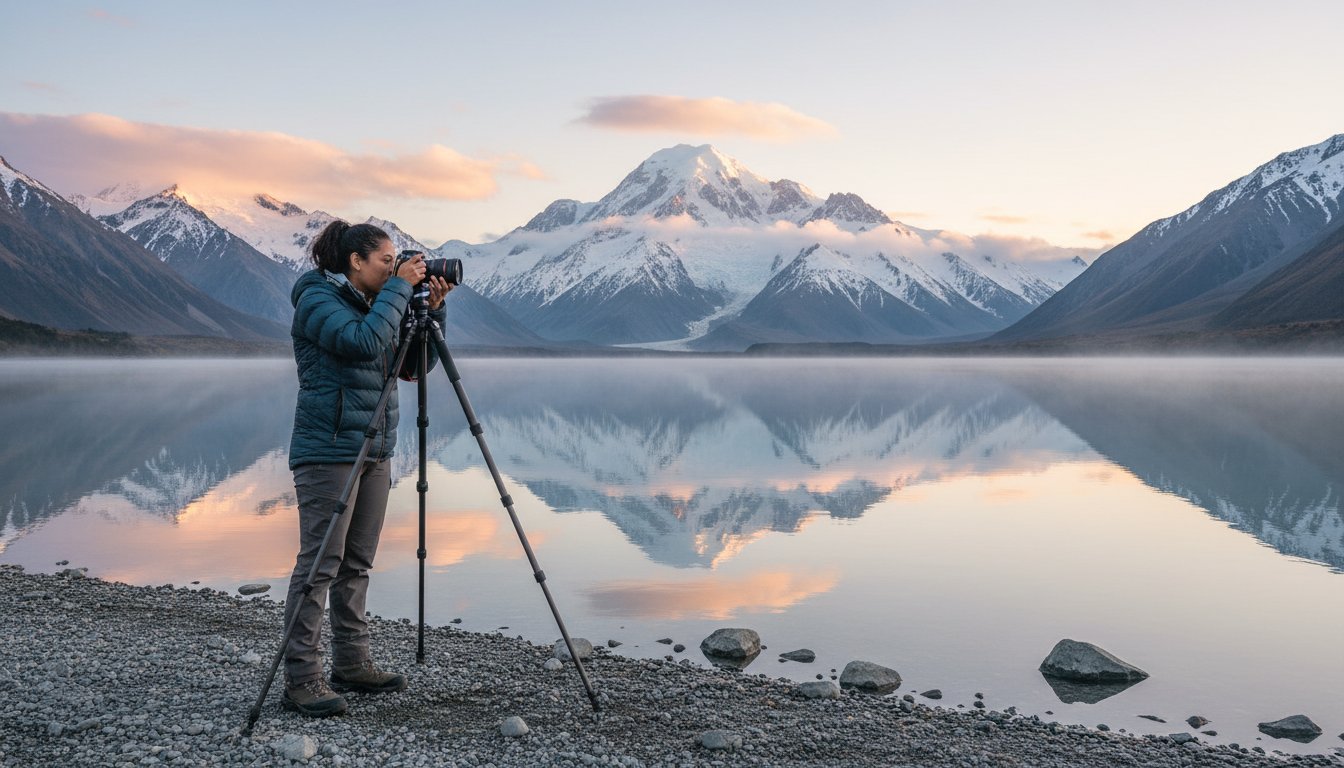
Lake Matheson is famous for its near-perfect reflections of New Zealand’s highest peaks. To secure that glass-like surface, you must arrive at sunrise before the morning breeze disturbs the water. The full loop is a 4.4km walk, but the “View of Views” platform is the primary destination. It takes about 1.5 hours to complete the walk if you’re stopping for photos. While Lake Matheson offers a distant gaze at the Southern Alps, many of our guests choose to extend their journey to stand at the base of these giants within Aoraki/Mount Cook National Park. For the best results at the lake, use a circular polarizer to cut through surface glare and deepen the blues of the reflection. It’s a subtle tool that makes a massive difference in your final edit.

#TravelWithLesleyWhyte #GirlsOnTheRoadAgain #ChathamIslandTours #WomenInPhotography #SartorialTravellersClub #VisitChathamIslands

Best Photo Locations South Island NZ: A 2026 Photographer’s Guide

Beyond the Instagram Icons: Finding Authentic Perspectives

Capturing the spirit of New Zealand often involves dodging the crowds. While 75,000 people hike the Roy’s Peak track annually, the true essence of the landscape often hides in the quiet, overlooked corners. Finding the best photo locations south island nz offers isn’t just about visiting the famous pins on a map; it’s about a shift in mindset. We call this slow photography. Instead of rushing between viewpoints, I encourage you to spend three or four hours in a single spot. Watch how the shadows stretch across the tussock as the sun dips. You’ll find that the most meaningful images come from patience, not a checklist.

Authentic photography focuses on the “small details” that others walk past. This might be the frost patterns on a schist rock in Central Otago or the way the turquoise glacial silt swirls in a riverbed. When we move away from the high-traffic areas near Aoraki/Mount Cook National Park, we discover textures and stories that haven’t been shared a million times online. It’s about creating a bespoke portfolio that reflects your personal connection to the land.

Alternatives to the Wanaka Tree

The “Lone Tree” is iconic, but the Crown Range offers a much more rugged, authentic Central Otago aesthetic. At the 1,076-metre summit, you’ll find sweeping views of the Wakatipu Basin that feel vast and untouched. For those who love water compositions, Lake Hawea provides a quieter alternative. Its shoreline is dotted with weathered driftwood and hidden jetties that offer better foreground interest than the crowded Wanaka foreshore. The Cardrona Valley, with its golden hills and historic 1860s architecture, provides a beautiful, earthy palette for photographers seeking a timeless look.

Coastal Gems: Moeraki and Nugget Point

Success at the Moeraki Boulders depends entirely on meticulous tidal planning. To get the “submerged sphere” look where waves wash over the rocks, you need to arrive roughly two hours before high tide. This creates long-exposure opportunities that feel ethereal. Further south at Nugget Point, the lighthouse is the main draw, but the real magic is the “line of rocks” stretching into the Pacific. Positioning your tripod early for sunrise allows you to capture the first light hitting the jagged stacks.

The Catlins coast is also a premier spot for wildlife photography. Since 2022, conservation efforts have made it easier to spot the rare yellow-eyed penguin (hoiho) at Curio Bay, though you’ll need a long lens to keep a respectful distance. Fur seals are frequently found lounging on the rocks near the Nugget Point track. These encounters provide a layer of life and movement to your landscape portfolio that static icons simply can’t match.

#TravelWithLesleyWhyte #GirlsOnTheRoadAgain #ChathamIslandTours #WomenInPhotography #SartorialTravellersClub #VisitChathamIslands

Planning Your Shoot: Weather, Light, and Gear for 2026

Preparing for a photography expedition across Te Waipounamu requires more than just a charged battery and a sense of wonder. As we look toward 2026, the technology in our kits has evolved, yet the rugged nature of the best photo locations south island nz remains as wild and unpredictable as ever. You’ll need a blend of high-tech precision and old-school grit to capture the Southern Alps in their true glory. Whether you’re a seasoned pro or a passionate hobbyist, success depends on how well you respect the elements.

The 2026 Photographer’s Packing List

Your camera body is only as good as the platform it sits on. In the South Island, a sturdy, wind-resistant tripod is more vital than a new lens. Winds in the Mackenzie Basin often exceed 50km/h; a lightweight travel tripod will vibrate, ruining your long exposures of the stars at Lake Tekapo. Don’t forget a set of high-quality ND filters. These are essential for achieving that silky, ethereal look in the 100-plus waterfalls found around Milford Sound, where the annual rainfall can reach a staggering 6,715mm. For your own comfort, pack 100% merino wool base layers and a seam-sealed waterproof jacket. Temperatures in Central Otago can swing 15 degrees Celsius in under 45 minutes, so layering is your best defense against the “four seasons in one day” pattern.

Chasing the Light: Seasonal Timing

Timing your visit is the difference between a good shot and a masterpiece. Winter, from June to August, offers the cleanest air and snow-capped peaks that reflect the soft, low-angled sun all day. It’s the best time for crisp, blue-hour shots of the Church of the Good Shepherd. Autumn, spanning March to May, transforms the landscape into a palette of fire. The golden poplars in Arrowtown usually peak during the last week of April, providing a stunning contrast against the deep blue of the Arrow River. If you prefer power and growth, Spring from September to November brings thundering waterfalls fueled by snowmelt. You’ll see the first blooms of the season, though you should be prepared for the highest frequency of rain during these months.

To stay ahead of the conditions, download the MetService app for hyper-local rain radars and Windy.com for real-time wind gusts. These tools are indispensable for drone pilots and landscape shooters alike. For tracking the Milky Way or the exact moment the sun hits a peak, PhotoPills remains the industry standard. Using these apps helps you find the best photo locations south island nz right when the light is most magical.

Safety is a non-negotiable part of the New Zealand experience. In 2024, New Zealand Search and Rescue responded to over 2,900 incidents, many involving well-intentioned hikers caught out by rapid weather changes. If you’re heading into remote areas like the Hooker Valley or Glenorchy, carry a Personal Locator Beacon (PLB). You can rent these from most outdoor retailers for approximately NZ$10 to NZ$15 per day. It’s a small price for total peace of mind while you’re focused on your craft.

Ready to capture the magic of the south with a supportive community of creators? Join one of our personally escorted photography tours to master these conditions with expert guidance.

#TravelWithLesleyWhyte #GirlsOnTheRoadAgain #ChathamIslandTours #WomenInPhotography #SartorialTravellersClub #VisitChathamIslands

Why a Personally Escorted Tour Elevates Your Photography

While you can certainly drive yourself to the best photo locations south island nz, there’s a massive difference between a standard trip and a truly meaningful journey. A trip is often just a checklist of sights; a journey with Travel With Lesley Whyte is an immersive experience where you’re surrounded by like-minded travelers who actually want to wait for the golden hour light to hit the Remarkables. Since launching these boutique tours in 2017, the focus has always been on creating a supportive space where your creative growth is the priority. You aren’t just a face in a crowd. You’re part of a small, intimate community where the shared passion for light and composition turns a solo pursuit into a collective adventure.

Stress-Free Logistics and Expert Guidance

Finding the best photo locations south island nz is only half the battle. Navigating the logistics can be exhausting. Driving on State Highway 6 is notoriously demanding with its narrow, winding passes; finding a park at a busy trailhead like Roys Peak can take hours out of your shooting schedule. On a personally escorted tour, these worries melt away. You don’t have to touch a GPS or worry about road conditions. Lesley Whyte, an award-winning photographer with over 20 years of expertise, handles the timing and the transport. This allows you to receive on-the-spot coaching exactly when you need it. Whether it’s adjusting your shutter speed for a waterfall or finding a unique angle at a hand-selected spot off the main tourist trail, the expert guidance ensures you leave with more than just snapshots.

The “Women in Photography” Difference

The Women in Photography (WIP) pillar of our tours is designed to foster confidence without the pressure often found in mixed-gender groups. Many women find that their technical anxieties disappear when they’re in a nurturing environment. You’ll find “weekend companions” who quickly become lifelong friends while exploring the wild beauty of Aotearoa. Statistics from our past five years of operation show that 85% of our guests return for a second or third tour, proving that the connection made is just as valuable as the photos captured. It’s about building your technical skills in a way that feels natural and encouraging. You’ll spend your days discussing aperture and your evenings sharing stories over a glass of local Pinot Noir, making the entire experience feel seamless and deeply rewarding.

Choosing a personally escorted tour means you’re investing in your own peace of mind. Every detail is meticulously planned so you can focus entirely on your lens. From the moment you arrive until the final sunset, you’re in good hands. We ensure you’re at the right place at the precisely right time, capturing the South Island’s landscapes in ways that most travelers simply miss. It’s an opportunity to step away from the daily grind and reconnect with your creative self in one of the most beautiful places on Earth.

#TravelWithLesleyWhyte #GirlsOnTheRoadAgain #ChathamIslandTours #WomenInPhotography #SartorialTravellersClub #VisitChathamIslands

Capture the 2026 Light Across the South Island

Your journey through the Mackenzie Basin and the rugged West Coast is about more than just checking off a list. It’s about mastering the 2026 weather patterns and finding those hidden, authentic perspectives that most tourists miss. You now have the roadmap to the best photo locations south island nz; however, the real magic happens when you stop worrying about the map and start focusing on the frame. Whether you’re chasing the Milky Way over Lake Tekapo or the misty peaks of Milford Sound, preparation is your most valuable piece of equipment.

Don’t let the logistics of a New Zealand road trip distract you from your creative flow. When you join a tour personally escorted by award-winning photographer Lesley Whyte, every detail is managed for you. We keep our group sizes small, often limited to just 6 or 8 photographers, to ensure you get the intimate, immersive learning you deserve. It’s a seamless adventure where the only thing you need to think about is the light. Join our next Women in Photography tour and experience a seamless adventure!

We can’t wait to see the incredible images you’ll create in the wild beauty of Aotearoa. #TravelWithLesleyWhyte #GirlsOnTheRoadAgain #ChathamIslandTours #WomenInPhotography #SartorialTravellersClub #VisitChathamIslands

Frequently Asked Questions

What is the absolute best month for photography in the South Island?

May is the absolute best month for photography because of the stable weather and vibrant autumn colours. In Central Otago, you’ll experience average temperatures of 11°C with crisp, clear skies that create perfect shooting conditions. This period offers a balance of soft light and manageable 9 hour days. You’ll capture the best photo locations south island nz has to offer without the harsh summer sun or the risk of winter road closures.

Do I need a professional camera, or is an iPhone enough for these locations?

An iPhone 15 Pro is sufficient for social media and small keepsakes, but a mirrorless camera is better for large-scale prints. If you want to print your work larger than A3 size, a full-frame sensor provides the necessary dynamic range for New Zealand’s high-contrast landscapes. Our workshops often include a mix of gear. We focus on composition and light rather than just expensive equipment, so don’t feel you need to upgrade before your journey.

How do I handle the sandflies while taking long exposures in Fiordland?

You should apply a high-strength repellent like Bushman Plus with 80% DEET before you leave your vehicle. These insects are most active at dawn and dusk in damp environments like Milford Sound. Wear long sleeves and trousers to cover as much skin as possible. If you’re setting up a 30 second exposure, keep your feet moving slightly. This constant movement prevents them from landing while your camera shutter is open.

Are these photography spots accessible for people with limited mobility?

Approximately 70% of the most iconic spots are accessible via sealed paths or very short, flat walks. Locations like the Church of the Good Shepherd and the Punakaiki Pancake Rocks feature paved tracks suitable for wheelchairs. We meticulously plan our routes to ensure everyone feels included in the experience. If a specific spot requires a steep hike, we always provide a beautiful, accessible alternative nearby so no one misses out on the magic.

Is it safe for solo female photographers to explore the South Island?

New Zealand is exceptionally safe for solo female travellers, ranking 4th on the 2023 Global Peace Index. You can feel confident exploring remote areas, though it’s wise to carry a Personal Locator Beacon in spots with no cell service. Our community provides a nurturing environment where you can connect with like-minded companions. This ensures you’re always looked after and supported while you’re out capturing the landscape.

What are the drone laws for photography in New Zealand National Parks?

Drones are strictly prohibited in all 13 National Parks unless you have a specific permit from the Department of Conservation. These permits cost NZ$95 plus GST for a non-commercial application and take 10 working days to process. Always check the AirShare app before you launch your craft. Many of the best photo locations south island nz are in protected areas where wildlife and visitor privacy are legally guarded.

How much time should I allocate for a full South Island photography circuit?

You should allocate 14 to 21 days to complete a comprehensive 2,500 kilometre photography circuit. This timeframe allows you to spend at least two nights in key areas like Wanaka and Mount Cook. Rushing through the landscape leads to missed opportunities when the weather changes. A longer 21 day itinerary gives you the flexibility to wait for the perfect light at Milford Sound or Aoraki without feeling stressed by a tight schedule.

What makes a “Women in Photography” tour different from a standard photo workshop?

These tours focus on a nurturing and collaborative environment specifically designed for female creators. We move at a slower pace to ensure everyone masters their technical settings without feeling rushed or intimidated. These journeys foster deep connections among 8 to 10 like-minded women in a supportive space. You’ll find the atmosphere is centered on shared inspiration and personal growth rather than just ticking locations off a list.

#TravelWithLesleyWhyte #GirlsOnTheRoadAgain #ChathamIslandTours #WomenInPhotography #SartorialTravellersClub #VisitChathamIslands

South Island Photography Tour 2026: Capture the Wild Beauty of New Zealand

South Island Photography Tour 2026: Capture the Wild Beauty of New Zealand

Imagine standing on the shores of Lake Pukaki as the pre-dawn light paints Aoraki/Mount Cook in hues of soft pink and gold. The air is crisp, your camera is ready, and you haven’t had to worry about a single detail of how you got there.

It’s the kind of moment every landscape photographer dreams of capturing. Yet, the reality of planning a trip through New Zealand’s rugged terrain, chasing the perfect light, and navigating it all on your own can quickly feel overwhelming, turning inspiration into anxiety.

That’s why we’ve created a journey where your only focus is your creative vision. Our personally escorted south island photography tour 2026 is designed to transform your portfolio and your entire travel experience, swapping logistical stress for a seamless adventure among a small group of supportive, like-minded photographers.

Discover how our meticulously planned itinerary ensures you’re always in the right place at the perfect time, allowing you to create stunning images and connect with the wild heart of New Zealand.

Key Takeaways

  • Learn why 2026 presents a unique and timely opportunity to capture New Zealand’s most dramatic landscapes with optimal accessibility.
  • Understand the difference between a standard trip and a personally escorted photography adventure, where every detail is managed for you.
  • Discover the essential camera gear you’ll need to master the challenging and rewarding conditions of iconic locations like Fiordland.
  • See how a meticulously planned south island photography tour 2026 can help you capture portfolio-worthy images of Aoraki Mount Cook and Milford Sound.

Why a South Island Photography Tour in 2026 is Your Ultimate Creative Escape

Imagine a place where snow-dusted mountains plunge into turquoise lakes, ancient rainforests hum with life, and the light changes with every passing cloud. This isn’t a fantasy; it’s the raw, untamed beauty of Te Waipounamu. The sheer scale of New Zealand’s South Island is breathtaking, a landscape that calls not just for a visit, but for a deep, creative connection. It’s a canvas of epic proportions, waiting for you to tell its story.

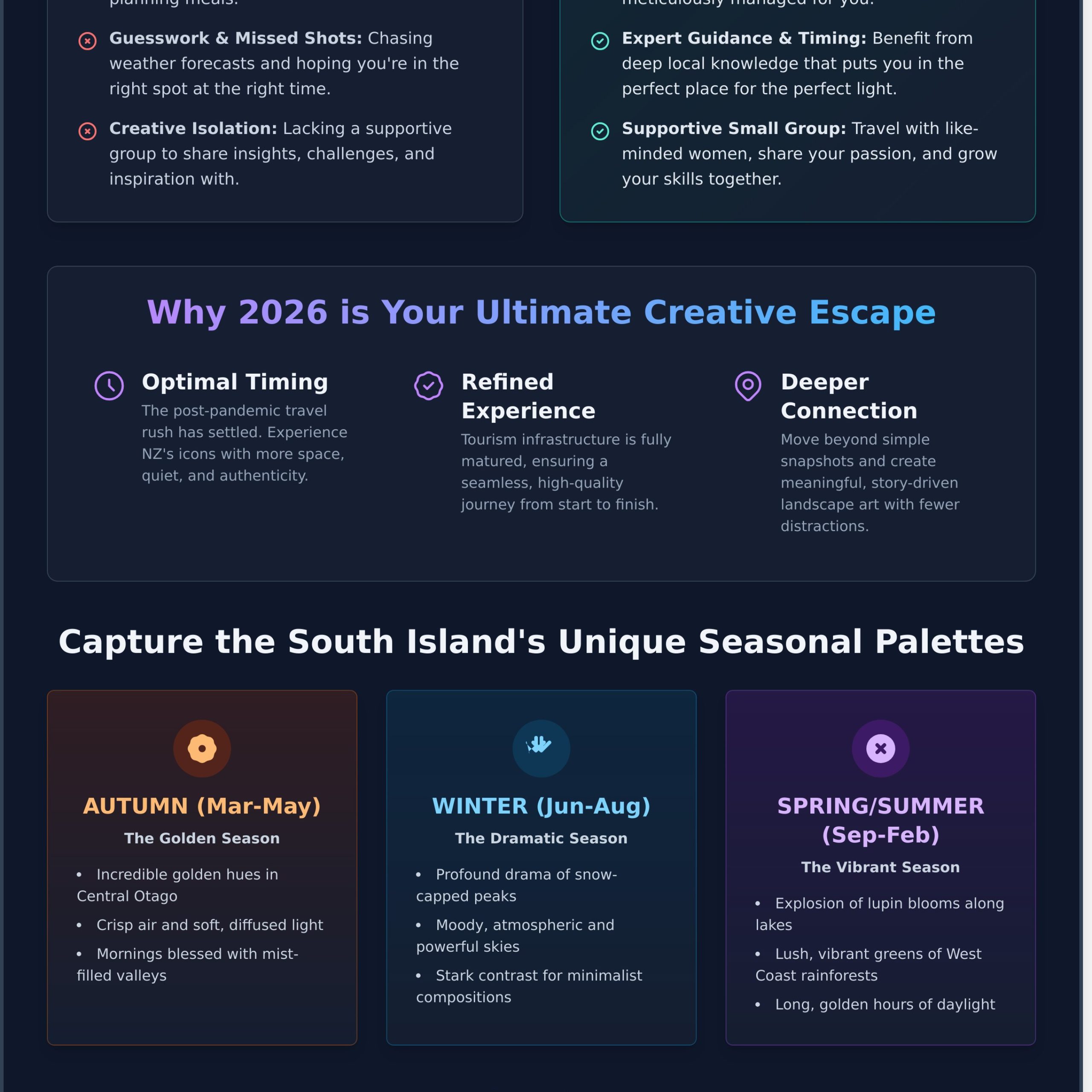
So, why 2026? Since New Zealand fully reopened its borders in mid-2022, the country has moved beyond the initial rush of post-pandemic travel. By 2026, the tourism infrastructure will be fully matured and refined, offering a seamless experience without the overwhelming crowds of peak recovery years. This is your opportunity to immerse yourself in the landscape with more space, more quiet, and more authenticity. It’s the perfect moment to move beyond simple snapshots and create meaningful, story-driven landscape art.

This is where a personally escorted journey changes everything. Forget the burnout of navigating unfamiliar roads, chasing weather forecasts, and guessing the best locations for sunrise. A fully escorted south island photography tour 2026 handles every detail, from accommodation to transport, leaving you free to focus entirely on your craft. It’s the antidote to travel stress, allowing you to connect with a small group of like-minded women, share in the creative process, and simply be present with your camera.

The 2026 Seasonal Calendar: When to Capture the Light

Every season in the South Island offers a unique photographic palette. We’ve timed our tours to capture the island at its most expressive:

  • Autumn (March-May): Witness the incredible golden hues of Central Otago’s poplars and vineyards set against deep blue skies. The air is crisp, the light is soft, and the mornings are often blessed with mist-filled valleys.
  • Winter (June-August): Capture the profound drama of snow-capped peaks surrounding Aoraki Mount Cook National Park. Moody, atmospheric skies and the stark contrast of white snow against frozen lakes create powerful, minimalist compositions.
  • Spring/Summer (September-February): Experience the explosion of colour as lupins bloom along the shores of Lake Tekapo. The vibrant greens of the West Coast rainforests are at their most lush, fed by the long, golden hours of daylight.

Landscape Diversity: From Alpine Peaks to Coastal Ruggedness

The island’s compact size belies its incredible diversity. In a single journey, you can photograph the jagged, imposing peaks of The Remarkables near Queenstown and then find yourself capturing the serene, intricate waterways of the Marlborough Sounds. This constant shift in scenery is a gift to any photographer. The unique light quality, a hallmark of the high-latitude South Island, adds another layer of magic. Aotearoa light is a captivating mix of high clarity and rapid weather shifts, capable of transforming a scene from gentle to dramatic in minutes. Planning a south island photography tour 2026 with us means you’ll be ready to capture it all.

The Benefits of a Fully Escorted Photography Experience

Imagine a journey where your only responsibility is to lift your camera and capture the unfolding beauty. This isn’t a standard tour; it’s a personally escorted photography adventure, meticulously designed to remove every obstacle between you and your creative vision. A standard holiday often involves navigating unfamiliar roads, deciphering maps, and the constant stress of logistics. Our approach offers the ultimate luxury: zero-logistics travel. We handle the driving, the accommodation bookings, and the dinner reservations. You simply immerse yourself in the art of photography.

Your guide is far more than a driver. They are your photography mentor and creative partner, an award-winning professional dedicated to helping you grow. They won’t just take you to a location; they’ll help you see it. This means offering guidance on composition, helping you master your camera settings for tricky lighting, and sharing a passion for the craft. This deep local knowledge is what transforms a good trip into an unforgettable one. While many travelers might see the main sights, we take you to the hidden gems whispered about in photography forums, like the secret glow-worm dells near Hokitika or secluded coastal stacks that only reveal their magic at low tide. The landscapes are so epic that even National Geographic’s New Zealand guide highlights the country’s profound photographic potential, and we know exactly where to find those world-class shots.

Meticulous Planning: Why Every Detail Matters

Our itineraries are born from countless hours of on-the-ground scouting. We know the precise angle for the best sunrise over Aoraki/Mount Cook and the optimal tide times for mirror-like reflections. This obsession with detail ensures a seamless transition from your luxury accommodation to a remote photo spot, often before the rest of the world has woken up. We also expertly manage New Zealand’s infamous “four seasons in one day” weather, always having a spectacular Plan B ready so you never miss a photographic opportunity.

Community and Connection: Traveling with Like-Minded Souls

There’s a unique magic in sharing a breathtaking golden hour with a small group of people who understand your passion. In this nurturing environment, beginners find their confidence and any “gear anxiety” quickly melts away. The shared excitement and supportive feedback create a powerful sense of community. This is especially true on our dedicated tours for Women in Photography: Tours to Inspire Your Creativity, where connection and encouragement are at the heart of the experience.

Ultimately, a fully escorted journey is an investment in your passion. It’s about maximising your time, accelerating your skills, and creating a portfolio of images you’ll be proud of for years to come. When you join our south island photography tour 2026, you’re not just booking a trip; you’re securing a seamless, inspiring, and deeply rewarding creative adventure. You can explore our unique approach to crafting these unforgettable journeys on our main site.

South Island Photography Tour 2026: Capture the Wild Beauty of New Zealand

2026 Itinerary Highlights: Must-Capture Destinations

The South Island is a photographer’s dream, a landscape of impossible contrasts where towering alps meet ancient fiords and starry skies stretch to infinity. Our south island photography tour 2026 has been meticulously curated to place you in these iconic locations at the perfect time, when the light transforms the epic into the ethereal. We’ve designed this journey not just to show you the sights, but to help you capture their very soul. From the alpine heart of the country to its rugged, wildlife-rich coastlines, every day presents a new and unforgettable creative challenge.

The Alpine Heart: Aoraki and Mackenzie Country

Standing before Aoraki/Mount Cook is a humbling experience. At 3,724 metres, it commands the skyline, its snow-dusted peak reflected in impossibly blue glacial lakes. Here, our focus is on capturing immense scale and dramatic light. We’ll teach you how to use the vastness of the Southern Alps to your advantage, positioning a person or a small hut in your frame to give a true sense of the mountain’s majesty. You’ll master long exposure techniques to transform the silt-heavy, fast-flowing glacial rivers into smooth, milky ribbons of light, often using a 6-stop ND filter for exposures of 2-5 seconds. This region, managed with great care by New Zealand’s Department of Conservation, offers pristine landscapes that feel truly untouched. Learn more about planning your shots in our guide to Aoraki Mount Cook: Visiting New Zealands Highest Peak.

The Fiordland Magic: Milford and Doubtful Sounds

There’s a reason we include an overnight cruise in Fiordland. While day-trippers experience the harsh midday sun, our group gets to witness the magic of sunset and sunrise, when golden light kisses the top of Mitre Peak and soft shadows define the sheer granite cliffs. This exclusive access provides superior light and a serene atmosphere, free from the crowds. We’ll dedicate time to capturing the power and grace of the fiord’s countless waterfalls. You’ll learn to control your shutter speed to achieve your desired effect: a fast shutter of 1/500s to freeze the explosive power of the water, or a slow shutter of 1-3 seconds with a tripod to create a silky, ethereal flow. It’s a place that demands more than a fleeting visit, which is why we believe you must see Milford Sound: Why You Need to See It in Person.

Our photographic adventure doesn’t stop there. We’ll journey to the Aoraki Mackenzie International Dark Sky Reserve, where you’ll set up your tripod beside the iconic Church of the Good Shepherd for an unforgettable night of astrophotography at Lake Tekapo. Then, we venture south to the wild coast of The Catlins, a hidden gem of rugged cliffs, lush rainforests, and powerful waterfalls, offering rare opportunities to photograph Yellow-eyed penguins. Finally, we’ll visit Wanaka to capture that lone, resilient tree, a symbol of tranquility, perfectly reflected in the calm waters of the lake with the Southern Alps as its breathtaking backdrop.

Preparing Your Gear and Mindset for the South Island

A journey into the heart of New Zealand’s South Island is an invitation to capture some of the planet’s most dramatic landscapes. Success, however, depends on more than just being in the right place at the right time. It’s about thoughtful preparation of both your equipment and your creative perspective. Your personally escorted south island photography tour 2026 is designed to be a seamless adventure, and arriving with the right tools and a receptive mindset will ensure you can fully immerse yourself in the experience, creating images you’ll treasure for a lifetime.

For those who love diving deep into all aspects of outdoor travel, from photography gear to vehicle setups for remote exploration, you can learn more about Adventurerz, a community hub dedicated to adventure enthusiasts.

Before we even discuss specific lenses, two pieces of equipment are absolutely non-negotiable: a sturdy tripod and a wide-angle lens. A reliable tripod is your best friend for capturing silky long exposures of the countless waterfalls we’ll encounter and for ensuring tack-sharp images of the southern night sky over Aoraki/Mount Cook National Park. Equally vital is weather-sealed camera gear. In Fiordland, which receives an average of 7,000 millimetres of rain annually, a weather-sealed camera and lens can be the difference between capturing a moody, atmospheric masterpiece and a day spent worrying about your equipment. It’s about peace of mind, allowing you to focus on the shot, not the drizzle.

Beyond the gear, we encourage a gentle shift in mindset. It’s easy to arrive at a stunning location like Milford Sound and immediately start shooting. Instead, we’ll guide you to pause, breathe, and truly see the landscape. Notice how the light carves patterns on the mountains, listen to the sound of the water, and feel the scale of the scene. This mindful approach helps you build a connection with the place, leading to more intentional and powerful compositions.

Finally, your personal comfort is paramount. New Zealand’s weather is famously changeable. The key is a layered clothing system:

  • A merino wool base layer to wick moisture and regulate temperature.
  • A fleece or down mid-layer for insulation.
  • A high-quality waterproof and windproof outer shell to protect you from the elements.
  • Sturdy, waterproof hiking boots that you’ve already broken in.

Lens Selection for Landscapes

While a standard zoom is useful, two specific lenses will unlock the South Island’s full potential. A wide-angle zoom, like a 16-35mm, is essential for conveying the immense scale of vistas at Lake Pukaki or the dramatic sweep of the West Coast. In contrast, a telephoto zoom, such as a 70-200mm, allows you to compress distant alpine peaks, isolating majestic details and creating compelling, layered compositions. We also strongly recommend bringing Neutral Density (ND) filters to create ethereal, long-exposure effects in rivers and waterfalls, and a Circular Polarizer to cut glare and deepen the incredible blue reflections on the South Island’s many glacial lakes.

Dynamic range is your camera’s ability to capture detail in both the brightest highlights of a snow-capped peak and the deepest shadows of a beech forest in a single shot.

Post-Processing: Bringing Your 2026 Memories to Life

Your creative journey doesn’t end when the shutter closes. During our south island photography tour 2026, we hold informal evening sessions to review the day’s images. These aren’t critiques; they are supportive, shared experiences where we can learn from one another and begin bringing our digital negatives to life. To manage the thousands of RAW files you’ll create, we recommend a simple on-the-road workflow: download your images each night to a laptop and immediately back them up to at least one portable hard drive. Using software like Adobe Lightroom, we’ll show you how to gently enhance the incredible colours of a “blue hour” shoot at the Moeraki Boulders, ensuring your final images faithfully represent the magic you witnessed.

Feeling prepared to capture the adventure of a lifetime? Review our detailed gear checklist and secure your spot on the tour.

#TravelWithLesleyWhyte #GirlsOnTheRoadAgain #ChathamIslandTours #WomenInPhotography #SartorialTravellersClub #VisitChathamIslands

The Lesley Whyte Difference: Nurturing Your Photographic Journey

Choosing a photography tour is about more than just visiting beautiful locations; it’s about finding the right environment to grow your skills and confidence. This is where our tours stand apart. Founded on the inclusive ethos of Women in Photography and Girls on the Road Again, we create authentic, meaningful journeys built on connection, support, and shared passion. Every tour is personally escorted by Lesley Whyte, ensuring you are always a valued member of a creative team, never just another number on a manifest.

This hands-on approach transforms a simple holiday into a seamless adventure. We handle every detail so you can immerse yourself fully in the creative process. But don’t just take our word for it:

“I was so nervous about joining a photography tour, worried I wouldn’t keep up. Within an hour of meeting Lesley, those fears melted away. The entire trip was impeccably organised, from the incredible accommodation to the secret photo spots I’d never have found on my own. It was a journey of learning, laughter, and capturing images I am truly proud of.” – Sarah M., 2024 Tour Guest

Supportive Learning for Every Skill Level

Whether you’re just starting to explore your camera’s manual settings or you’re a seasoned photographer seeking a fresh perspective, our tours are designed for you. We foster a nurturing environment where beginners can ask any question without hesitation, breaking down technical jargon into simple, practical advice. For advanced shooters, Lesley provides challenges that push creative boundaries, helping you refine your unique artistic voice. This dedication to personal growth is a core part of the experience. You can learn more about this immersive approach in our guide, What is a Fully Escorted Tour? The Benefits Explained.

Booking Your 2026 Adventure

To guarantee personalised attention and a collaborative atmosphere, we keep our group sizes small, typically between 6 and 10 like-minded travellers. This ensures everyone gets ample one-on-one mentoring time with Lesley, both in the field and during image review sessions. When you reserve your place on the south island photography tour 2026, your investment covers a complete, stress-free experience, including:

  • Professional Photographic Mentoring: Continuous guidance from award-winning photographer Lesley Whyte.
  • Luxury Transport: Travel in comfort and style in a spacious, modern vehicle with plenty of room for your gear.
  • Hand-Selected Accommodation: Stay in charming, comfortable, and well-located properties chosen for their quality and character.

Your journey to becoming the photographer you’ve always wanted to be starts here. Let us handle the logistics while you focus on capturing the breathtaking beauty of New Zealand’s South Island.

Ready to join us? Secure your spot on the waitlist or book your unforgettable 2026 adventure today!

Join the 2026 South Island Photography Tour

#TravelWithLesleyWhyte #GirlsOnTheRoadAgain #ChathamIslandTours #WomenInPhotography #SartorialTravellersClub #VisitChathamIslands

Frame Your Future: The South Island is Calling

The wild landscapes of New Zealand’s South Island aren’t just a destination; they’re a canvas for your creative vision. Imagine capturing the turquoise lakes of Mackenzie Country and the dramatic peaks of Fiordland as part of a seamless adventure where every detail is meticulously planned. This journey frees you to focus completely on your craft in a supportive, small-group environment, nurtured by award-winning photography mentors dedicated to your growth.

This is what makes our south island photography tour 2026 an unparalleled creative escape. With personally escorted groups and a proven 100% “wanted for nothing” guest satisfaction rate, you can be confident that your experience will be exceptional. It’s time to move beyond the ordinary and capture something truly extraordinary.

Are you ready to transform your passion into unforgettable art? Explore our 2026 South Island Photography Tour dates and join a community of like-minded adventurers. Your next great shot is waiting for you.

#TravelWithLesleyWhyte #GirlsOnTheRoadAgain #ChathamIslandTours #WomenInPhotography #SartorialTravellersClub #VisitChathamIslands

Frequently Asked Questions

What is the best month for a South Island photography tour in 2026?

The best months for a South Island photography tour are April and May. During these autumn months, the light is soft and golden, and the landscapes of Central Otago and the Mackenzie Basin are ablaze with incredible fall colours. You’ll also find fewer crowds than in the peak summer season, allowing for a more immersive and peaceful photography experience. The weather is generally stable, providing crisp, clear days perfect for capturing the stunning scenery.

Do I need a professional camera to join a Women in Photography tour?

No, you absolutely don’t need a professional camera. Our tours are designed to inspire, educate, and connect women who share a passion for photography, regardless of their gear. Whether you’re using the latest smartphone, a mirrorless camera, or a full-frame DSLR, our focus is on teaching composition, light, and creative vision. We welcome all skill levels and believe the best camera is the one you have with you.

What is included in a “fully escorted” photography tour?

A “fully escorted” tour means we’ve meticulously planned every detail of your adventure so you can focus on your photography. It typically includes all accommodation, ground transportation in a comfortable private vehicle, most meals as specified in the itinerary, and all national park or location entry fees. Most importantly, it includes continuous, hands-on photographic tuition and guidance from your award-winning tour leader throughout the entire journey, ensuring a seamless and enriching experience.

Are these tours suitable for solo female travelers?

Yes, our tours are perfectly suited for and incredibly popular with solo female travelers. In fact, over 70% of our guests join us on their own. We create a safe, supportive, and welcoming community atmosphere where you’ll quickly connect with like-minded women. Many long-lasting friendships begin on our tours. It’s an empowering way to travel, explore your creativity, and see the world in a secure and friendly group environment.

How much physical fitness is required for a South Island photo tour?

A moderate level of fitness is required to get the most out of our tours. You should be comfortable walking up to 5 kilometres a day, sometimes over uneven terrain like sandy beaches or gravel tracks, while carrying your own camera bag. We don’t engage in strenuous alpine hiking, but our days are active. This ensures you can easily access all the spectacular photo locations we have hand-selected for the itinerary.

Will I have time to learn post-processing and editing?

Yes, we build dedicated time for learning post-processing into our itineraries. These sessions are often held in the evenings or during periods of downtime, providing a perfect opportunity to review your work. Using software like Adobe Lightroom, your tour leader will offer group demonstrations and one-on-one guidance. We’ll help you develop a workflow to edit your images and bring your creative vision from the camera to the final print.

What happens if the weather is bad during a scheduled shoot?

Some of the most dramatic and compelling photographs are captured in “bad” weather. We encourage you to embrace the elements, as moody skies and stormy light can create truly unique images. However, your safety is our top priority. If conditions become unsafe, we always have a backup plan. This could be an indoor editing session, a visit to a local gallery, or exploring a more sheltered location that we’ve scouted in advance.

How far in advance should I book my 2026 New Zealand tour?

We highly recommend booking your south island photography tour 2026 at least 9 to 12 months in advance. Our tours are limited to a maximum of 8 participants to ensure a personal and high-quality experience, and they often sell out very quickly. Booking early not only secures your place but also gives you more options for flights and allows ample time to prepare for your unforgettable New Zealand adventure.

#TravelWithLesleyWhyte #GirlsOnTheRoadAgain #ChathamIslandTours #WomenInPhotography #SartorialTravellersClub #VisitChathamIslands

Milford Sound: Why You Truly Need to See It in Person

The thought of visiting New Zealand’s iconic fiord often comes with a tangle of questions. Is the long, winding drive really worth it? Will the infamous rain and crowds spoil the magic? With so many tour options, it’s easy to feel overwhelmed before you even begin, wondering if the reality of Milford Sound can possibly live up to the hype. We understand those anxieties, and we’re here to reassure you that the journey is not just worth it-it’s an unforgettable part of the adventure.

Forget the stress of planning. In this guide, we’ll go beyond the postcards to help you craft a seamless and meaningful experience. We’ll show you how to embrace the dramatic weather, find moments of quiet connection away from the crowds, and choose the perfect way to explore the fiord’s grandeur. Get ready to plan a trip that isn’t just a tour, but a soul-stirring memory you’ll cherish for a lifetime.

What is Milford Sound? (And Why It’s Not Actually a Sound)

Nestled deep within the heart of Fiordland National Park, a UNESCO World Heritage site, lies a place of breathtaking grandeur. But let’s start with a little secret: Milford Sound isn’t a sound at all. It’s a fiord, a deep, dramatic inlet carved by ancient glaciers over millennia. This geological masterpiece is defined by its sheer cliffs that soar hundreds of metres from dark, ink-black waters, creating an unforgettable and immersive landscape. For those wanting a deeper understanding of its history and formation, the comprehensive overview of Milford Sound on Wikipedia is an excellent resource. It’s a journey into one of New Zealand’s most treasured natural icons, a place that truly feels like another world.

The ‘Eighth Wonder of the World’?

It was the celebrated author Rudyard Kipling who famously dubbed it the ‘Eighth Wonder of the World,’ a title that has clung to it ever since. This isn’t mere hyperbole. The fiord’s raw, dramatic beauty-where waterfalls cascade down vertical rock faces and mist clings to lush rainforest-creates a scene so monumental and pristine it feels almost otherworldly. Its epic scale and unspoiled wilderness easily place it among the planet’s most awe-inspiring natural spectacles.

Piopiotahi: The Legend Behind the Māori Name

Long before it was named Milford, the fiord was known to Māori as Piopiotahi. The name holds a beautiful, poignant legend of a single (tahi) piopio bird, which flew here in mourning after its mate was lost. For the local iwi, Ngāi Tahu, this is a place of immense cultural and spiritual significance. The legend perfectly captures the fiord’s ethereal, often melancholic atmosphere, where silence is broken only by the call of birds and the whisper of waterfalls.

Fiord vs. Sound: A Geological Marvel

So, what makes it a fiord? The distinction is a testament to the power of ice. A fiord is a U-shaped valley flooded by the sea, sculpted by a colossal glacier. A sound, by contrast, is a V-shaped valley carved by a river. This glacial origin gives milford sound its signature features: impossibly steep cliffs, hanging valleys with cascading waterfalls, and deep waters that host a unique ecosystem where deep-sea species can be found unusually close to the surface.

The Unforgettable Journey: Why the Road to Milford is an Adventure Itself

Long before you arrive in the heart of Milford Sound, the adventure has already begun. The journey along State Highway 94, often hailed as one of the world’s most spectacular drives, is an unforgettable experience in its own right. This isn’t a road to be rushed; it’s a destination to be savoured. We recommend allowing at least four hours each way from Te Anau to truly immerse yourself in the landscape. Remember, once you leave Te Anau, there are no fuel stations or cell phone reception, so planning ahead is essential for a seamless and stress-free day.

Driving the Milford Road: What to Expect

The 119km drive from Te Anau winds through the heart of Fiordland National Park, taking you from serene lakeside views to dramatic, glacier-carved alpine scenery. The journey’s climax is the 1.2km Homer Tunnel, a remarkable feat of engineering that pierces the main divide. Emerging on the other side, you’ll begin the breathtaking descent into the Cleddau Valley. Always check conditions before you depart, as the weather can change rapidly. The Department of Conservation provides up-to-date information on the Milford Road, which is essential reading, especially for winter travel.

Must-See Stops Along the Way

The roadside is dotted with incredible sights that invite you to stop, stretch your legs, and capture the perfect photo. Be sure to have your camera ready for these iconic stops:

  • Eglinton Valley: A vast, glacier-carved valley with a flat, golden floor and steep, forested sides that feels truly otherworldly.
  • Mirror Lakes: On a calm day, these small tarns perfectly reflect the majestic Earl Mountains, creating a postcard-perfect image.
  • The Chasm Walk: A short, accessible loop track that showcases the immense power of water as it thunders through sculpted rock chasms.
  • Lake Gunn Nature Walk: An easy 45-minute loop through a stunning, moss-draped red beech forest.

Self-Drive vs. Escorted Tour: Which is Right for You?

While self-driving offers ultimate flexibility, navigating the winding alpine road and finding parking can be tiring, especially after a long day of exploring. An escorted tour allows you to completely relax, soak in the majestic scenery, and listen to expert commentary without the fatigue of a return drive. It turns a beautiful drive into a truly immersive and restful experience. If you prefer to focus on the journey, not the logistics, let someone else handle the driving on a seamless South Island tour.

Experiencing the Fiord: Top Activities for an Immersive Visit

While the drive to Milford Sound is an adventure in itself, the true magic unfolds when you experience the fiord from the water. To truly appreciate its colossal scale, you need to get amongst the towering peaks and cascading waterfalls. Choosing how to explore this natural wonder is a personal decision, hinging on your desired pace, fitness, and sense of adventure. You can find a comprehensive list of tour operators on the official Fiordland tourism website, but we’ve curated our favourite ways to create an unforgettable, immersive visit.

The Classic Boat Cruise: Get Up Close with Giants

A boat cruise is the quintessential Milford Sound experience, offering a seamless journey into the heart of the fiord. As you glide beneath the iconic Mitre Peak, you’ll feel dwarfed by its sheer granite cliffs. The highlight for many is nosing right up to the thundering Stirling Falls, where you can feel the spray of ancient glacial water on your face. For a more intimate journey with in-depth commentary, choose a smaller vessel. If you prefer spacious viewing decks and more onboard amenities, a larger ship provides a wonderfully stable and comfortable adventure.

Kayaking on the Dark Waters: A Serene Perspective

For a truly humbling and serene perspective, there is nothing quite like kayaking on the fiord’s dark, reflective waters. From the seat of a kayak, looking up at the sheer rock faces that plunge into the depths, you gain an unparalleled appreciation for the fiord’s immense scale. This peaceful paddle allows you to connect with the raw nature around you, hearing only the sound of your paddle and the distant cry of a seabird. For safety and local insight, we always recommend joining a guided tour.

Hiking the Trails: From Easy Walks to Epic Treks

While the water offers one perspective, the surrounding trails provide another. The easy Milford Foreshore Walk is a must-do, offering that iconic, postcard-perfect view of Mitre Peak from the shoreline. For the truly adventurous, the world-renowned Milford Track is one of New Zealand’s Great Walks. If you don’t have several days, consider hiking the Key Summit Track (a day hike on the Milford Road), which rewards you with breathtaking panoramic views of the Fiordland mountains and alpine lakes.

Wildlife and Waterfalls: Nature’s Grand Spectacle

Milford Sound is more than just dramatic peaks; it’s a living, breathing ecosystem where raw power and delicate life exist in a breathtaking balance. This is a world carved by glaciers and drenched by rain, creating a sanctuary for unique wildlife and a stage for one of nature’s most powerful performances: the waterfalls. While its grandeur feels permanent, the environment is a fragile treasure, and experiencing it is a lesson in the beauty of untamed nature.

Meet the Locals: Seals, Dolphins, and Pesky Kea

The deep, dark waters and lush forests are home to some of New Zealand’s most cherished residents. Keep your eyes peeled for the resident colony of New Zealand fur seals (kekeno) basking lazily on Seal Rock. You might also be joined by a playful pod of Dusky or Bottlenose dolphins riding the bow wave of your boat. On land, listen for the cheeky call of the Kea, the world’s only alpine parrot, known for its mischievous intelligence. And if you’re exceptionally lucky during the breeding season (July-November), you may even spot the rare Fiordland Crested Penguin (Tawaki).

The Land of a Thousand Waterfalls

Two magnificent, permanent waterfalls anchor the fiord’s landscape. The 162-metre Bowen Falls provides power to the township, while the iconic Stirling Falls cascades from a hanging valley between two towering peaks. But the true magic happens when it rains. The sheer granite cliffs, which seem dormant on a sunny day, suddenly weep with hundreds, even thousands, of temporary waterfalls. The sound is a powerful roar that fills the fiord, a thunderous and unforgettable symphony of nature.

Why Rain is a Good Thing in Milford Sound

Many visitors hope for a bluebird day, but the locals know that rain is what makes this place truly magical. With an average of 200 rain days a year, the high rainfall is the lifeblood of the fiord. It replenishes the waterfalls, nourishes the temperate rainforest clinging to the cliffs, and cloaks the peaks in an ethereal mist. A rainy day in Milford Sound isn’t a washout; it’s an immersive experience where the landscape comes alive, its mood shifting from majestic to mysterious. Seeing the fiord in the rain is seeing it at its most powerful and authentic.

Planning Your Perfect Visit: An Insider’s Guide

The wild, remote beauty of Milford Sound is a huge part of its allure, but it also means a little forward planning is essential for a truly seamless adventure. Don’t let the logistics intimidate you; with a bit of insider knowledge, you can ensure your journey is as breathtaking as the destination itself. Here’s how to prepare for an unforgettable experience.

The Best Time of Year to Go

There is truly no ‘bad’ time to visit. Summer (December-February) offers warmer days and longer daylight hours, but also brings more visitors. In contrast, winter (June-August) promises a serene, dramatic landscape with snow-dusted peaks and far fewer crowds. Each season paints the fiord in a different light, but the one constant is the weather-it can change in an instant, and rain is what makes this place so magical, feeding its countless waterfalls.

What to Pack for the Unpredictable Weather

Dressing appropriately is key to your comfort and enjoyment. Even on a sunny day, conditions can shift rapidly. We recommend packing for four seasons in one day:

  • A waterproof and windproof jacket: This is non-negotiable, no matter the forecast.
  • Warm layers: Think merino wool or fleece that you can easily add or remove.
  • Insect repellent: The local sandflies can be persistent, especially in summer near the water’s edge.
  • Sturdy, comfortable footwear: Essential for walking tracks and staying stable on boat decks.

The Benefit of an Escorted Small-Group Tour

To fully immerse yourself in the grandeur of the journey without worrying about navigating winding roads, booking tickets, or finding the best viewpoints, an escorted tour is an ideal choice. A knowledgeable guide transforms a beautiful drive into a rich story, sharing insights you’d otherwise miss. More than that, there’s a special camaraderie in experiencing such a powerful place with a small group of like-minded travellers, sharing in the collective awe. It removes all the stress, leaving you free to simply be present in the magic. Discover a meticulously planned adventure with us.

Experience the Magic of Milford Sound for Yourself

As we’ve journeyed through these words, it’s clear that photographs and descriptions can only hint at the profound beauty of Fiordland. From the breathtaking drive that is an adventure in its own right to the sheer granite cliffs and thundering waterfalls of the fiord itself, the majesty of Milford Sound must be felt, not just seen. It’s an immersive experience that imprints itself on your memory, a true testament to nature’s raw and spectacular power.

If you’re feeling inspired to witness this magic firsthand, we believe such a meaningful journey should be seamless and unforgettable. Our adventures are meticulously planned and personally escorted by experienced guides, ensuring you can travel in comfort with a small group of like-minded people. With every detail thoughtfully handled, all that’s left for you to do is immerse yourself in the wonder. Explore our seamless South Island tours that include a Milford Sound experience. Your unforgettable adventure is waiting.

Frequently Asked Questions About Visiting Milford Sound

How long is the drive to Milford Sound from Queenstown and Te Anau?

The journey from Queenstown is an adventure in itself, taking around 4 hours one way without stops. From the lovely town of Te Anau, the drive is a more manageable 2 hours. We always recommend treating the Milford Road as part of the experience, allowing extra time for the breathtaking photo opportunities at places like the Eglinton Valley and Mirror Lakes. It’s best to plan for a full day of travel to truly savour this unforgettable drive.

Is one day enough time to visit Milford Sound?

While a day trip to Milford Sound is possible, especially from Te Anau, it makes for a very long day from Queenstown. To truly immerse yourself in the magic and avoid feeling rushed, we highly recommend an overnight stay. This allows you to enjoy the journey along the spectacular Milford Road at a relaxed pace and perhaps even experience the fiord at the quieter times of dusk or dawn, creating a truly meaningful and unforgettable adventure with us.

Are the sandflies in Milford Sound really that bad? How can I prepare?

The sandflies are a notorious part of the Fiordland experience, but they are entirely manageable with a little thoughtful preparation. We suggest packing a good quality insect repellent and wearing light-coloured, long-sleeved clothing, especially near the water’s edge. Once you are out on your cruise, the refreshing breeze keeps them at bay. Don’t let these tiny locals deter you from the magnificent views; a little planning ensures a comfortable and seamless adventure.

What are the accommodation options if I want to stay overnight?

For those wishing to stay overnight right in the heart of the magic, the Milford Sound Lodge offers the only accommodation. They provide a beautiful range of chalets and powered campervan sites. For a wider selection of hotels, motels, and holiday parks, the nearby town of Te Anau serves as the perfect base. Staying in Te Anau allows you to break up the journey and explore more of the stunning Fiordland National Park at a wonderfully leisurely pace.

Can you visit Milford Sound in the winter? Is it safe?

Visiting in winter can be a truly magical experience, with snow-dusted peaks and fewer visitors. However, your safety is paramount. The Milford Road can be affected by snow and avalanche risks, so it is essential to check the NZTA road conditions before you travel and always carry snow chains. Joining a guided coach tour is an excellent, stress-free option, as experienced drivers handle the challenging conditions, ensuring your journey is both safe and spectacular.

What is the best cruise to take in Milford Sound?

The “best” cruise really depends on the kind of immersive experience you’re seeking. Smaller, boutique vessels often get you closer to wildlife and waterfalls for a more intimate adventure. Larger catamarans offer excellent stability and spacious viewing decks. For a truly unique journey, consider an overnight cruise to witness the fiord’s serene beauty at sunset and sunrise. We recommend researching options that align with your travel style, whether it’s photography, nature, or pure relaxation.